
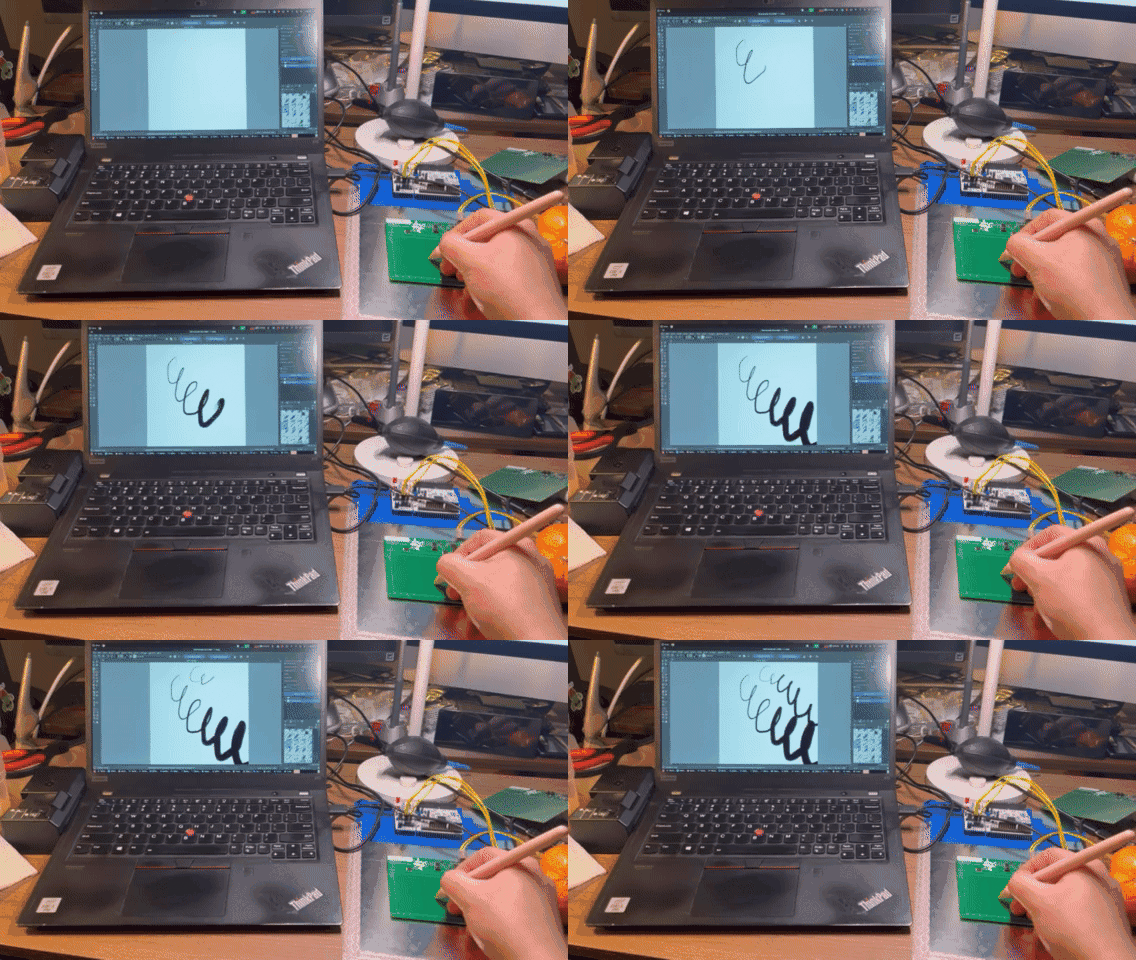
Drawing tablets have been a favorite computer of artists since its inception in the 1980s. If you have ever used a drawing tablet of this nature, you may have wondered, how it works, and if you can make one. Well, wonder no longer as [Yukidama] has demonstrated an open source electromagnetic resonance (EMR) drawing tablet build!
The principle of simple EMR tablets is quite straight forward. A coil in the tablet oscillates from around 400 kHz to 600 kHz. This induces a current inside a coil within the pen at its resonant frequency. This in turn, results in a voltage spike within the tablet around the pen’s resonant frequency. For pressure sensing, a simple circuit within the pen can shift its resonant frequency, which likewise is picked up within the tablet. The tablet’s input buttons work in similar ways!
But this is merely one dimensional. To sample two dimensions, two arrays of coils are needed. One to sample the horizontal axis, and one the vertical. The driver circuit simply sweeps over the array and samples every coil at any arbitrary speed the driver can achieve.
Finally, [Yukidama] made a last demo by refining the driver board, designed to drive a flexible circuit containing the coils. This then sits behind the screen of a Panasonic RZ series laptop, turning the device into a rather effective drawing tablet!
If tablets aren’t your style, check out this drawing pen.
Thanks [anfractuosity] for the tip!












Good job! i guess it would not take too much to implement the erasing also ?
Software problem lol. Probably you just switch tools in the app in question. For instance, erasing isn’t a “mouse” problem.
This is absolutely amazing, love it!
Professional pen displays cost an arm and a leg.
This is a super cool project… It’s very cool to see how this works, I didn’t really understand this technology before
The pen displays typically do cost a fortune, but the smaller pen-only ones are surprisingly reasonable.
https://estore.wacom.com/en-us/tablets.html
I’m also really impressed by recent tablets (like Samsung Galaxy tab) that can also be used as great wireless pen input displays, for a few hundred dollars.
I’m in animation and I can tell you that not a single persin in our field likes samsung tablets and most no longer care for ipads either.
When you get a job you’re typically handed a cheap huion pen display and most of us just use those now in our OS of choice — including android if our phones have dp apt mode out.
Samsung pen tablets have serious jitter issues in conjunction with an overly aggressive “smoothing” algorithm meant to correct for that and its extremely annoying to use.
xp-pen works great too.
hw goes finally cheap but unfortunately, genai made a dent too on what was already difficult craft to monetize.
Take a look at proper convertible laptops, like the (unfortunately now defunct along with all other consumer computers) T series from Fujitsu. These feature an embedded fully functional wacom tablet in the screen and whole not on powerhouses are just fine for most media tasks.
especially funny when the maker claims that it is actually cheap while demonstrating the pen under oscilloscope.
wacom, scammy
This is awesome! Now I want to build one for myself! :-D
Now hold a magnet or ferromagnetic metal object.near the touch sensor
Watch it go crazy
Maybe be able to actually directly capture magnetic field lines
B.S. You clearly have not tried this.
A static magnetic field doesn’t affect them.
A big hunk of steel nearby doesn’t affect them.
line-frequency AC fields don’t affect them.
They can’t see through a sheet of metal, but that’s kind of expected.
Take a neodymium magnet and swirl it around
You obviously don’t understand that a magnetic field moving around coils will produce a voltage proportion to the turns and field strength
So ac generators are impossible then because moving a magnetic field around a conductor can’t possibly produce a voltage and current in said conductor
Just like holding a conductor near a coil energized at a frequency causes resonance to shift
Wireless power cant work because the magnetic coils in my receiver can’t convert a magnetic field to an electric current to charge my Smartphone based on that🤷♂️
Never said the magnetic field was static, you gonna have to move it around, that causes a change in field position and strength relative to the coils 🤷♂️
Induction exists, but EMR systems are explicitly designed so that only deliberately driven, frequency-locked magnetic fields matter. Everything else is noise by design.
Yes, moving a magnet near a coil induces some voltage. That’s not in dispute. The problem is magnitude, coherence, coupling, and synchronization.
EMR tablets actively drive known AC fields and use tuned resonance plus synchronous detection to extract pen position. Random, hand-moved magnetic fields are weak, broadband, unsynchronized, and get filtered out — otherwise power lines, speakers, and Earth’s field would constantly trigger false input.
Physics allows induction; engineering decides what survives the filters.
Thank you for putting that much more helpfully (and politely) than I would have.
“So ac generators are impossible then because moving a magnetic field around a conductor can’t possibly produce a voltage and current in said conductor”
Have an AI explain the article to you. The detection oscillators are tuned 400-600KHz.
If you can wiggle your magnet back and forth 400,000 times a second, then you’ve got yourself some interference.
Yea i can do that
Called grabbing a coil of wire, a mosfet
And a function generator and a dc power supply
Nobody is going to experience problems in normal or even extreme use. Your attempt to engineer a problem is proof enough of that.
i wonder if this could be used to rescue my old inutous4 xlarge and use with new pens?. at some point they changed something about the pen and i couldnt get replacements or drivers anymore.
like it seems like the “expensive” part of that one is just the huge coil array, but its just a coil array so maybe i could use this to drive that… idk enough about it.
having that larger active area was amazing when you had a bigger screen. anyone whos tried a small tabelt with a big screen will know the trouble of trying to click accurately.
not that i need another other other project.
I used a CAD system in the late ’80’s with a 16″x16″ tablet and puck. There’s something about absolute position that a mouse just doesn’t touch. Part of ours was mapped to the screen and part was mapped to various icons and macros. You could reach over and click on an icon and go back to drawing without looking at the tablet with muscle memory.
yeah pen input is for way more than just “drawing”. basically any computer activity that is mouse heavy and lots of clicking or clicking and dragging will benefit.
a new one ive been literally playing with lately is using a pen for playing real time strategy games. (beyond all reason- open source and awesome btw) its all clicking on units and buildings, dragging to select etc. there are keyboard shortcuts for rhe build menus but im pretty close to that muscle memory point where it would be actually faster to just click on the gui than use they keyboard for those.
Osu! can really be a challenge even with a tablet.
Someone has got a twitchy “Report comment” finger.