
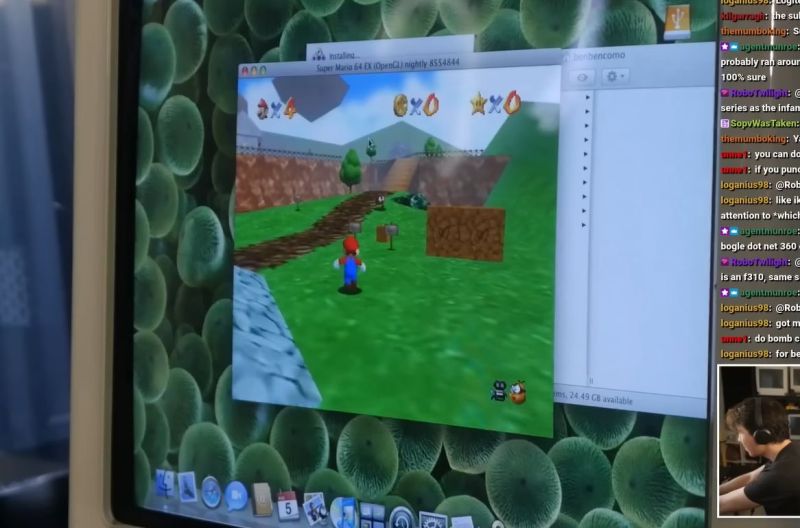
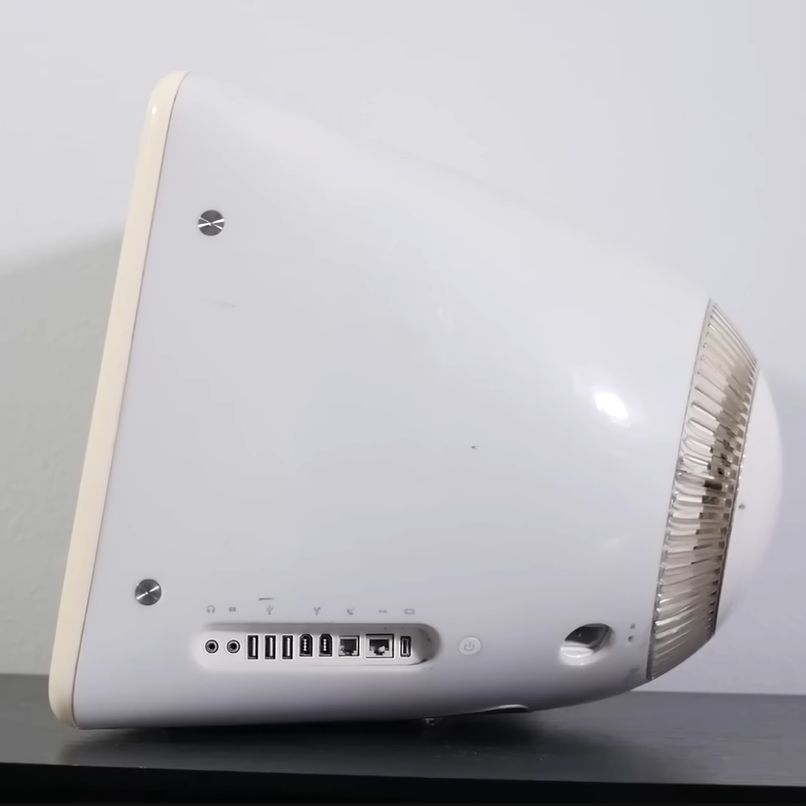
What’s it like to use a 2002-era Apple eMac all-in-one in 2025? That’s what [MattKC] asked himself after obtaining one of these systems from a seller who ominously mentioned that it had been ‘left outside for years’.
The Apple iMac is a bit of a cult symbol, whether you’re talking about the iconic fruity iMac G3 or the desk lamp-like iMac G4, but few reminisce or actively collect the Apple eMac. Manufactured from 2002 to 2006, it featured the PowerPC 7450 (G4e) CPU with clock speeds ranging from 700 MHz to 1.42 GHz, as well as a 17″ CRT. In terms of design it was basically a bland iMac G3 that was firmly targeting the education markets to try and regain market share after Windows PCs had begun to eat its lunch there.
As for the model that [MattKC] purchased, it was this earliest model, featuring a 700 MHz PowerPC G4 CPU in addition to 640 MB SDRAM. Despite the seller’s description it seems to be in good nick with it firing right up, and even a glance inside after beating the challenge of 2.5 mm hex screws showed it to be in relatively good condition.
Unlike the iMac G3, you can play the Mac port of Halo on it, but the Minecraft port is very much not performant. With generally multimedia and gaming working well, it does show why the eMac was released, as it’s quite capable relative to an iMac G3 which would have struggled with the educational software of the era. We definitely hope that [MattKC] restores it to its full glory instead of ripping out its innards, as the neglected status of the eMac makes it much more likely to go extinct than PowerPC-based iMacs.











The Apple vi was better.
Thanks a lot for the article! 😃👍
These old Macs seem old but were quite capable already!
By turn of century, the Voodoo 2 was available to the first gen iMac G3 (Mezzanine slot),
the towers could use a regular Voodoo PCI cards for PC.
There were 3dfx drivers for it on MacOS 8.6/9, I think.
At the time, in addition, MacOS featured QuickDraw 3D and RAVE API, still.
PC emulators such as VPC 2 and 3 or SoftWindows 98 could pass-through Voodoo 1 and 2, too,
so PC games were playable using 3D acceleration (Glide/Direct3D).
Then there also was Connectix Virtual Game Station in ’99,
which ran PS1 games on 90s era Power Macs (and Win PCs).
PC users were more familiar with Bleem! rather, maybe.
But even on ca. MacOS 10.2-10.4, there were many 8/16-Bit emulators that would run fine on a basic ~300 MHz G3, such as an ’98 iMac.
Such as DOSBox, NoSTalgia or the earlier Mac ports by R. Bannister (Nestopia, Gens, Generator etc)..
The G4 processors then introduced AltiVec,
which roughly could be compared to MMX/3Dnow! or SSE on x86 processors.
Anyway, just saying.. Because not that people were familiar with the Mac platform of that time and I remember how there was that stereotype that Macs are unusable for playing games.
Gamers were more into PCs and Windows98SE or 2k/XP, maybe. Or Linux.
By contrast, in early 90s, Macintoshs were still “normal” for playing games, I guess, since ports to non-PC platforms still were very common.
DOS games such as Point&Click Adventures or Jump&Runs were ported to other platforms such as Macintosh, Windows 3.1, OS/2, Atari ST (fast sinking ship),
the Amiga (oh well!), CD32, Sega CD, 3DO etc. Or FMTowns, X68000 and PC98 (Japan only).
(At the time, the early 90s, the Macintosh platform even featured “enhanced” ports using 640×400 or 640×480 pixel screen resolution,
when their DOS originals were commonly stuck to mode13h of MCGA/VGA and a 320×200 pixel resolution still.
It needed Windows 3.x ports to change that. Shortly before Windows 95, Win32s, WinG became available. And Video for Windows and Apple’s QuickTime.
QuickTime was used by Myst, for example.)
Simpler games were made available to Amiga/DOS/Windows 3.1 and SMS, NES, SNES, Sega MD, Game Gear, Gameboy, Lynx etc.
Like the Disney or Sega games (Lion King, Aladdin or Ecco the Dolphin, Sonic CD, Comix Zone etc.)
Or games such as SimCity, Prince of Persia etc. They were very multi platform.
Windows 9x during the 90s then really blew everything else out of water, including DOS.
That’s when we had entered the DirectX era, so to say, with mostly only a few indie games still offering OpenGL/OpenAL as an alternative.
Mobygames gives a good idea, maybe, since it can filter by specs/platform.
But again, just saying.. It’s difficult to just write a comment using
just two or three lines about the topic, because it wouldn’t do things justice.
Hope the author and the other commenters don’t mind the long monolgue.
I can’t stand hearing myself talking too much, either.
I wished the comment was just a fraction as long, but the topic is so interesting on other hand. 🙂
It’s 2026 already.