
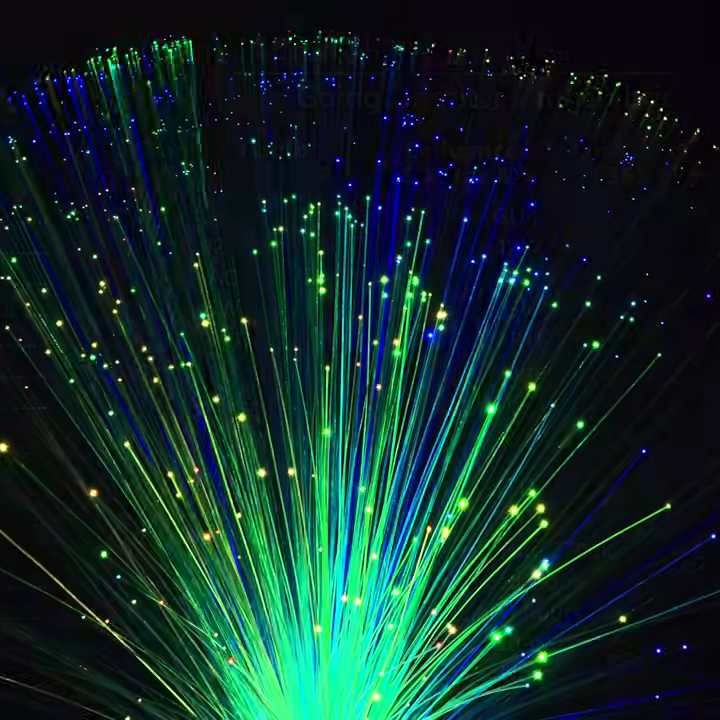
[Brainiac75] is a fan of fiber optic lamps, except for one thing—they’re often remarkably dim. Thus, they set out to hack the technology to deliver terrifying amounts of light while still retaining their quirky charm.
Older fiber optic lamps use a dim filament lamp or halogen lamp to light them up. They also often feature a spinning color disk to vary the light patterns, which does have the side effect of absorbing some of the already-limited light output.
When it came to upgrading his own decades-old lamp, [Braniac75] decided to initially stick within the specs of the original halogen lamp. The fixture was rated for 12 volts at 5 watts, with a GU4/GZ4 compatible base, and white light was desired so the color wheel could still do its thing. Swapping out the original 5 W halogen for a 2.5 W LED unit brought a big upgrade in brightness, since the latter is roughly equivalent to a 20 W halogen in light output. Upgrading to a 4.2 W LED pushed things even further, greatly improving the look of the lamp.
The video also explores modding a modern fiber optic lamp, too. It was incredibly cheap, running off batteries and using a single color-changing LED to illuminate the fibers. [Braniac75] decided to try illuminating the plastic fibers with an RGB stage lighting laser rig—namely, the LaserCube Ultra 7.5 W from Wicked Lasers. With this kind of juice, the fiber lamp is eye-searingly bright, quite literally, and difficult to film. However, with the laser output dialed way down, the lamp looks amazing—with rich saturated colors dancing across the fiber bundle as the lasers do their thing.
If you’ve ever wanted to build a fiber lamp that doesn’t look like a cheap gimmick, now you know how. We’ve looked at weird applications for these lamps before, too.










I wonder how it would look it the sides of the fibers were painted black/silver, so only the tips shone. It might even be cool to fill in the space with filaments of different lengths.
If the sides of the fibers were painted with anything it would absorb the light — the coating would interfere with the total internal reflection that the fiber optic relies on to work. Almost no light would make it to the end.
Nope. Telecom fibres are commonly painted in all colours of the rainbow (i.e. all.twelve if them). Internal reflection happens between fibre core (9um for single mode) and cladding. On top of cladding there goes layer of acrylic getting total diameter to.250um.
Source – used to work for.otpical.fibre company
True for glass single-mode and even multimode telcom grade fibers that include a lower-index-of-refraction cladding (or graded index). Not true for the simple unclad plastic fibers used in these toys.
The single mode fibers that have that nice property are useless for this application because the fraction of the cross section of the fiber that transmits light is a tiny, tiny fraction of the area of the face of the fiber. Without a launcher to focus the light onto the individual fiber core, 99+ percent of the light is immediately lost into the cladding.
Source irrelevant but what the heck you started it — 40 years in the field in industry R&D, and a graduate degree, papers, textbook chapters and a startup company in optical engineering.
But how does Toslink cables work?
They are made of 1mm plastic optical fiber in a black plastic sheath.
Sorry, I did paint a rather broad brush there.
The TOSLINK and similar short-haul large-diameter plastic fibers DO have a thin low-index cladding, typically 10 microns thick. It’s sufficient for the application, and allows the fiber to touch the protective sheath with relatively little loss. Low enough to allow 10 meter fiber run anyway.
So if the toy manufacturer opted to use a few hundred feet of optical-grade plastic fiber for the lamp then, sure, you could go ahead and paint it.
Heck, maybe the economies of scale make the cladded fiber cheaper than the plain stuff now, and that’s what you find in a modern version of those lamps. That would be great. I have not seen one in the wild since 1975, so can’t confirm.
Cool.
Neat to know TOSLINK is more advanced than I thought (I haven’t given it much thought though).
Coolest thing about TOSLINK is it gives you a battery-powered 16-bit 192 kHz ADC that is optically isolated, ten meters away from your electrically noisy computer. Great for a setup to pick up VLF radio transmissions below 22 kHz. (The antialias filter is a brick wall at that frequency). Radio station SAQ is one to listen for.
Sounds like nonsense, telecom fibers are so thin you have trouble seeing them with your eyes, they are embedded in a gel (to protect them from breaking and water ingress which can in fact even mess with fiber) then a layer of glass fibers protection them then a plastic shell, which can be various colors, but the fibers themselves you don’t color since what would be the point? You need a microscope-using device to splice them together.
Some fibers have a coating, but the purpose of that is not to color them.
(AFAIK).
The light traveling down the fiber is reflecting off the interface between the inner core and outer cladding – it doesn’t reflect off the interface between the outside of the cladding and air.
What you see coming off the side of the fiber is ‘wasted’ light that was never going to get to the tip. Light that hits the interface at too steep an angle to reflect.
Not true. Light passes through the core and the outer clad has lower reflective index to propagate total internal reflection. External coating g will have no effect on light being transmitted to the tip.
i wish them a pair of concrete boots and a nice view of the titannic.
and on topic again: this was often done in musea with a strong light source and small fibers with a lens on the end to light objects in an exposition. those were covered with a black sleeve.
Without comment on what a waste of electrons and eyeballs this is: Note the tremendous difference in brightness ISN’T just because it’s a frickin’ laser. It’s because the power numbers quoted measure different things.
The power quoted for an LED or a light bulb is the input electric power. The actual power of the visible light emitted is a tiny fraction of that. A plain incandescent tungsten bulb might make one to two percent of its input power into visible light. A very good tungsten-halogen could make that three percent. A normal white LED gets 15% on a good day. Even the best white LEDs can only manage 25%. So that 4.2 watt LED is only putting 1 watt out.
But a laser power measurement is the actual light power. A 7 watt laser produces 7 times more light than the best 4 watt LED.
Further, it’s a lot easier to get most of a laser beam into a fiber bundle than it is to direct even 10% of a LED’s output into a fiber. It’s all about the etendue of the beam and optical system. Sure, go look that one up — others have explained it much better than I could write out here.
Read the laser operating instructions with the remaining eye.
I love how people built glowing clothing and purses with fibre optics
Color rendition when transitioning from filament to LED is difficult. There’s a hard lesson in using “white” LEDs behind a colored filter since it’s technically a fluorescent lamp (UV source plus phosphors) and will exhibit strange anomalies from the narrow-band light emissions our eyes ignore otherwise – one of the recurring challenges faced by people who replace white filament bulbs on vehicles (stop lights, marker & navigation lights etc.).
My favorite example of this is a large site I visited often: Decades ago they installed “safety pillars” with a ‘help’ button and an intercom, with an omnidirectional blue light on top.
Originally they used a powerful incandescent bulb in it, which produced a fine looking blue, but some sparkle decided it should be more efficient and require fewer lamp changes, so a few years later they retrofitted them all with yellow sodium vapor bulbs. They went from a not-bad blue to a sickly, dim blue-orange and stayed that way for many years. (I was actually surprised at how much blue came out of a LPS lamp.)
They re-lamped them again a few years ago with either compact fluorescent or (more likely) white LED. Now it’s a slightly less sickly but no brighter greenish-brown-blue. The deep blue exciter spike seems to miss the blue filter passband, and the phosphors don’t produce much light there either. Another fail. They seemed not to consider using blue LEDs.
I would suggest you’d fix your faq’s.
Brainiac75 actually did this two years ago, as shown in the linked YouTube video. Why is this ‘news’ now? Genuinely wondering if there’s a reason I am unaware of.
Well if you must know, what HaD does these days is take youtube suggestions and if fitting turn those into an article, lately this project has been showing up in YT suggestions of tech-interested viewers
So it’s either the YT algorithm or because the youtuber is one that pays YT to push their videos (something YT nowadays offers as a service I understand).
♫ The More You Know ♫
Love how this hack takes a nostalgic fiber-optic lamp and pushes it into something truly eye-catching. It’s a great example of creative problem-solving with LEDs and lasers, balancing technical curiosity with playful design. Really inspires you to rethink the capabilities of simple components!
I like how this Hackaday post takes something nostalgic and usually pretty underwhelming — a fiber‑optic lamp — and creatively cranks it up with LEDs and even lasers to make it genuinely striking, showing how a few thoughtful mods can turn a dim novelty into something that’s both fun and technically interesting.