

These days, the conversation around climate change so often focuses on matters of soaring temperatures and extreme weather events. While they no longer dominate the discourse, rising sea levels will nonetheless still be a major issue to face as global average temperatures continue to rise.
This poses unique challenges in coastal areas. Municipalities must figure out how to defend their shorelines, or decide which areas they’re willing to lose. The City of Palo Alto is facing just this challenge, and is building a natural kind of seawall to keep the rising tides at bay.
Seawalls That Breathe
The traditional way to fight back against the sea is with seawalls. These typically consist of steep slopes constructed on the shoreline, which are designed to reflect wave energy back to the sea and stop it from eating away at the land. They are normally built using rocks, steel, or concrete walls to dissipate the energy of incoming waves. They are typically simple to design and construct, and prove relatively effective at staving off erosion. However, they can also be quite imposing and unsightly, and often do very little to support native fauna and flora.
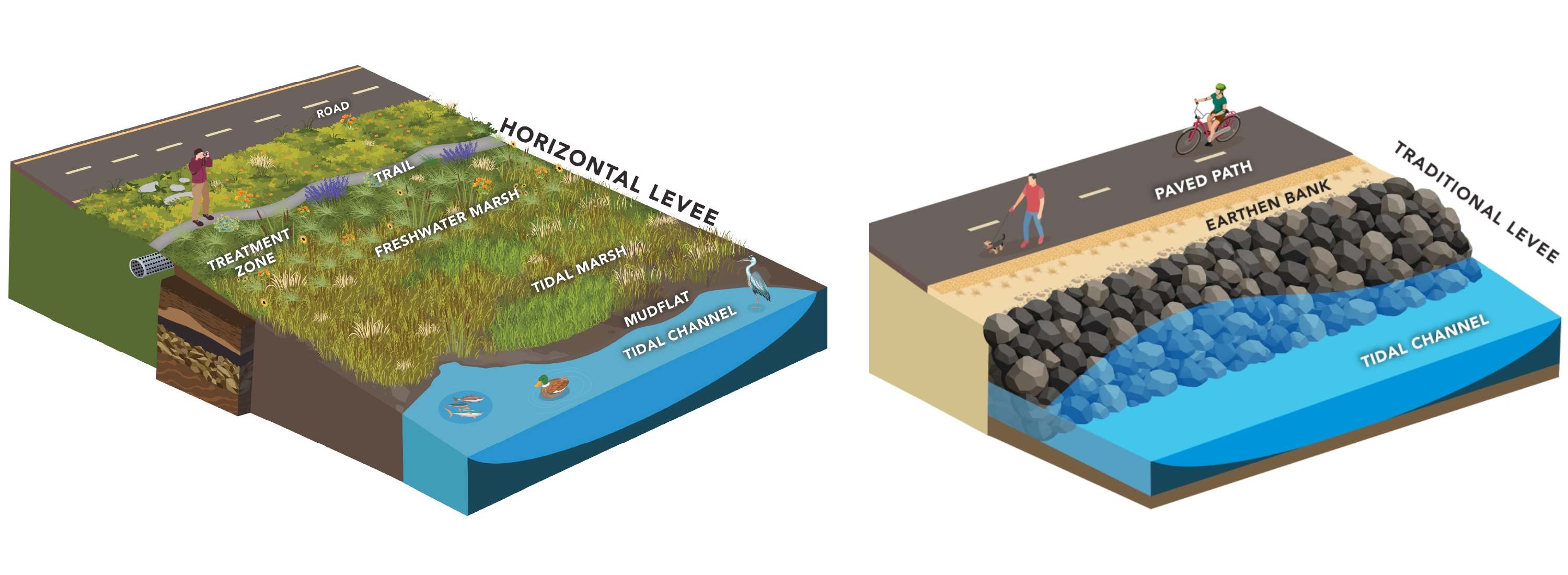
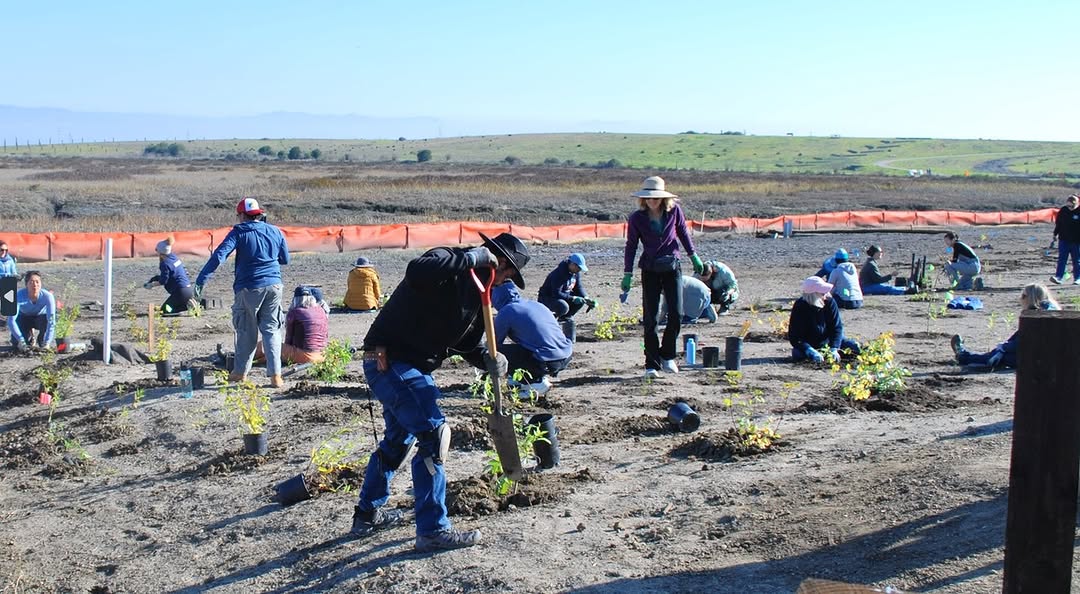
The City of Palo Alto is taking an altogether different approach by building a horizontal levee to protect the shore of Harbor Marsh. It eschews the usual steeply sloped seawall concept entirely. Instead, the coast is to be given a gentle gradient constructed of earth, creating a so-called “ecotone slope”—a long, sloping habitat down to the water line. Where the tide meets the shore, native plantings will support a tidal marsh, transitioning to a freshwater marsh with different plants farther up the slope, with volunteers planting 35 species in all. It’s hoped that restoring these habitats in the area will provide support to species like the Ridgway’s rail and the salt marsh harvest mouse.
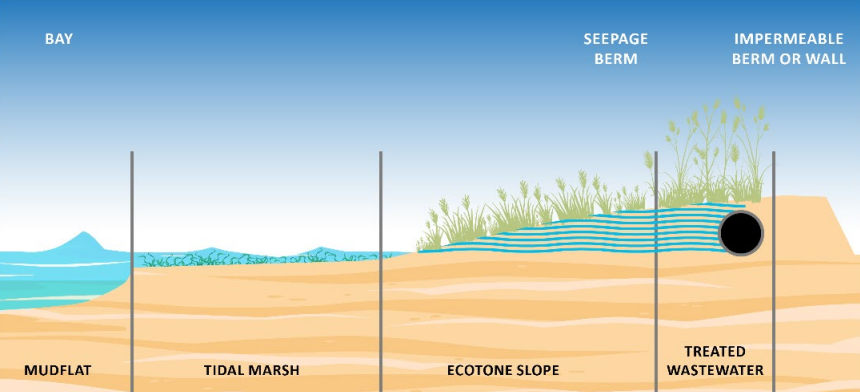
Furthermore, from the top of the horizontal levee, wastewater will be fed in to support the growth of native plants, which will work with the soil to filter out pollutants as it makes its way to the sea in a process referred to as “polishing treatment”. It’s not intended to remove heavy pollutants from the water; this work is handled at existing municipal water treatment facilities. What the levee can handle is soaking up some of the nitrogen and phosphorous content to support plants on the slope. This reduces the amount of these nutrients that gets released out into the bay, which can cause fish die-offs, algal blooms, and other undesirable consequences.
Due to its limited size, the horizontal levee will only handle 100,000 gallons of wastewater per day, which isn’t much against the 20 million gallons that currently flows out into the bay. Ultimately, that’s because the work at Harbor Marsh is a pilot project for the City of Palo Alto. Ideally, it will prove effective in both limiting coastal erosion as well as supporting native plants and animals. If it proves successful, it could become a strategy used elsewhere along the San Francisco coastline and beyond. The Bay Area as a whole needs to be protected against rising sea levels, as the name implies, so projects like this are a key focus as authorities plan for the future.
As it stands, large artificial seawalls probably aren’t going anywhere. It’s very straightforward to build massive concrete and steel structures to defend a piece of coastline. The engineering involved is well understood, and the construction process does not require particular finesse in the selection of plants or the maintenance of native habitats. However, in areas where it’s desirable to slow erosion in a greener fashion, horizontal levees could become popular. After all, it’s a lot nicer to stroll on a path alongside a burgeoning native marshland than it is to feel the sun bouncing off acres of harsh concrete. If the Harbor Marsh experiment works, expect to see similar projects take off in coastal areas around the world.











The barrier islands in the southeastern U.S. could take a lesson from this. They spend quite a bit every year to add sand to their northern ends to prevent erosion.
I understand why they are doing this but I also understand that this merely pushing the problem onto nations that cannot afford to build seawalls. Then again, the whole pollution issue is just pushing the problem onto poor nations to start with. Basically, from the perspective of poor nations, this is just a shitty things to do that is a result of past shitty behavior.
I do not approve as I think people should be forced to live with the consequences of their actions.
If there is a pollution problem, the poor nations are it. Conservation is a luxury. Trying to send the western world back hundreds of years to fix “climate change” will only reduce the standard of living for more of the population and cause even more pollution. Which is, I believe, the goal.
one of the crazy things about our privileged existence is that we not only want to use every resource, we also want to feel good about ourselves while we do it
This is a seawall deep inside the San Francisco Bay. There is no other nation that would be affected. Perhaps it means the neighboring cities of Mountain View and Redwood City will need to do something, but neither of them qualify as poor by any measure.
I think that your point is that instead of building seawalls, we should fix the atmosphere so that sea levels don’t rise?
I would argue that California is ALSO fighting that fight, with some of the strictest environmental regulations on Earth (including carbon cap-and-trade). In terms of per capita CO2 emissions, it is in 3rd place nationally (and New York State is an outlier due to half the population living in and around one megacity). https://en.wikipedia.org/wiki/List_of_U.S._states_and_territories_by_carbon_dioxide_emissions
Unfortunately, sea levels are going to rise anyway. Leaving that unmitigated doesn’t help poor nations; it just punishes coastal populations.
After hacking the sea, for maintenance of our “project” called The Netherlands, we now add sand off the coast in a shape made for erosion onto a much longer stretch of beach. Google “Zandmotor gif” for nice animations of it. As the North Sea (that isn’t north of anyone) is such a stormy sea, I guess a levee wouldn’t stand much of a chance.
This can’t be Hackaday, can it?!?!
I think so. Still pushing an agenda and Chicken Little. :)
Seems to be. You can tell by the commenters complaining about climate change articles.
If an 18cm rise in 100 years will flood your country you have other problems. And why has your country not been wiped clean by storm surge? Curious people want to know.
Palo Alto is built on a flood plain in an old estuary/mud flat. If not for the large and deep concrete and stone “creek” drainage system, and pumping stations near the Dumbarten bridge and other sites, it would be severely flooded regularly. The tideland is/was bordered by salt ponds to the north and south. They produced all those colors you can see from the air. Some are being planted with native estuary plants with trial reclamation projects. Palo Alto is a ludicrous example of dealing with sea level rise! How is this having any effect on island nations, which have been crying wolf and demanding money for decades?
IMHO, The City of Palo Alto is reinventing the wheel and could have learned from Netherlands. Levees with windmills that pump our the seawater for free. Technology is quite old, tried, and it works when applied properly at the shore with free unlimited wind. Even Rick Steves couldn’t resist telling about it, and if City of Palo Alto doesn’t want to watch Rick Steves’ video about his travels in Netherlands, so be it, ignore the obvious and pretend we are the first in the whole wide world (also punny how WWW stands for the Whole Wide World as well as the World Wide Web :]).
PResent-day pah-li-tiks is a maddening mishmash of private interests untermeshed with idiocy and ineptness.
De-la-where, prime example how NOT to approach such a thing, windmill (or Atlantic City, similar). If we wanted we could have powered our shore communities for free, and maybe have extra to run intrastate narrow gauge (which De-la-were had for quite long while, btw, narrow gauge that can literally sneak anywhere, bypassing private interests and idiocy and and ineptness), but no because no and no and no. Drive DE rt1 during the summer season and admire unlimited land availability throughout, almost entire length buffeted by the 24-hr shore wind, and arrive at the conclusion that we truly don’t know what we are doing – plenty of land to do both, windmills AND narrow gauge running along.
Ah, also, important, current bird-mincers with tall propellers (witness few of these in the Appalachia, btw, next to the PA turnpike) have their proper modern variant – vertical towers that scoop wind at slightly higher altitude, which then gets funneled to the ground level serviceable generator with the blades safety hidden inside the closed facility. Not much new there either, btw, Ancient Persia had their badgirs, ie, windcatchers for centuries, so there, pleasing the fastest buck profit vs strategic planning makes sure we are stuck with the bronze age economy again.
Nothing is for free, here in the Netherlands. Watermanagement has a separate democratic level of government, who levy taxes. The idea that a municipality should be responsible for primary defense against rising sealevels is very strange and not realistic.
The situation is quite different from the Netherlands for Palo Alto. I love the Netherlands, but if you applied their solution to the San Francisco Bay and Delta, you’d be building giant storm surge infrastructure across the Golden Gate and draining much of the bay and delta. There was an attempt to do this in the 1950s and ’60s but it was roundly rejected.
In the case of Palo Alto, there is minimal catastrophic storm surge risk. There are actual hills in Palo Alto that are more than twice as tall than the highest point in the Netherlands.
What is ‘twice as tall’ as a point below sea level?
RE: Jkk City of Palo Alto with High Tech headquarters hardly quality as “poor municipality”. Entire City can probably buy itself three or six dams and still not notice a dip in its budget. Have they invested into proper R&D and learned from the best … I’ll refrain from repeating myself.
But I hear ya, some things don’t go well with what looks like dumping all the expenses on the municipality the most affected. It only works if the future expansion allows for increased tax base, which means population should be growing at healthy increasing rate, not staying mostly the same, when weighted against nationwide averages. Our local experiment that largely failed, Atlantic City, showed just how swiftly such downfall could go, and I agree with you, something went amiss.
Having said that, there is more than few places, both East and West Coast, where we could use similar dykes. I also recall some historical land was reclaimed to start with, though many were was left to their own devices since, largely forgotten by the “planners”.
I don’t know if anyone else has noticed, but 20 years after “An Inconvenient Truth”, the arctic ocean still has ice, Kilimanjaro still has snow, and nobody seems to be selling their beach front property. Oh, and the “leaders” of this movement still fly by fossil-fueled private jets and there are now more polar bears than ever.
As the late, great physicist Richard Feynman pointed out, “It doesn’t matter how beautiful your theory is, it doesn’t matter how smart you are. If it doesn’t agree with experiment, it’s wrong.”
I have no respect for Al Gore, and you are right to criticize people who try to profit off of fear-mongering. But I recommend a much higher-quality resource: https://www.rescuethatfrog.com/wp-content/uploads/2017/05/Hansen-et-al-1981.pdf (Hansen, 1981)
It clearly expresses which parts are certain and which are uncertain. And it’s 45 years old and agrees with experiment very well.
I don’t mean to deprive you of the joy of refuting sensationalism but i hope people would also learn the science.
How much ice? How much snow? How much does the insurance cost for those houses?
Look at the graphs of these things over time.
Beachfront property has always been a “last one out the door loses” proposition, regardless of climate.