
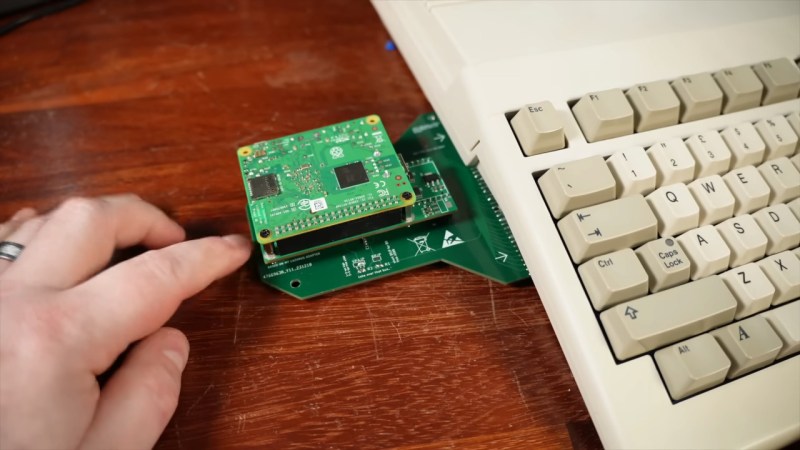
The PiStorm is nothing new; if you’re familiar with the retrocomputer scene, you’ve probably heard of it. By replacing the 68k processor in an old Amiga (or some models of Atari) the PiStorm accelerator gives a multiple order of magnitude speedup. It’s even a reversable mod, plugging in where the original CPU was. What’s not to love? Well, some people would simply prefer to keep their original CPUs in place. [TME Retro] has a video highlighting the solution for those people: the Lazarustorm by [arananet].
It makes perfect sense to us– back in the day, you could plug a whole x86 PC-compatible ‘sidecar’ into your Amiga, so why not a PiStorm? The whole bus is right there for the taking.The Lazarusstorm, as a project, is bog simple compared to the PiStorm itself. A PCB and the connectors to get it plugged into the expansion port on the Amiga side, and the connectors to plug the PiStorm into it on the other. A couple of jumpers and a few passives, and that’s it. [TME Retro] also took the time to come up with a case for it, which sits on felt feet to relieve stress on the PCBs. It’s a nice bit of CAD, but we rather wish he’d done it in beige.
As for the upgraded Amiga, it runs just as fast as it would had the 68k been replaced with a Pi3 and PiStorm internally, which is to say it’s practically a supercomputer by 1980s standards. You get the SD card to serve as a hard drive and can even access the internet via modern WiFi, something Commodore engineers likely never expected an A500 to do. Of course, just connecting to the network is only half the battle when getting these retro machines online. When these accelerators were new, the 68k emulation ran on top of Linux, but now that the EMU68k project has it bare metal and even faster.
This isn’t the first Raspberry-flavoured slice of Amiga sidecar we’ve featured: here’s one running Spotify. If you haven’t got an Amiga, there’s a PiStorm for the FPGA-based MiniMig, too.











Unfortunately, whilst the idea is good, more often than not you still need to remove your internal CPU for the lazarustorm to work due to conflicting signals (particularly E clk). Sometimes it will boot fine, other times it won’t. Depends if you get lucky with timing.
It really isn’t an ideal solution. Many who have them end up installing the Pistorm internally anyway.
I think it must be possible in principle, I don’t think the classic accelerators had these problems:
https://bigbookofamigahardware.com/bboah/product.aspx?id=87
The classic accelerators didn’t work the same way. The lazarustorm is a dumb adaptor that does nothing more than pulldown BR and VPA. The 68000 still generates an e clock signal when doing this so causes a conflict.
It’s a well known issue.
The A600 Pistorm takes over the CPU using exactly the same method (as do some other A600 boards), but in this case it works fine as the E clk signal is handled by Gayle (the E clk from the CPU is not actually connected on the 600 motherboard at all). It seems some assume as it works for the 600, that it also should work fine for the 500, which is not the case.
Interesting project for those who are Amiga fans.
I tried to look up ‘bog simple’ but only get wet lands/spongy ground definitions. In context I assume what it is supposed to mean :) .
A Britishism, I think? “Bog-” as a qualifier is on a par with “Dead-” (“dead-simple”, “dead easy”)) or if you prefer, “Utterly-“.
“Bog-standard” is the variant I’ve heard most, meaning “unmodified”, “base spec”, or “bottom of the range”; as in, “I was able to get a bog-standard A500 to boot with this”.
I always assumed it was related, like companies being “bogged down” could still come up with it. But that seems to be unlikely.
https://english.stackexchange.com/questions/553115/origin-of-bog-standard
Piss storm . . . no.