
Helium is inert, which makes it useful in a lot of different industries. But helium’s colorless and odorless non-reactivity also means traditional gas sensing methods don’t work. Specialized detectors exist, but are expensive and fussy. Thankfully, researcher [Li Fan] and colleagues found a physics-based method of detecting helium that seems as elegant as it is simple.
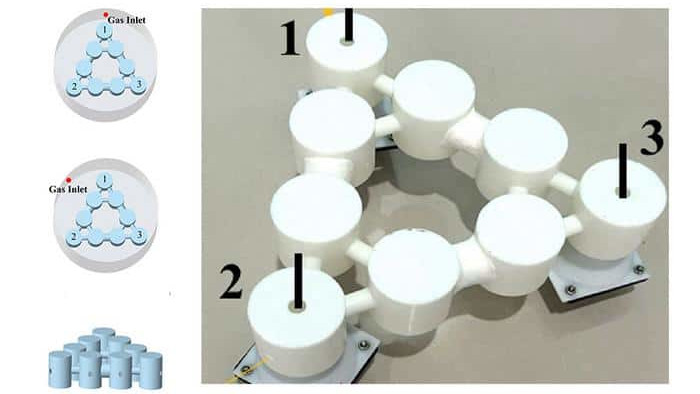
The new sensor relies on a topological kagome structure, and doesn’t depend on any chemical reaction or process whatsoever. The cylinders in the structure are interconnected; air can flow in and speakers at the three corners inject sound.
Sound waves propagate through the air within the structure at a fixed rate, and as helium enters the sensor it changes how fast the sound waves travel. This measurable shift in vibration frequency indicates the concentration of helium. It’s stable, calibration-free, doesn’t care much about temperature, and resets quickly. Even better, the three corners act as separate sensors, making it directional. It’s even quite rugged. Just as a basket weaved in a kagome pattern is stable and resistant to damage or imperfections in the individual strips that make up the pattern, so too is this sensor only marginally affected by physical defects.
The sensor design has been tested and shown to work with helium, but could possibly be applied to other gases. More detail is available at ResearchGate, with some information about the math behind it all in a supplemental paper.












This is so cool. It’s essentially the voice raising helium balloon flipped over to make a measuring device. HaD’s sins for the current part of this week are forgiven.