
It was January 25th of 1979, at an unassuming Michigan Ford Motor Company factory. Productivity over the past years had been skyrocketing due to increased automation, courtesy of Litton Industry’s industrial robots that among other things helped to pick parts from shelves. Unfortunately, on that day there was an issue with the automated inventory system, so Robert Williams was asked to retrieve parts manually.
As he climbed into the third level of the storage rack, he was crushed from behind by the arm of one of the still active one-ton transfer vehicles, killing him instantly. It would take half an hour before his body was discovered, and many years before the manufacturer would be forced to pay damages to his estate in a settlement. He only lived to be twenty-five years old.
Since Robert’s gruesome death, industrial robots have become much safer, with keep-out zones, sensors, and other safety measures. However this didn’t happen overnight; it’s worth going over some of the robot tragedies to see how we got here.
Just Following Orders
Perhaps the the most terrifying aspect about most industrial robots is that they are fairly simple machines, often just an arm containing a series of stepper motors and the electronics that strictly execute the tasks programmed into it when the manufacturing line was designed and assembled. This means a large metal arm, possibly weighing more than an adult human, that can swing and move around rapidly, with no regard for what might be in between its starting and end position unless designed with safeties in place.
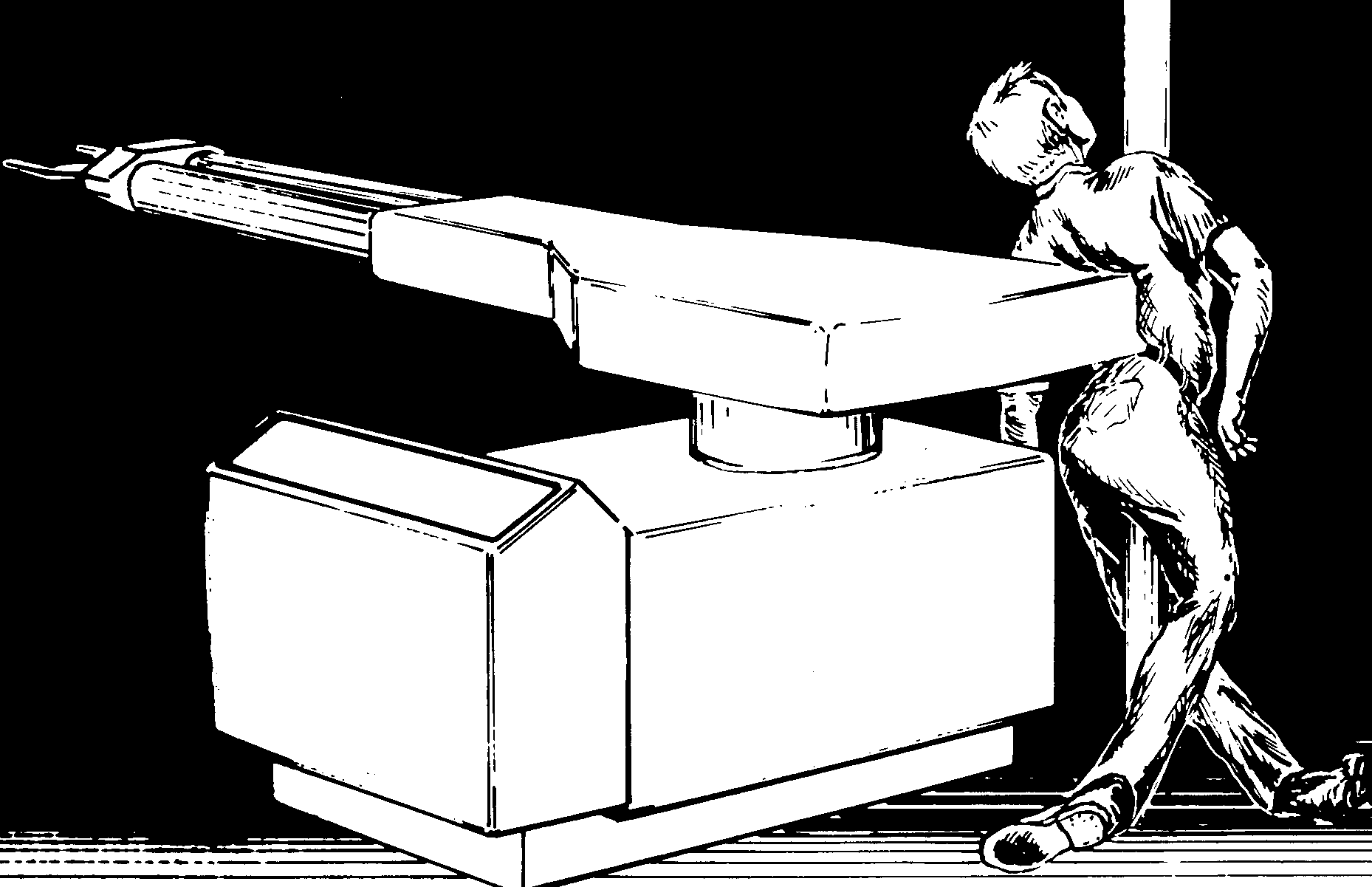
This is what led to the death in 1981 of another factory worker, Kenji Urada, a maintenance worker, who was trying to fix a robotic arm. Although a safety fence had been installed at this Japanese plant that would disconnect the power supply of the robot when this fence was unhooked, for some reason Kenji decided to bypass this safety feature and hop over the fence. Moments later he would be dead, crushed by the robotic arm as it accidentally was activated by Kenji while in manual mode.
During the following investigation it was found that Kenji’s colleagues were unfamiliar with the robot’s controls and did not know how to turn it off by simply opening the fence. Subsequently they were unable to render him any aid and were forced to look on in horror until someone was able to power down the robot.
A similar accident occurred in the US in 1984, when a 34-year old operator of an automated die-cast system decided to cross the safety rail around the robot’s operating envelope to clean up some scrap metal on the floor, bypassing the interlocked access in the safety rail. In this case it wasn’t the arm that crushed the worker, but the back end, which the worker apparently had deemed to be ‘safe’. He had received a one-week training course in robotics three weeks prior.
Protecting Squishy Humans
When it comes to industrial robot safety rules, we have to consider a number of factors beyond the straightforward fact that getting crushed by one is a scenario that a reasonable person would want to avoid. The first is that industrial robots are quite expensive, which makes adding major fencing and other safety measures not much of a financial issue in comparison.
The second factor is that while humans are really quite versatile, they tend to have the annoying habit of bypassing safeties despite endless briefings and drills that are designed for their own protection. Let’s call this factor “human nature”. Kenji Urada’s gruesome death is an example of this, but other industries are rife with examples too, giving agencies like the US Chemical Safety Board a seemingly endless collection of safety rule violations to investigate and condense into popular YouTube videos of disaster sequences.
The final, third factor that ties all of this together is that we no longer live in the early decades of the Industrial Revolution, where having a human worker getting caught with an arm between some gears, or crushed by a mechanism would only lead to some clerk rolling their eyes, crossing out a name and sending out an errand boy to post a fresh ‘help wanted’ note.
Ergo, we needed to find ways to human-proof industrial robots against humans and protect us against ourselves.
ISO 10218
Although some nations have their own standards, the overarching international standard is found in ISO 10218, currently in its 2025 update. This standard comes in two parts, ISO 10218-1, which concerns itself with the robot’s individual parts and targets robot manufacturers, as well as ISO 10218-2, which looks at complete systems and the integration of robots.
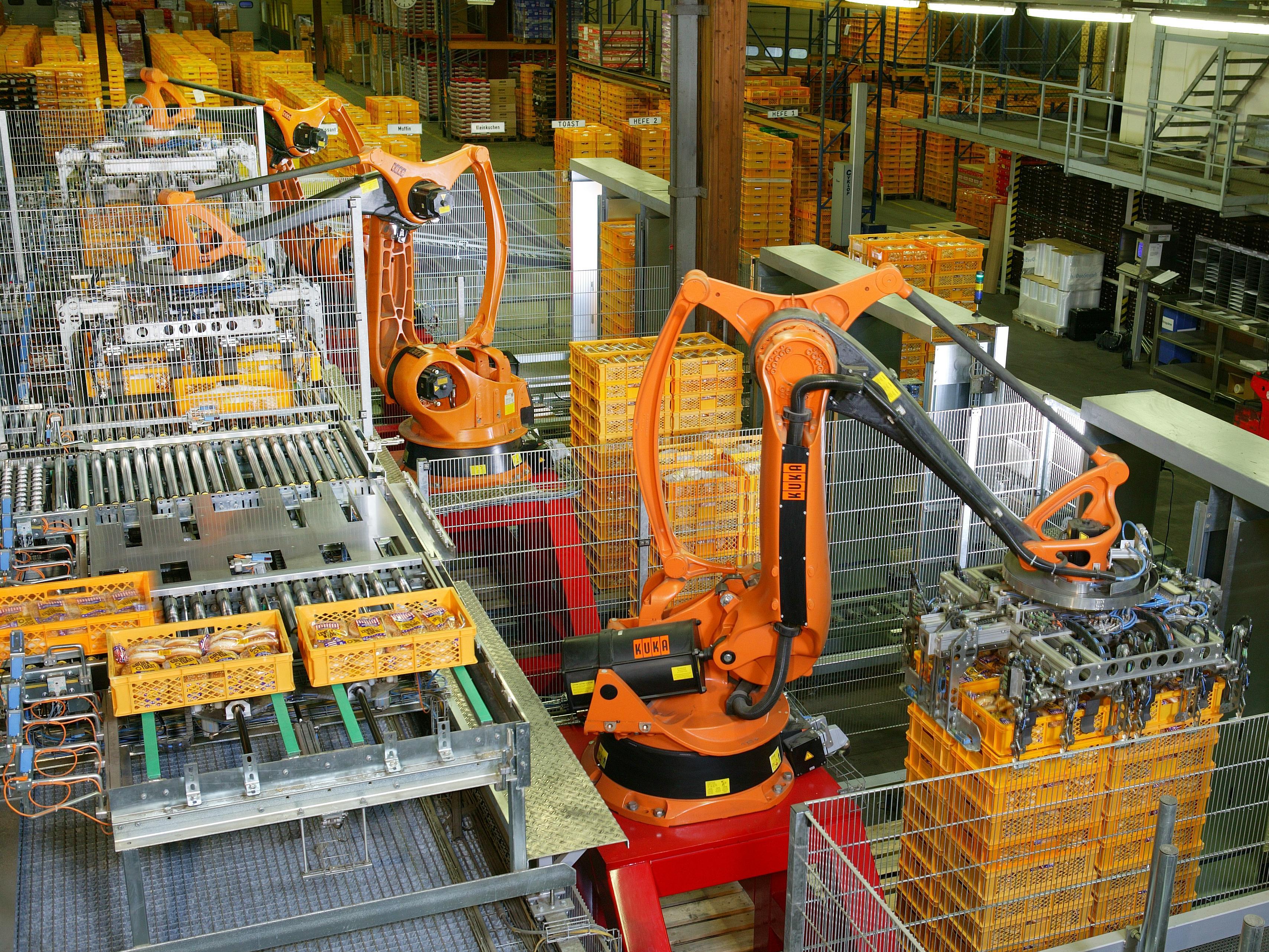
There are a number of distinct types of hazards when it comes to working around industrial robots, the most obvious of which is the crushing hazard. To prevent this and similar hazards, we can install plentiful of safety fencing to ensure that the squishy human cannot get within the range of the unsuspecting robot.
In the case of an especially persistent human, or potentially a legitimate human maintainer or operator, it’s crucial to ensure that the robot is powered down or rendered harmless in some other way. For example, the safety fence that should have prevented Kenji Urada from losing his life was designed for this, but unfortunately could be bypassed.
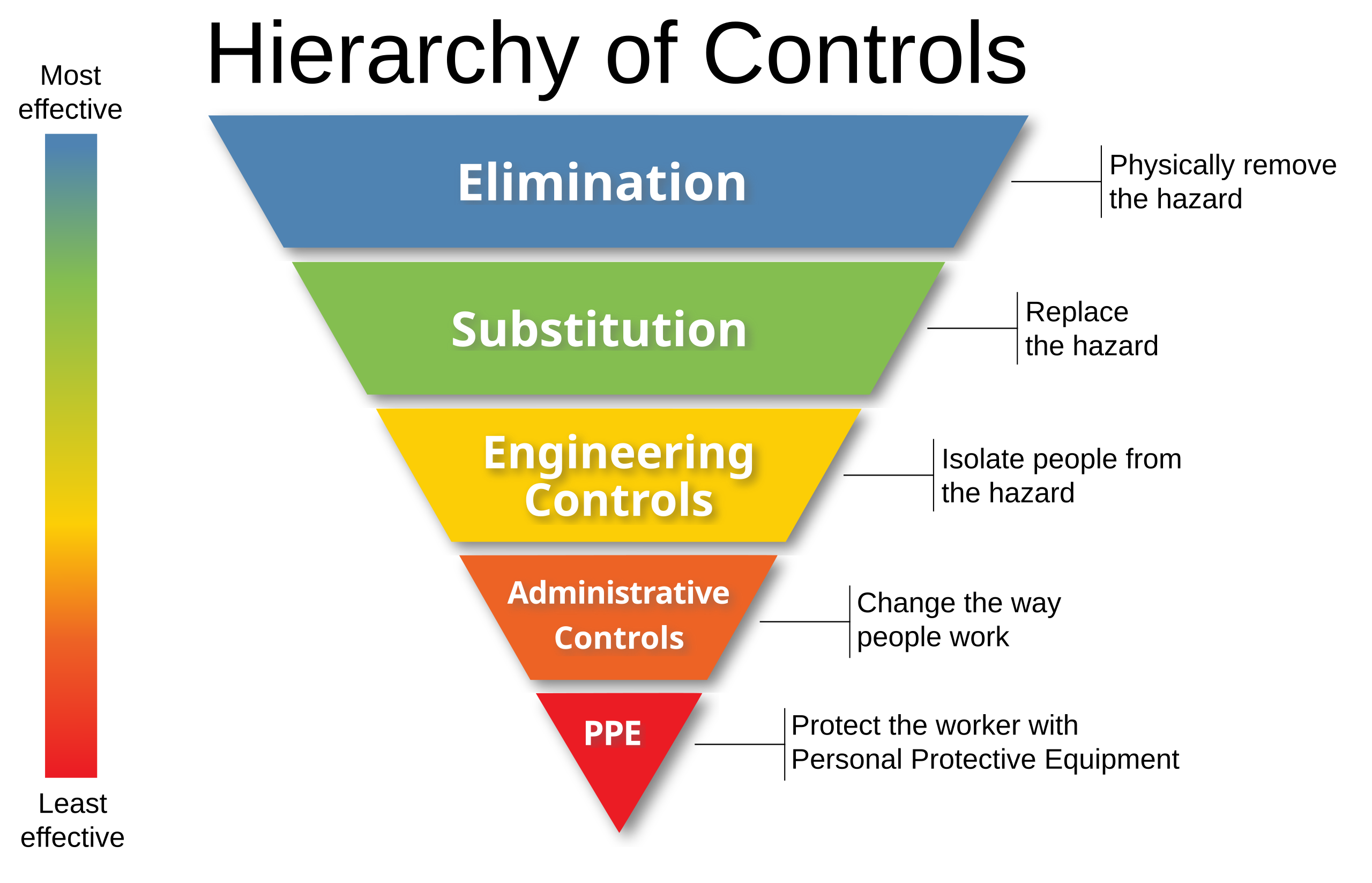 Similarly, in the case of Robert Williams there was a tag in/tag out system in place for the robotics, but Robert had not been instructed in this and apparently unaware of the dangers. Being able to bypass such safeties gets us firmly sliding down the rabbit hole of the hierarchy of controls.
The most effective hazard elimination is basically that, but since the robots are rather needed, and we got no replacement for them other than forcing the humans to do all the work again, this step is no real option here.
Next we can try to make robots safer, by adding intrusion detection sensors to the robot’s hazard zone, or as Amazon trialed in 2019 by making the squishy humans in its warehouses wear a device that alerts the robots around them on the warehouse floor of their presence without relying on either machine vision or obstacle recognition.
The placing of physical barriers is next, as part of engineering controls. This effectively tries to prevent humans from wandering into the danger zone like a particularly big fly around a brightly lit up bug zapper. Theoretically by putting a sufficiently daunting barrier between the hazard and the worker will said worker not end up facing their doom.
In an ideal world this would be all that it’d take to guarantee a completely safe work floor, even in the case of some distracted wandering. Of course, this doesn’t help much if said robots are sharing a warehouse floor with humans. To patch up the remaining gaps we got safety training courses as part of the administrative controls, but if these were very effective then the USCSB would already be mostly out of a job.,
The final item in the hierarchy of PPE can easily be skipped in the case of industrial robots, other than perhaps steel-tipped boots, a hard-hat and safety glasses in case of dropped items and flying debris. If an industrial robot’s arm is headed your way, there’s no PPE that will save your skin.
The Future
At this point in time industrial robots are fairly safe from humans, though in the US alone between 1992 and 2015 at least 61 people died due to sharing the same physical space with such a robot or a similar unfortunate event. As the number of robots increases in industry, but also in construction and health care, the topic of safety becomes ever more important.
In the case of a stationary industrial robot it’s fairly easy to just put a big, tall fence around it, lock the only gate and force anyone who absolutely needs access to beg an audience with the maintenance chief. In the case of the thousands of robots rolling around in warehouses like Amazon’s, situational awareness on the part of the robots can help them detect and avoid obstacles.
As long as humans are more fragile and weaker than the robots that they find themselves working around, it’s probably reasonable to expect said humans to pay a modicum of respect to the Death Machine, as the engineers who built them can only add so many technological solutions to what ultimately ends up being a game of idiot-proofing. Because absolutely nobody would ever do these exact things to willingly endanger themselves and/or others.











And yet, you still see people doing stupid stuff in factories. A while ago, I worked in the summers as a student worker in a metal factory, putting pieces in a machine that would cut them or solder them with a laser etc While I was working there, people would tell me about accidents that happened in that factory, one, a metal sheet drum fell while it was being loaded by an automated system on top of the legs of a worker. He died. The thing is he shouldn’t have been near it
Another story I was told, is that some guy had to do some maintenance inside the machine, and activated the manual mode of the laser robot. He didn’t notice that the speed was set to high, and crushed his own skull.
One could think, no way this happened, but while I was working there I saw my chief going into a machine that was giving problems, and hold a metal plate on front of the laser while putting the other hand over his eyes to cover them from laser radiation and ordered the line worked to press start
There where safety systems in place in these machines. The machines where quite modern. It was just that the wrong people had access to the keys that would disable the safety systems
Ah, yeah, I almost forgot. These machines have a system that sucks the air and filters it, to suck all the fine metal dust. This dust is extremely dangerous for humans, it can burn, it is really bad for your lungs and it icks and burns like hell in the skin. Workers need a special training and special PPE to clean the filters and empty the bucket where the metal dust goes. Well, I, just a normal student that was working for just 10 weeks a year there with no special training, was ordered to clean those filters and empty the bucket while the supervisor was watching from 5 meters away…
I worked there not even 10 years ago
I forgot to say, that while other workers did the cleaning with the special PPE, that was like a suit and a mask with positive airflow, I was asked to do it with just a pair of latex gloves and a normal mas that you can buy for 5 € in a homedepot
It seems they wanted to get rid of you :D. A setup for a major claim.
Idiot proofing only works until the system is tested by a more clever idiot.
Amen to that. It applies to computer users also.
It’s a common expression, but systems build for functional safety should not just fail safely and redundant, it is also required to make it very difficult to use unsafely. This goes for gate sensors with encrypted links, optical fences, lock-out-tag-out locks, etc.
I’ve always seen that principle expressed as “make something idiot-proof, and Mother Nature will breed a more ingenious idiot”.
The root problem is that common sense is in reality uncommon sense.
Exactly – safety is a process not a product. You need skilled personnel from operators through technicians up to management. All need to be involved.
Safety culture is site specific.
I worked at a couple industrial labs and several academic labs.
On the one, great, end there was only one entrance to the labs right by the secretary desk. If you walked in with anything bless than perfect PPE it would be treated as if you shoes up to work with no pants. Like- confusion. The safety culture was very strong and non judgmental. Lapses happen and everyone would be like “hey bob you shouldn’t be doing that” and bob would say “oh shoot thanks!”
Other end of the spectrum different lab (academic) if you pointed out dumb stuff they treated you like a Narc. I saw the summer intern lock himself in the liquid N2 filling room in shorts and flip flops, no face protection, and one oven mitt. Fortunately they weren’t jerks when poi ted it out hit the level of cluelessness was astounding.
Many, many more examples over the last 30 years or so of lab work but you get the idea.
Good thing not working with anything fluorine.
Safety is important but it can go to far. We had a tiny boat sitting on land. I had to paint a piece of it. Small job. Total height I had to stand on was 1.5 meters. I was standing on a small platform ladder with guide rails. so no way to fall off. I was in the sun above land, with a safety jacket on, helmet, life vest. I was told to stop because I wasn’t wearing any falling protection. I did stop, told them were to stick it. Safety is good especially with chemicals, but common sense should also be a thing.
The thing is of course that if you did managed to fall (and there probably was a way if you really tried) you could sue them into oblivion. So I get they really didn’t want you to fall.
What is “falling protection”?
A rope around your neck tied off to something that will hold your weight.
“[…] with guide rails. so no way to fall off.”
Without extra info, I could understand the life vest, but not the falling protection.
Using a single safety mechanism to protect yourself is stupid, not common sense. You are not the smart one in that case
There’s a great story about workspace safety issues in each episode of a podcast ‘Well, There’s Your Problem’. It really makes you wonder how creative and reckless some humans are.
Watch the Paul O’neill talk about his start as CEO at Alcoa if you want an education… https://vimeo.com/203872993
I remember reading about electricians working on big machinery in someplace like Los Alamos. They would not only turn the appropriate breaker off, not only put a lockout tag or padlock on the breaker, they would also put a big honking steel bar or wrench across the power terminals at the machine – because a PhD with a deadline would see the breaker off and cut the tag or padlock to get the machine running, regardless of the electrician up to his elbows in the guts of the machine.
The most dangerous thing anybody can do around machinery is cut off a lockout tag.
Because whomever owns that tag will beat that person to within an inch of their life.
Some 25 years ago I programmed some really basic industrial robots. The control unit allowed the force to be changed on the motors. It could do the same movements with barely any force, so you can stop it easily with your fingers. And you could programm it to use so much force that it could easily bend 2cm thick metal sheet when it hit (accidentally, or “just to see what happens” you name it).
My respect and fear from the force of the machine instantly jumped, after I saw how much force it could apply.
One thing our first safety measures forgot about was, that simply cutting power(electricity) to the machine, when someone hits the emergency stop button, is not a good solution. As the robot will continue moving just by inertia and momentum. We had to put in place additional systems to actively brake it’s movement. The code to reduce force and brake and wait for stop and then cut power was actively reviewed by 3 programmers from different departments. The signalling wiring that would allow the emergency stop was reviewed by external electical engineers.
It was just an experimental robot, that would allow to simulate different manufacturing situations, so the best can be chosen. But still many safety measures.
I worked quality control for the last 6 years of my employment. I use to get in trouble and have even suffered days-off without pay for pointing out safety concerns. Stuff like double ended extension cords, leaking hoses on forklifts, devices with switched neutral leads.
Being an employee you are only as safe as the manager “allows” and they don’t get any technical training in business management school.
That manager that I showed the two-headed extension cord? When I told them it was unsafe and actually against the law they replied “false news”. Fortunately the general manager had risen through the ranks and had a technical background. His response was immediate and I didn’t even have to go to him, he walked through the area on his evening rounds and caught me looking under the workstation.
“Being an employee you are only as safe as the manager “allows””
Managers judge by simple metrics and like see racing as best way to improve efficiency. Teams that follow safety rules can’t outperform those who cut corners – have seen that so often.
Forrest Gump had it nailed, “Stupid is as stupid does.”
Shake hands with danger.
Having worked in food manufacturing for over a decade I’ve seen quite a bit of stupid both in terms of personnel and machine design. My key takeaway is that you can never actually stop a determined idiot, myself included. That, and country of origin has a very real impact on safety. This won’t apply much to robots, but automated or semi-automated lines in general.
American machine builders generally suck – I don’t think its necessarily a lack of safety focus, rather the compartmentalization of duties and regulations – IE, the engineer responsible for the overall layout is not necessarily in line with the controls guy, who could care less about the sanitation department, and then safety guy has to point out what everyone else missed and you wind up with a hodgepodge of soft/hard interlocks and guarding that is technically fine, until the end user looks at it the wrong way. But, as long as all the documentation says DO NOT DO X, when they know full well that there is no other way to feasibly perform said operation, they’re legally in the clear.
Germany in particular, and any European machines i’ve operated in general, tend to much more “homogeneous” in their design process. You really get the feeling that the department heads met on a regular basis to make sure everyone was still going the same direction. Guards you physically can’t open in operation, absurdly complex bypass procedures, oversized guarding around areas an operator would be reaching into that are sized so no human arm can reach the danger zone, hierarchies of privilege from “nope” to “call us and we’ll enable it” and everything in between for manual jogging, I’m sure i’ve got more but those stand out.
I’ve only played with one Italian machine, and while it is absolutely perfectly designed for it’s function I have absolutely ZERO clue how OSHA is ok with it even being in the building.
. . . That said, every injury i’ve seen has been from the “determined idiot” side of things, even with the caveat of poor design factored in. The poster above that mentioned speed over everything has it right – your employer could care less, especially if they can blame you.
I’ve had a finger crushed in an 80 year old cam-driven American machine, two fingertips partially degloved in 5 year old servo-actuated American machines, and my head nearly crushed when pinned in the same 5 year old machine by stepper driven sled that for some reason I still can’t discern, the design team decided to use encoded steppers but not actually use the encoders for. Only injury on the German machines was a pinned hand, but that one was a setup error from an untrained idiot wherein the maintenance staff had no clue which way to fix it – we spitballed some ideas, I tried mine, and then we found out which direction a few pneumatic actuators fail “safe” in the hard way. The italian machine is likely to rip some fingers off sooner rather than later, but I know of no issues yet.
Never underestimate the drive and fortitude of the determined idiot – but at the same time, design considerations must be made to preclude said idiot from ever being that motivated in the first place. Same with operations – if everyone who runs machine X agrees that product Y has ABC issues, maybe actually address them, rather than finding another idiot who thinks everything’s ok simply because they don’t understand WHY the issues occur in the first place.
Beyond that, we generally look down on manufacturing jobs in this country as being low-skill, low-class, low-prestige, and pretty much any other derogatory stereotype you can imagine – and treat them as such. While this should be as far from true as possible, the reality is that most owners/managers could care less about 95% of their workforce as long as they have that 5% that know what they’re doing. Every hiring manager in the world will tell their staff that they’re only going to bring on “the best of the best,” but not a single one of them will look an applicant in the eye and say “I’m sorry, but I don’t believe that you’re the right candidate for this position.”
. . . Long post, but I’ve had that running through my head for a month or so now. I lost my last job last summer for being one of the 5% that did exactly what the big boss ordered and pissing off the HR guy as a result. Completely different industry now, hand assembly of sensor components for aerospace – turning a hobby into a new career and I couldn’t be happier – been trying to get out of food in general and stupid entitled brats in particular for quite a while.
From your list of injuries, some from the same machine, I think you need to look in the mirror to find the determined idiot instead of blaming the manufacturers.
Also, the phrase is ‘couldn’t care less’. ‘Could care less’ implies they had some care and not none….
Maybe there’s a common theme of carelessness in your life? :)
I’m going to be pretty blunt here, but it’s for your own good. “Over a decade” is most likely equivalent to “less than 20 years”, and you listed 5 incidents. You’re averaging between two and four incidents per year. I would seriously think about some kind of office job.
You can’t just mentioned the CSB, allude to their very well animated and made videos and not link to their channel:
https://www.youtube.com/@USCSB
I attended a seminar presented by one of the leading robot programmers in the UK, in the 80s. Back then DEC PDP11’s and RSX11 OS were state of the art for this sort of thing. He was musing about how to deal with overconfident young new robot software engineers. He said they often thought their code was production ready when it needed more testing. He’d tell them that if they were really sure that it was ready to go and safe to use, they had to stand inside the test cell, within easy reach of the robot’s effectors, where it would dismember them if there was a software problem, while it ran through its task. He said that they always agreed that maybe more testing was necessary.
That’s often a really good way to do QA, yes. Also seems to work wonders when managers have to sign off on release and deployment.
Add “while someone else is at the controls” … There is a strong belief that whatever they think is intuitive (perhaps only after months of working with that program) will be obvious to everyone.
“The final item in the hierarchy of PPE can easily be skipped in the case of industrial robots, other than perhaps steel-tipped boots, a hard-hat and safety glasses in case of dropped items and flying debris.”
And for some jobs proper glovitation is important.
Let us not forget the humble ear tampon. I worked in a Coca-Cola bottling plant and they really were necessary. We all passed by the (free) vending machine on the way in.
But – it’s the first Law?
A robot may not injure a human being or, through inaction, allow a human being to come to harm.
A robot must obey the orders given it by human beings except where such orders would conflict with the First Law.
A robot must protect its own existence as long as such protection does not conflict with the First or Second Law.
I was a robot service technician for two major robot manufacturers over 30 years. Both of these companies mandated I pass multiple safety classes every year. Lock-Out Tag-Out and operational safety. If you didn’t pass, you were required to go through remedial safety training. I worked installing & servicing robots at most of the major automotive manufacturers (Ford, GM, Honda, Mercedes, Chrysler, Subaru, Tesla, Nissan) and I was required to go through those companies additional safety training during each visit. I can’t speak for small mom & pop companies, but anytime I entered into the robotic cell to program or repair the robot, the robot was placed in manual mode (no remote start via PLC possible). I was required to place a safety lock on the gate of the work cell, with my name tag on it. This lock prevented the robot from being started in auto mode. Additionally, I had to have have the teach pendent with me at all times. Also anyone inside the cell was also required to Lock out at the entrance of cell. Anyone caught inside without lockout, was subject to punishment including suspension and termination. In my time, I was witness to individuals bypassing safety interlocks with jumpers several times, and fortunately injury was not fatal. I informed my employer that I would not work at this facility again, because they did not take safety seriously. It is unfortunate if anyone loses their life in an industrial accident. In my personal experience robotic systems professionally installed per Robot Industry standards are safe, but if an individual is intent on injuring themselves, or companies don’t follow industry safety standards accidents can and will happen.
I worked at a place that had strict lockout procedures. My co-worker managed to get his keys jammed in an electrical outlet when attempting to remove his lock. For some reason, I was the one stuck writing the safety report on how to prevent this from happening again. No matter how safe you try to make it they will find a way!