
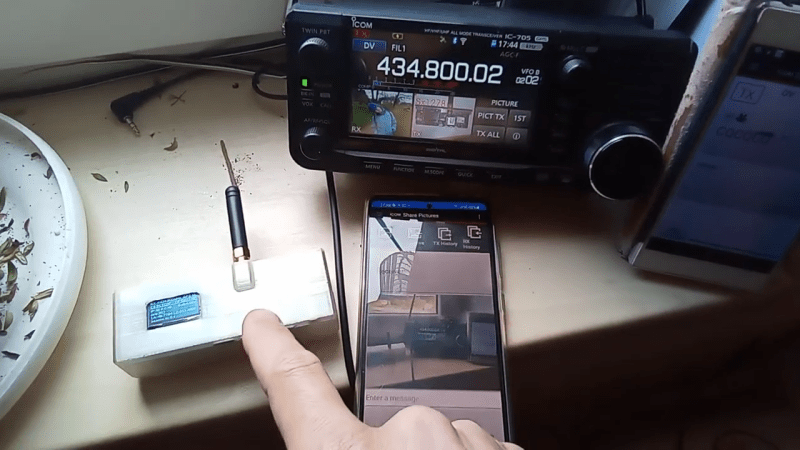
[Yeckel] recently put the finishing touches on an ambitious implementation of a simple D-STAR (Digital Smart Technologies for Amateur Radio) transceiver using some very accessible and affordable hardware. The project is D-StarBeacon, and [Yeckel] shows it working on a LilyGO TTGO T-Beam, an ESP32-based development board that includes a SX1278 radio module and GPS receiver. It even serves a web interface for easy configuration.
What is D-STAR? It’s a protocol used by radio operators for voice that also allows transmitting low-speed data, such as short text messages or GPS coordinates. While voice is out of scope for [Yeckel]’s project (more on that in a moment) it can do all the rest, including send images. That makes beacon-type functions possible on inexpensive hardware, instead of requiring a full-blown radio.
As mentioned, voice is a big part of D-STAR. While [Yeckel] was able to access the voice data, attempts to decode it were unsuccessful. A valiant effort, but we suppose voice decoding isn’t terribly relevant to beacon-type operations like transmitting APRS (Automatic Packet Reporting System).
So far as [Yeckel] is aware, D-StarBeacon is currently the only open-source implementation of a D-STAR radio available on the internet, which is pretty interesting. We’ve seen projects that touch indirectly on D-STAR, but nothing like this.
Watch it go through its paces in the video embedded below. Since the T-Beam is just a microcontroller development board, the user interface comes from an Android app on a mobile phone, which is why you see a phone in the video.












D-Star is a dead mode. See DMR or Fusion or FreeDV.
The high cost of D-Star killed it from the start.
And I hope to one day see DVSI (AMBE+2 CODEC) without ANY footrprint in
Amateur radio. OSS only. One can dream!!! haha.
RADE (FreeDV) out preforms anything AMBE has, by far.
See: https://freedv.org/ for info :)
Take a look at M17 if you want a standalone mode rather than needing a tethered PC.
I use D-STAR as a matter of routine.
You got the first comment slot. You used it to tell everyone, on a hackaday article about someone actively hacking on D-STAR, that people should not hack on D-STAR because it’s ‘dead’. I’m not dead. This hacker here, is not dead. The D-STAR repeaters maintained across the entire country and the reflectors running all over the globe are not dead.
Calling people working on something you don’t personally like ‘dead’ to sway the opinion of hackers, on a page talking about hacking on that mode, is incredibly dishonest and rude.
I’m all for using any and all digital radio modes, I don’t need a nanny telling me or new hackers which one they have to pick and marginalizing me. Grow some balls.
C4FM and DMR are a bit, um, annoying.. It’s both too smartphone-like.
Where’s the fun of that? As a computer and radio “nerd” I seek the difference, not a bad version of VOIP. 😞
C4FM is annoying on FM/C4FM hybrid repeaters,
because you’re always get to hear the noise on a normal FM scanner (for monitoring) if there are C4FM users!
So you’d have to build an external squelch for AF out of the FM scanner that decodes the CTCSS sub-tones and enables an external speaker.
But wait, the sub tones are being filtered out because they’re too low (to remove humming), so you can take the opportunity to tap the FM discriminator.
And not all FM repeaters to transmit CTCSS for a squelch.
Then there’s DMR which requires registering in a network.
How it’s called again? Waldmeister? I don’t know.
Anyway, it’s annoying I think. I had an DMR capable radio and setting it up causes headaches, not fun. 😒
By comparison, Echo-Link was straightforward. And it worked without special hardware and allowed visitors from far away to show up on local repeater.
Really, why couldn’t digital voice repeaters not simple use the KISS model, rather? 😮💨
Keep it simple and stupid? Use a dumb 70s era PCM circuit with a DAC/ADC and without protocols and computers?
To have the FM repeater experience in short, but digital.
Using the old 25 KHz segments of the day it was no problem to have some extra bandwidth on VHF, not to say UHF.
Also, no proprietary codec involved. Open as AM/FM or SSB.
The interesting thing about DMR is that is a system meant to be used for private commercial radios, and bent to be used on amateur radio services. While using commercial radios in FM for amateur use it’s quite straightforward, you end with a channel list you could associate to local repeaters or simplex frequencies, with DMR you need to add some bureaucracy. While on commercial system associate a numeric ID to a radio isn’t strange on amateur radio you have to register this id and associate to your callsign. When you have a DMR radio you have to reprogram it like a commercial radio, but there are a lot more parameters compared to a simple FM radio.
Thank you for your calm and helpful response.
I was already worried that my comment was seen as too agressive.
But that wasn’t intended, I’m rather a bit exthaused in terms of DMR.
I know of an OM who is a fan of DRM and wants me to participate (for the lack of other conversational partners) the hobby, but it’s a bit too stressful to me.
I rather enjoy vintage tech and pre-smartphone era.
Another thing that saddens me slightly about modern modes is that they focus on licensed radio amateurs and forget about the SWLs/listening amateurs or CBers.
Those who are using FM scanners, world band receivers and SDRs to listen to amateur radio.
As a CBer that feels a bit unfair. I wished DMR had a monitor function that would work without any ID, thus.
D-Star can be decoded via SDR meanwhile, but it’s s legal gray area because the voice codec is patented and normally would require a dongle with a chip.
The reason is understandable (origin being commercial radio), but it’s a bit sad.
Because I prefer that modes are free without patents, just like AM/FM and SSB are. Or PAL and NTSC television (thinking ATV).
These modes could be received using not just one technology.:
FM could be demodulated with de-tuned AM receivers, SSB with AM receivers that had a BFO.
AM could be demodulated using an SSB receiver, too.
PAL could be decoded using two NTSC circuits, basically.
That way, amateurs could communicate with each others despite technological or legal barriers (patents).
But with digital modes it’s all more closed and restrictive.
I guess that’s why old FM is still in use. It can be used with FM/PM radios of different manufacturers and different age.
No one’s left behind (except for CTCSS requirement vs old 1750 Hz opening tone).
“…Because I prefer that modes are free without patents, just like AM/FM and SSB are. Or PAL and NTSC television (thinking ATV)….)
I agree with you, completely.
I’m not against digital modes in the ham bands (I used to love TTY , PSK31, and others), but I’m of the opinion that there is no place for modulation schemes that are encumbered by copyrights, patents or licenses… unless those licenses provide specific, down-to-source-code, exemption for ham users, with ham equipment, on ham bands.
Any proprietary, closed-source, modulation method used on a ham band (especially in the worst-case where it actually became popular) would amount to a kind of commercial monopoly in parts of the spectrum where (at least under U.S. law) you’re not supposed to be making money.
“commercial monopoly in parts of the spectrum”
Pactor — VARA—
Both have no place on the ham bands.
(or AMBE!!)
Hi, yes, I admit the latest Pactor IV is commercial by nature.
It’s being meant for maritime use, among other things.
The technology relies on advanced DSP technology and supports compression and encryption (for commercial use).
Actual speed depends on band conditions.
The P4dragon/PXdragon are the PTCs that supports that, I think (1000€ range, for professionals).
They can do Packet-Radio, RTTY and WEFAX too, of course.
Like any good multi-mode TNC since the late 80s/early 90s can.
That being said, the original Pactor 1 is free, though, and uses AFSK/FSK.
It’s being supported by multi-mode TNCs such as PK-232 MBX and the PTCs (Pactor TNCs).
WinLink on shortwave still supports Pactor 1 (and up).
https://en.wikipedia.org/wiki/PACTOR
https://en.wikipedia.org/wiki/Winlink
That being said, I think I must add that amateur radio is experimental by nature.
It’s always good to be open to new technologies for sake of research and experiments (and fun).
That doesn’t automatically mean same time that existing commercial technology must become a de-facto standard, though.
Once infrasturcture such as VHF/UHF repeaters come into play,
it’s being recommend that things are open and free of patents.
To make sure amateur radio remains accessible to everyone. IMHO.
PS: Reading these lines myself feels funny.
In the past, I’ve always been a bit critical torwards Linux and open-source movement.
I was fine with using either types: I’ve used a mix of free/closed sourcce software on 98SE/XP (and DOS).
In these current days, though, considering all the developments on geo politics and IT,
the philosophy of open source and open hardware makes sense to me more than ever.
Things like vendor lock-in and manufacturers which try to brick or try to dictate type of use of their products have become real issues.
As someone who uses D-STAR as a matter of routine, I disagree. You’re saying this on a hackaday page with someone hacking on D-STAR. They seem to have a pulse. There’s an entire network of repeaters you’re calling ‘dead’. Why?
Don’t discourage your fellow hackers by telling them people not working in your mode aren’t real or don’t matter. It’s incredibly disingenuous and gross behavior. Let people decide for themselves without lying to them!
Dead? Perhaps, but I think it was mostly due to the incredibly poor documentation, obstructionists licensing (and just general obstructionism, see: poor documentation) and bizarre gatekeeping for even getting on the system. It has real potential, but not as long as Icom holds the reigns. The hardware is fine (and yes other modes have better quality, but it’s still acceptable)
Good work… effort to get this working. Amazing how universal ESP32 is! Is D-Star best protocol to pursue today? D-Star allowed 128kbps and IP addressing at 1.2 GHz, not lower frequencies. >1GHz , LoS issues, and cost of equipment/lack of surplus… limited adoption. Amateur radio is littered with ideas that never quite find the practical application to keep going. Without wider adoption, sales and support, they wither and fade. APRS is terribly inefficient, slow and overly simple… New Packet Radio (NPR) can do IP over 500kHz BW at 430’s (except USA due to regulatory), but seems the latest packet renewal attempt isn’t exactly seeing excitement (I think NPR is a super effort!). General public (non-hams) playing with Meshtastic and Meshcore, which at LoRa speeds is OK for text and telemetry and limited range with sub 1W power. Of course, Hams aren’t limited by 1W. Try and put this on a high perch and it will collapse with noise and traffic control limitations. The ISP community has tried 900 MHz before and given up. AREDN (amateur radio emergency data network) is ham radio based transport (WiFi freqs), but is not a “drop” delivery to mobile / portable users.
Younger hams need a killer app they can achieve as a hobby, but with practical value…. they want to use it too! Cellular data is the gorilla in the room. Delivering wide-area high speed mobile data over-the-air independent of a public carrier is the counterpoise.
As a fan or the original AX.25 Packet-Radio, NPR sounds lame to me.
It has all the disadvantages of Packet-Radio, but none of the good things.:
300, 1200 to 2400/4800 Baud Packet using AFSK worked on any infrastructure, not just proprietary things.
It could be used on CB radio equipment, via geo satellites (nsrrow band transponder) and on shortwave, too!
Most importantly, it used a variant of good old X.25 protocol with built-in error checking for reliability (FEC via recent FX.25 extension).
NPR doesn’t deserve its name, IMHO, it has nothing to do with AX.25, cool serial terminals or intelligent TNCs (can be left “on air” without a PC).
It can’t use all the existing packet radio software. No KISS, TAPR-2 or TF compatibility.
It’s just something different that tries to get popular using an established, venerable name (PR). Akin to NewTrek does with ST. IMHO.
If a high-speed alternative to Packet-Radio is needed, then HAMnet is a better one, maybe.
It’s using WLAN technology and internet protocol.
(Then there’s also PACTOR IV, which can do dial-up speeds on shortwave.)
https://de.wikipedia.org/wiki/HAMNET
Modernization at some point means letting go of outdated methods. VHF and UHF mobile telephones –> NMT or AMPS –> GSM or CDMA –> HSPA/UMTS –> LTE –> 5G…. WiFi7 is here now. HaLow at 900 MHz. Discussing VHF and above…
How can NPR with IP and at least 128kbps at 430MHz be lame in comparison to APRS 1200???
IP is the universal transport, and once you have a clean IP pipe of even 128 kbps, you can carry any voice codec, telemetry, messaging, APRS‑IS, email, or streaming sensor data without being locked into legacy amateur‑radio digital‑voice constraints.
The real issue is that most amateur‑radio digital‑voice systems (D‑STAR, DMR, Fusion, P25) were designed in the 1990s–2000s for narrowband 6.25–12.5 kHz channels, long before modern low‑cost broadband RF hardware existed. That’s why they’re stuck at 4.8 kbps, 9.6 kbps, or 12 kbps payloads. ≥128 kbps mobile IP—is absolutely achievable today, but only with systems designed for broadband, not legacy DV.
Sure there are Broadband systems (AREDN, Hamnet, HaLow, 802.11 variants), but these are point to point, or multipoint transport. HaLow is the first amateur‑legal technology (USA) that gives both range and broadband at 900 MHz.
The Practical Path to ≥128 kbps Mobile IP that is legal… AREDN HaLow for mobile nodes, or NPR at 430 MHz in regulatory areas that allow BW there.
(1–4 Mbps, long range, low power) paired with AREDN 5 GHz for fixed infrastructure
(10–50 Mbps, high capacity)
This gives you:
– A mobile broadband IP link
– A fixed high‑capacity backbone
– Full IP routing
– Any payload you want (voice, telemetry, email, sensors)
– Amateur‑legal operation
– No dependence on legacy DV systems
It’s the closest thing to a “carrier‑grade amateur broadband network.”
Canada does not impose the same strict 430 MHz bandwidth limits that the FCC enforces in the United States, and the RAC band plan confirms that wideband digital modes are explicitly permitted in several parts of the 430–450 MHz amateur allocation. This makes NPR‑70 or similar 128 kbps UHF systems far more viable in Canada than in the U.S.
IP is the universal transport, and once you have a clean IP pipe of even 128 kbps, you can carry any voice codec, telemetry, messaging, APRS‑IS, email, or streaming sensor data without being locked into legacy amateur‑radio digital‑voice constraints.
Short answer: The fascination about classic Packet-Radio is not performance, but something different.
It can be implemented using humble technology and targets a different group of users than NPR.
NPR is about a wireless internet connection, while PR was about terminal-to-terminal connections.
Situation is like browsing world wide web vs dialing into a BBS. Two different things, in short.
And there are still fans who enjoy visiting or running classic ANSI BBSes via dial-up these days, too.:
Some use the internet (telnet connection) or VOIP for connection (dial-up modem on cable modem), while others use a real landline (if still available).
AX.25 Packet-Radio used to be the equivalent on the air waves, basically.
Back in the 90s you had users who connected to each other, used digipeaters, sent e-mail..
Some played games via Graphic Packet or downloaded files.
Such as newest 2-element Kepkler data for MIR, ISS and other ham sats.
AX.25 PR wasn’t just slow internet, but an entire network separate from the internet. It was its own thing.
Well, until it had been neglected in favor of the then-new internet (www).
Hams had no idea what they had (with the PR network) until it was “gone”.
Similar situation on CB radio in my location, but here the PR network lasted up until mid-2000s.
APRS, I think, is fascinating because it allows a lot of homebrewing.
You can build your own KISS TNC using an Arduino (bought or DIY on a breadboard), for example.
Or build your own tracker. Or build an iGate using an SDR or old radio.
It’s fun, in short. Like 45,45 Baud RTTY or CW still are.
It’s also interesting because it’s Packet-Radio’s last stand.
And satellites and ISS use it, too. Doppler effect doesn’t affect the FM-modulated 1200 Baud AFSK signal very much, either.
We’re in the process of spinning up a new simulcast repeater system across my city with six separate fully functional repeater sites are all linked on the backend to a centralized controller that handles receive site voting, timing, and phasing sync. All of the repeaters of this system have been carefully located to minimize overlap but maximize coverage, and the whole system uses the same frequency pair, offset, and tone. Despite a large push to include whatever DV flavor of the month currently hot, we’re sticking to our guns of a 25khz analog FM because it just works. This system design was specifically to get the maximum coverage across our area while allowing absolutely everyone access. Primary system design motivation is of course mostly based around SKYWARN/RACES/emcomm.
System works great and is available to anyone, anytime. I got outvoted on the controller configuration and every single undesirable feature available on a repeater controller was enabled, so despite helping to keep it on the air, not a system I use.
My understanding is that MMDVM (http://mmdvm.com/) is also an open source implementation of D-Star.
The worst thing, IMHO opinion was HAMs letting the D-Star, DMR and Fusion overlords into our hobby. That is why FreeDV, and M17 via Codec2 is such a refreshing project. With over 350 M17 repeaters now worldwide, this is where we should be focusing our Amateur Radio Hobby. I applaud the fellows effort on this project for the joy of it, not the D-Star protocol. Maybe a sister project using M17 would be in line now.
Codec2 used by FreeDV (HF digital audio) and M17 are free (GPL3) and unencumbered allowing experimentation which is one of the core values of Amateur Radio.
Also the comment above that scanner listeners are cut out of DMR would not hold true with M17 as there are no licensing fees to develop a radio.
Also if you haven’t heard FreeDV HF SSB it’s quick amazing, if you are into HF, check it out.
See for further info.
https://radio-hobbyist.com/m17-and-the-rise-of-open-source-digital-ham-radio/
Armature radio needs more open digital mode standards, and we need to demand them on commercial radios. What we have to much bifurcations into proprietary modes, peculiar to certain radio brands; this is not healthy for armature radio continued existence, nor would it be optimal in case of an emergency.
–Ham General, working on my Extra.
lol. Yes, (/\/) should absolutely adopt open-source only digital voice modes and integrate them into their multi-thousand dollar handsets so they can offer checks notes 250 of them to broke hams like myself. Love the idea, but in practice that’s not going to happen.
“recently put the finishing touches”
Recently? The video is over 4 years old and the recent updates to github project are pretty inconsequential.
All of the comments here are ignorant. The codec dstar uses is a tweaked older varient of ambe with all patents expired, of which software implementations already exist. Thats how multimode xrf reflectors work, so we can all interoperate. Dstar is not a closed proprietary protocol its spec is fully documented by the Japanese amateur radio league in shogun.PDF freely available to download.
The only proprietary mode is fusion which is yaesu’s own thing that is incompatible with everything else because yaesu wants to be the apple of ham radio.
Hacking up a commercial mode to work with amateur radio isn’t the same as having a mode specifically designed for ham radio, and there is nothing stopping anyone from running ax.25 frames thorough dstar’s userdata unproto multiplexed streams. Of there there are two, and every dstar compatible radio includes a serial port or a emulated serial port over USB for accessing this multiplexed unproto data.
The comments about bizzare gate keeping are true but becoming moot as alternative open source homebrew repeaters replace G3. G3 is not ICOM BTW it is AA4RC’s own creation and he was just the person who did a lot of innovation on the gateway software in the early days.
The newer replacement of g3 routing is called ircdb and openquad.net. can be used with the qnetgateway software available on github as C source code for you to compile.
Ircddb routing was invented by the Germans after the snowden leaks who didn’t like the idea of a centralized us server running all of their routing metadata.
Stop shaming fellow hams are are creating cool things. If you don’t like digital then you don’t have to use it.
If you hate ICOM for some reason you can also get dsrar radios from Kenwood or alinco. What other manufacturer besides yaesu can you get yaesu fusion radios from? Thats right, none. So stop shaming ICOM for actually taking a risk in the early days to do something innovative for amateur radio by embracing an actual open digital standard rather then just sticking to their own proprietary mode like iDAS or fusion.
Regarding DMR, thats what you get when you have no brand protection whatsoever. A dozen flight by night Chinese knockoffs where everybody is at a different volume level making you have to twiddle your volume knob like a disco DJ just to use it on a public network, of which there are three which don’t easily interoperate with each other.
“All of the comments here are ignorant.”
Please tell me why DSTAR is 2X the cost of ANY other digital ham mode?
And don’t call me a Icom hater….most of my equip. is Icom.
Icom killed DSTAR by the price.
Thank you for your information and reply, I appreciate it! 😎
Personally, I didn’t mean to be ignorant on purpose or to critize the work of other amateurs.
If I did so, I’d like to apologize at this point here.
In my case it’s simply that my knowledge is a bit outdated.
I didn’t know that the voice codec patent has expired.
It’s merely 20 years that I heard of D-Star first time and I haven’t checked the current situation every 5 years.
What I wrote before simply was me thinking out loud. Vy73s.
No mention of P25 ?
“No mention of P25 ?”
No one short of the federal gov. can afford P25!!