
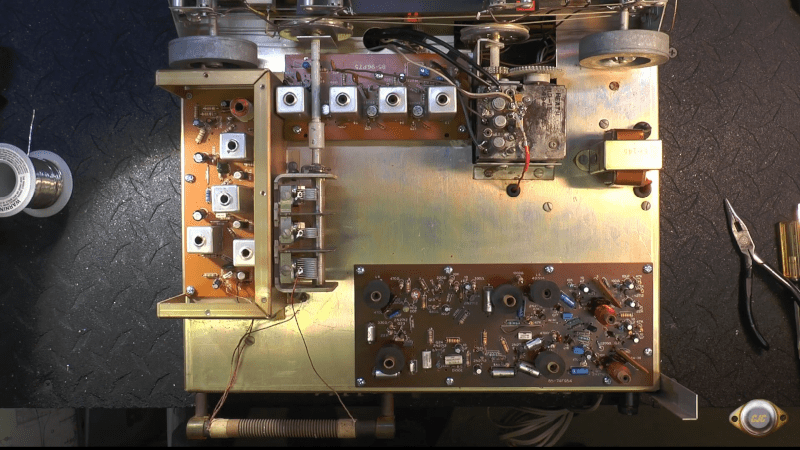
We miss the old Heathkit. You could build equipment that rivaled or even surpassed commercial devices. The cost was usually reasonable and, even if you could get by with less, the satisfaction of using gear you built yourself was worth a lot. Not to mention the knowledge you’d gain and your confidence in troubleshooting should the need arise. So we were jealous of [RCD66] when he found a Heathkit AJ-43C stereo tuner in the recycle bin.
As you can see in the video below, it needed a lot of love to get back to its former self. The device dates from around 1965, when the kit cost $130. In 1965, that was a lot of money. Back then, that would have bought you about four ounces of gold and would have been a great down payment on a $1,500 VW bug.
Things were a bit of a mess, so he removed all the parts and replaced most of them. Unsurprisingly, the electrolytic capacitors all tested bad. The transistors were all germanium, but if they tested good, his plan was to reuse them. There were several PCBs inside, and he made some changes, such as replacing the zener diode power supply with something more modern.
How did it sound? Watch the video and see for yourself. We usually like troubleshooting specific problems on gear like this, but in this case, it was probably smart to just do a total rework.
Heathkit had quite an origin story. This isn’t the first time we’ve seen someone strip and rebuild a Heathkit.












Never before have I seen a tuner with separate knobs for AM and FM. It looks like a very impressive design: the AM tuner has a 3 gang capacitor, both IFs appear to have multiple dual-tuned stages, and the stereo demultiplexer can be trimmed for maximum separation.
If I had done the rebuild, I would have been tempted to replace the FM RF input transistor with something modern, to improve sensitivity.
Why 2 knobs so you can get AM/FM stereo. Two stations for one program.
A little hint what it is would have been nice.
Ummmmm, it’s a tuner, as in a device for receiving high fidelity AM and FM broadcast signals and feeding them into an amplifier; where did I learn that? I read the article.