
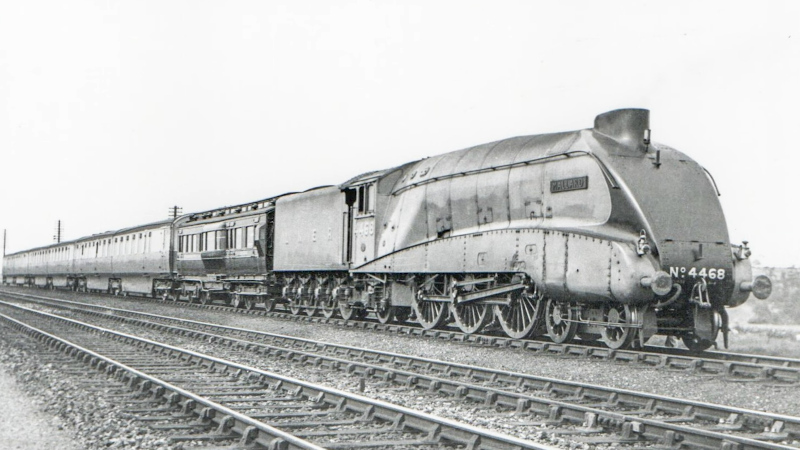
There aren’t many speed records that remain unbroken for the greater part of a century, but one of them is that of the fastest steam locomotive. As with so many such things, there’s a bit of controversy and more than one contender, but the one in the record books is the A4 Pacific, Mallard. In 1938, this locomotive thundered down an incline on the London & North Eastern Railway’s mainline in the north of England at 126 MPH. But can that number be taken as reliable? The Institute of Mechanical Engineers has a video in which they investigate.
It’s a fascinating look at the science of railway speed measurement as it existed in 1938, the record itself, and the paper dynamometer roll which recorded it. We’ve placed the video below the break, and in it, we see an in-depth analysis of the noise and inconsistencies in the recording, and see them come to the conclusion that a safer figure to quote would be 124 MPH.
Our assessment is that, of course, the LNER wanted to squeeze every morsel of publicity from it in a game of one-upmanship with their arch-rivals in the London Midland and Scottish railway, so it’s likely that their use of a momentary figure makes sense in that light. Even the best-laid 1930s jointed track would have been bumpy compared to modern continuous rail, and we are guessing that the ancient clerestory dynamometer car would hardly be as smooth-riding as a modern express coach. The achievement of measuring at all with mechanical instruments in such an environment at those speeds would have been tricky, to say the least. It leaves us wondering whether 1930s electronics could have produced some kind of trackside measurement device, but perhaps the LNER trusted their mechanical instruments more. Perhaps the Pennsylvania Railroad should have followed its example.












“…Perhaps the Pennsylvania Railroad should have followed its example.”
You mean, of course, by running the T1 down-hill on its speed run?
[the T1 was a beautiful locomotive; the Mallard was a beautiful locomotive. There ain’t</> no ugly steam locomotives…going down-hill or up-hill…nowhere]
“There ain’t no ugly steam locomotives…
I forgot: a candidate for the world’s all-time ugliest locomotive is the M-1 class ‘Chessie’, a 617-ton behemoth, three complete consists of which were built by Budd to provide much-needed (in the eyes of the genius CEO of the C&O railroad who conceived this plan) high-speed, luxury rail service between Washington, DC, and (wait for it) CINCINNATI, OHIO.
The infrastructure to support this boondoggle (high-speed track watering pans, all-route high speed rail upgrades, signalling, training, etc) were a large part of the total cost.
The trains never saw revenue service. Perhaps the loudest and most eloquent testimonial to the M-1 ‘Chessie’was provided in the last sentence of a piece written about it: “…all three Chessies were quietly scrapped in 1950.”
They must have been chuffed.
That tracks.
Well stoked!
I was fortunate to have travelled behind the Mallard about three times on
runs from Glasgow to York many years ago.
That possessive apostrophe in the word world in the title is a bit weird. I’ve only ever known such thing be called a world record.
Might be the two cultures separated by a common language thing, i.e. Brit vs Murican. Lawd knows us Muricans are always fixated on bigger and faster.
The Pennsylvania railroad T1 and S1 duplex drive locomotives are reported as going faster than Mallard at 130 and over 150 mph respectively though neither have been confirmed and are just speculative. I believe that both infact did go faster than mallard though sadly we can’t prove the S1 did go over 150mph, but the T1 trust is rebuilding a T1 and will likely go for the record.
ah, a Delorean and this train…..time travel can occur in the days of rail!
As I often have to wait at crossings, I wish they were all still going for a record speed ;) (Which makes me wonder what the diesel-electric speed record is 🤔)
here in Australia I asked a train driver/engineer who drove the Overland, the service that operates between Adelaide and Melbourne, how fast a diesel electric can go.
He told me around 150 – 160 kph the back EMF in the motors starts to mess up the brushes on the traction motors
The current diesel-electric speed record is 256 km/h, for a Talgo 21 train, set in 2002.
Regardless of the actual speed a locomotive moving that fast must have been a seen .
determine distance, then the time it takes to arrive?
That gets you the average speed over a section of track. A dynamometer can measure peak speeds.
The Hudson Dryfuss J-3a was pretty fast, too: 123.6 mph in 1937.
https://en.wikipedia.org/wiki/New_York_Central_Hudson
As seen in the Iron Giant : )
Interestingly the drawbar hp of Mallard was in the region of 1200hp which puts it in the same power band as an early war Rolls Royce Merlin. Mallard is still in the National Railway Museum in York, well worth a visit.