
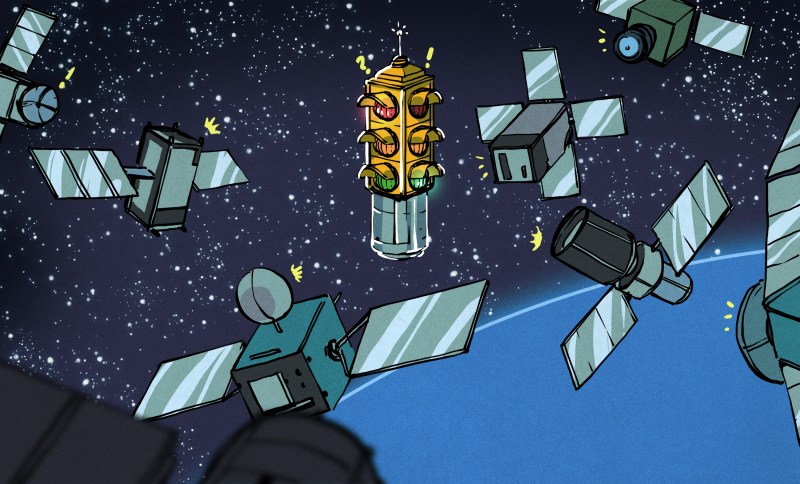
For many decades humankind has entertained the notion that we can maybe tweak the Earth’s atmosphere or biosphere in such a way that we can for example undo the harms of climate change, or otherwise affect the climate for our own benefit. This often involves spreading certain substances in parts of the atmosphere in order to reflect or retain thermal solar radiation or induce rain.
Yet despite how limited in scope these attempts at such intentional experiments have been so far – with most proposals dying somewhere before being implemented – we have already embarked on a potentially planet-wide atmospheric reconfiguration that could affect life on Earth for centuries to come. This accidental experiment comes in the form of rocket stages, discarded satellites, and other human-made space litter that burn up in the atmosphere at ever increasing rates.
Rather than burning up cleanly into harmless components, this actually introduces metals and other compounds into the upper parts of the atmosphere. What the long-term effects of this will be is still uncertain, but with the most dire scenarios involving significant climate change and ozone layer degradation, we ought to figure this one out sooner rather than later.
Nobody Hears You Burn In Space
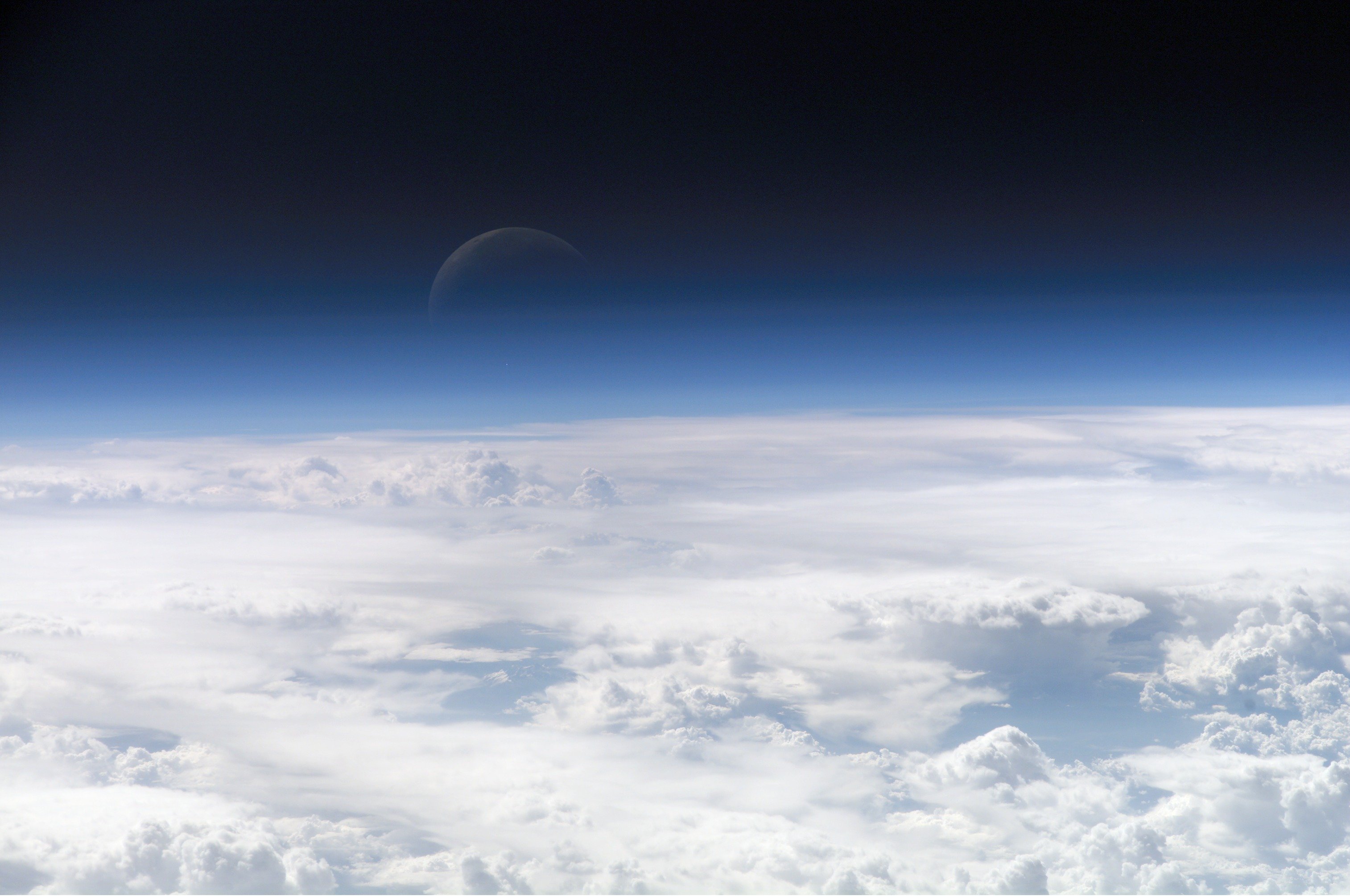
Although Earth’s atmosphere looks pretty peaceful if you’re gazing at it from a space station in LEO or from a commercial airliner at cruising altitude, it’s actually constantly being assaulted. Everything from radiation to meteoroids, as well as the occasional asteroid are constantly making an attempt at inflicting real harm. This ranges all the way up to another mass-extinction event, but a meteoroid will settle for at the very least flattening another forest or inconveniencing a home owner.
Fortunately the atmosphere provides another feature beyond allowing us to not suffocate: by providing strong friction, the resulting high temperatures and intense plasma formation tend to burn up any object that tries to enter it at high velocity.
A less extreme form of this comes in the form of aerobraking, which is what spacecraft use to reduce their velocity relative to the planet; by creating enough friction in the atmosphere to shed kinetic energy, yet not heating up the spacecraft’s exterior to the point where things begin to melt, is incredibly helpful if one wishes to avoid having to resort to Plan B, being the violence of lithobraking.
This incinerator feature of the atmosphere is also very useful when it comes to the question of where the trash goes, whether it’s literal trash from the International Space Station, or things like discarded rocket stages and fairings, all the way to satellites that have reached their end of life stage. Yet much like the medieval solutions to waste disposal, the theme here is very much an ‘out of sight, out of mind’ approach, which is understandable as long as the volume of waste is still relatively small.
Running The Numbers
When a human-made object disintegrates in the atmosphere, it’s reduced to its base compounds, after interaction with the super-heated plasma that forms around said object. With the commonly used aluminium, for example, this means the production of aluminium oxide.
By far the largest amount of mass that will be burning up in the atmosphere over the coming years is formed by LEO internet constellations such as Starlink, which have a cumulative mass of over 10,000 tons. In addition, the second stage of the Falcon 9 rockets that are currently used to launch Starlink v1 and v1.5 satellites into LEO also burns up in the atmosphere. Recently, such a Falcon 9 stage suffered a mishap that caused it to disintegrate over Europe, rather than the typical trajectory over remote parts of Earth’s oceans.
This provided the perfect natural experiment. Batteries onboard satellites contain lithium, and because it’s relatively scarce in the atmosphere, it makes a great marker for the effects of satellites burning up on re-entry.
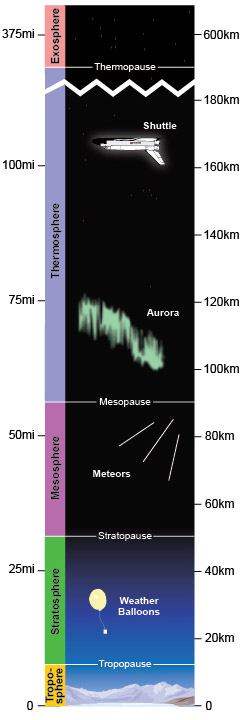
In the article by Robin Wing et al., as published in Communications Earth & Environment, the upper atmosphere measurements by a resonance lidar in Germany allowed for a ten-fold increase in atomic lithium to be measured after the stage had disintegrated near Ireland at an altitude of 100 km. Air currents subsequently dispersed the atomic debris over the rest of Europe.
Most notable perhaps was that the plume of atomic lithium was being detected at the same altitude of 100 km, after advecting for 1,600 km, placing ablation and dispersal in the mesosphere and lower thermosphere (MLT). Normally this plume would be dispersed far away from instruments, making it a fortuitous event from a scientific perspective that it could be measured like this.
Lithium is just one tracer for the debris plume, but there are many other metals. Here also lies the issue with comparing purely the mass of asteroids and rocket stages burning up in the atmosphere versus meteoroids and asteroids doing the same. The latter aren’t usually composed of intricate collections of metal alloys, rare earths and composite materials, but generally more boring things that we’d generously call ‘rocks’ or ‘gravel’, with the occasional iron variant mixed in.
As noted by Robin Wing et al., this feature makes artificial sources relatively easy to distinguish from natural ones. Since within the next decades re-entering satellites are projected to match or exceed 40% of natural meteoroid influx, the question remains of what these substances hanging around in Earth’s atmosphere will do to it and consequently life in Earth’s biosphere.
Potential Impact
Back in 1987 the Montreal Protocol was signed. This banned the use of chlorofluorocarbons (CFCs) after it was found that the large-scale release of CFCs into the atmosphere from refrigeration systems and other sources had resulted in a significant depletion of the ozone layer. This layer is found primarily in Earth’s stratosphere and is essential for blocking harmful ultraviolet radiation which would otherwise irradiate the surface, in particular UV-C.
Although it’s currently projected that the ozone will have completely regenerated by 2045, a worrying 2024 research letter by José P. Ferreira et al. from the American Geophysical Union (AGU) with accompanying press release suggests that the massive rise in satellites burning up in the atmosphere over the coming decades could add so much aluminium oxides to the atmosphere that it could revert this ozone layer regeneration process.
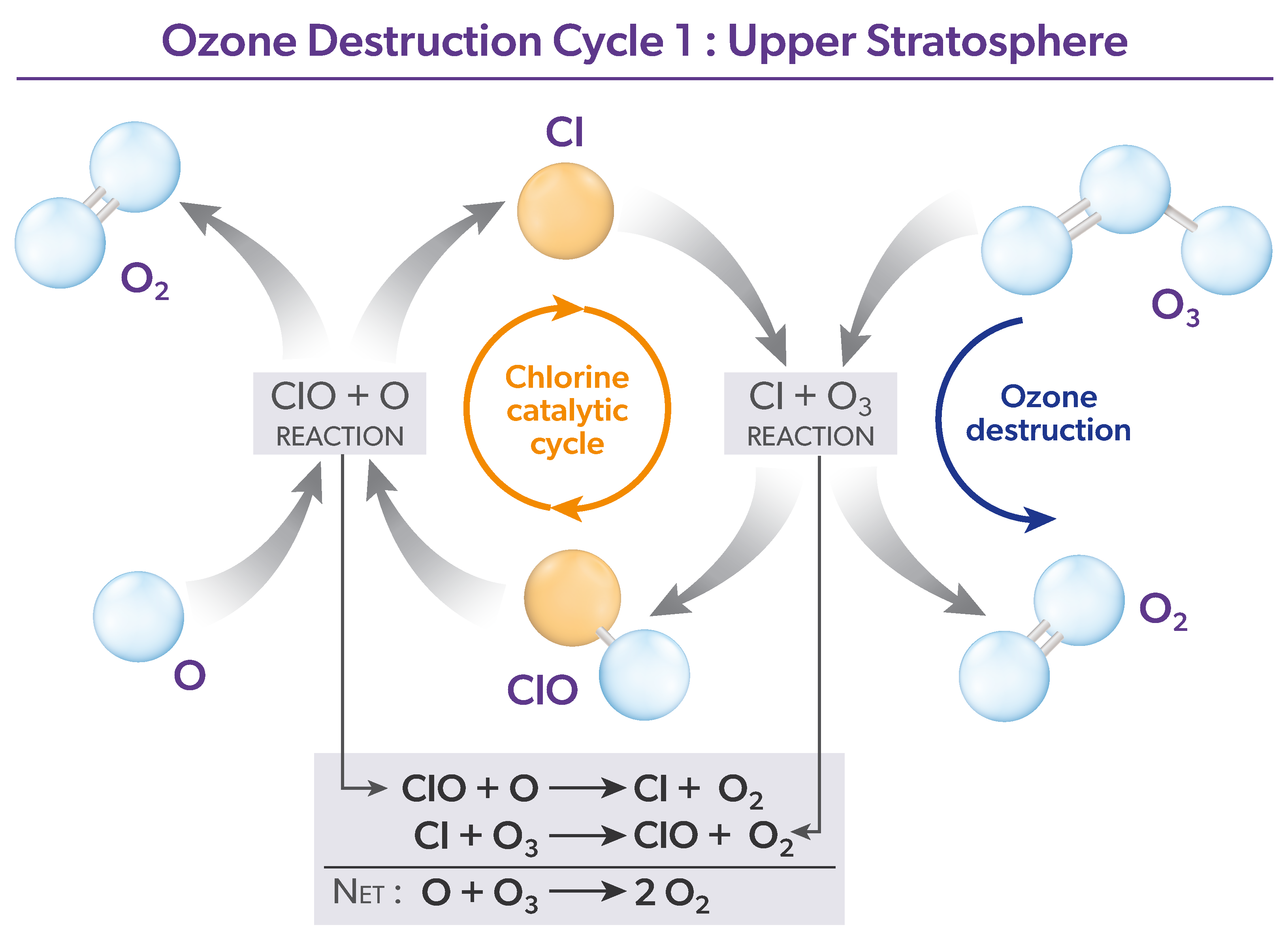
Using an atomic-scale molecular dynamics simulation they found that a typical 250 kg satellite upon its fiery demise in Earth’s atmosphere releases about 30 kg of aluminium oxide nanoparticles. These may remain in the atmosphere for decades, meanwhile acting as a catalyst for chlorine activation and thus ozone depletion.
With currently projected mass of mega-constellation satellites burning up in the atmosphere, we’d be looking over 360 tons of aluminium oxides per year being added. As a catalyst, these aluminium oxides would not be used up, but would keep depleting the ozone layer as fast as the input products (ClO or Cl) are added.
This is just one potential impact that we might see as we keep adding all of these foreign substances to the atmosphere. Fortunately there’s nothing that says that we cannot have all our satellites and still dodge these issues.
Reduce, Reuse, Recycle
The central issue here is that we have always treated the atmosphere similarly to the way that early medieval cities treated the local waterways. In their case it only took a few cholera- and other assorted epidemics to realize that maybe it was best to not use the waterways both for waste and drinking water. Similarly, we are now at a point where we’re beginning to realize that tossing our waste into the atmosphere may not be such a good plan, albeit it largely for financial reasons.
For many decades, it’s been accepted that rockets and satellites are effectively disposable, single-use items. Even the infamous STS (‘Shuttle’) program didn’t really push it much past ‘intense refurbishing’. Only recently has it become fashionable to reuse rockets and capsules, with the SpaceX Falcon 9 rocket’s first stage currently being the world-leader when it comes to partial reuse. Unfortunately its second stage still is burned up, as we saw with the analysis by Robin Wing et al.
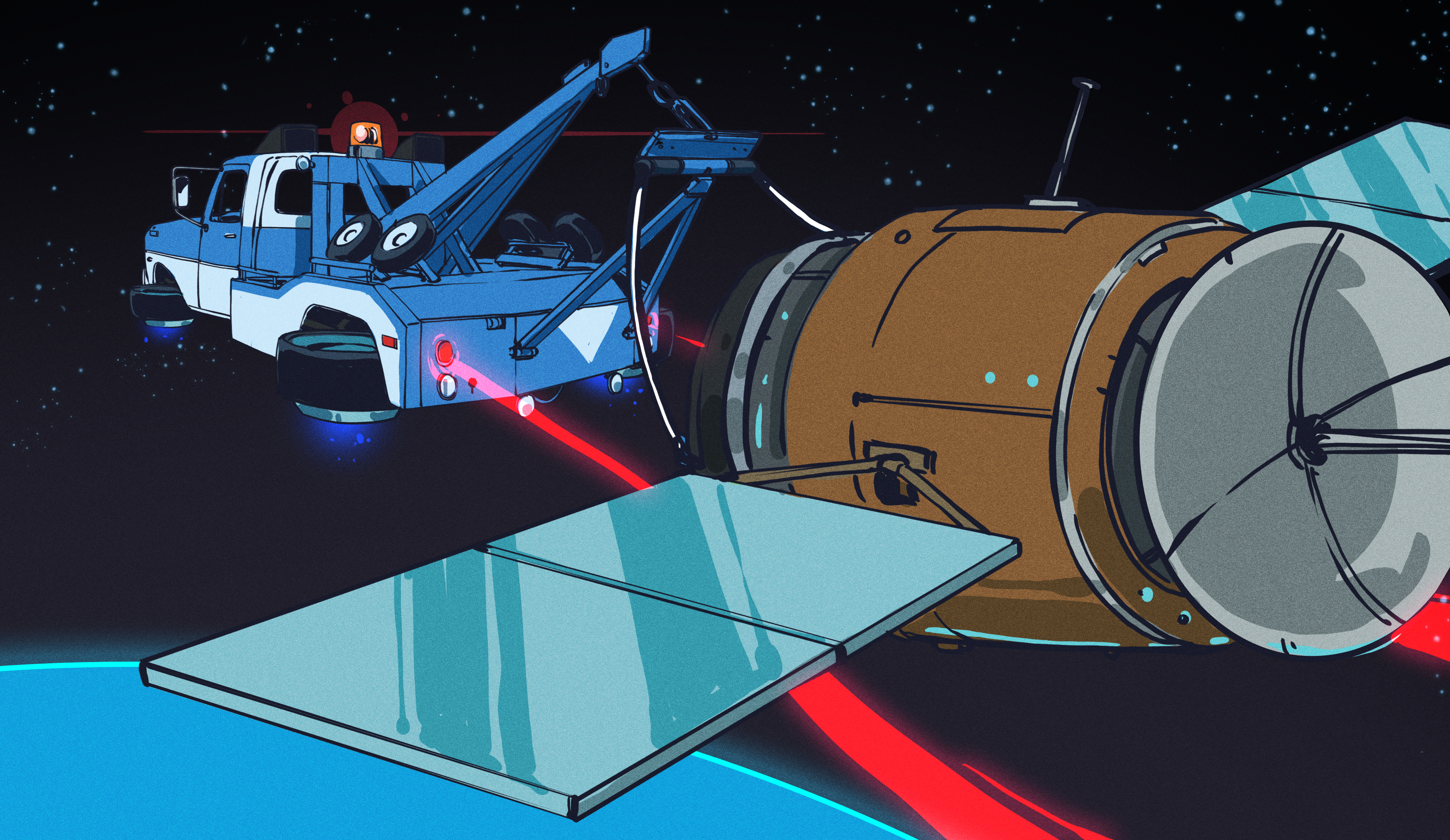 What can be done? Back in 2020 we covered Northrop Grumman’s Mission Extension Vehicle (MEV), which provides a way to latch onto an existing satellite and provide propulsion as well as other functionality when the target’s own resources have become exhausted. In 2021 MEV-2 docked with Intelsat 10-02 to push it back to a geosynchronous orbit, extending its life by five years.
This is an example of on-orbit satellite servicing, which can take many forms. At its most basic it will just drag a satellite to a specific orbit, but it can also entail actual servicing, refueling and repairs. This was actually one of the concepts behind the Shuttle, with the Hubble Telescope being serviced and upgraded during a number of missions.
Unfortunately with the STS program’s in-orbit repair feature remaining mostly a pleasant dream due to the high cost of such a mission, we may one day see satellites being refueled and repaired by robotic systems. Although fully reusable rockets seem to be just around the horizon with SpaceX Starship and kin leading the way, we can only hope that we can soon figure out a way to make it cheaper to just repair a satellite than to toss it and launch a new one.












https://www.sciencedirect.com/science/article/abs/pii/S0032063316302434 suggests natural influx at “30 – 180 tons with a best guess value of 54 tons per day.” … We’re quite a way from launching 20 tons a day to compete with that.
We also lose mass by atmosphere escape, https://www.astronomy.com/science/is-the-earth-gaining-or-losing-mass/ estimates 2x more mass is lost daily than is delivered.
atmosphere re-entry is hard: even without worrying about the chemical waste there will be a rather large energy pulse associated with returning stuff. This is why “asteroid mining” isn’t viable yet, even if we had a platinum asteroid in a close orbit it’d still be cheaper to use terrestrial sources.
The problem isn’t the sheer mass of manmade re-entering material though, it’s the amount of that mass that’s aluminum, which contributes to catalyzing ozone depletion.
There have been attempts to substitute aluminum in satellites with wood:
https://en.wikipedia.org/wiki/LignoSat
Hyperion’s Treeships coming soon
https://hyperioncantos.fandom.com/wiki/Treeship
I’m ignorant of the specifics of this problem but i’m just saying that the general problem with an analysis like this one is that it only holds if we are not at a tipping point. Metaphorically, one straw can break the camel’s back. Sometimes, in very specific circumstances.
If metals from satellite reentries were building up in the ionosphere in meaningful amounts or the right ionic form to actually change radio propagation, like noticeably stretching HF skip on long-haul links or throwing persistent extra scintillation and delays at GPS signals, we’d be seeing clear repeatable patterns in ham radio logs, ionosonde records, global GNSS data, and beacon monitoring by now, but so far there’s nothing beyond the normal solar and geomagnetic issues despite super-sensitive RF gear watching it constantly.
The post is not about free metals, but metal oxides.
You will have RF reflective ions from 85 km up, and regardless of absolute concentrations you should still see a proportional effect that is measurable. Semiconductors below that level due to oxides forming, and they diffuse and absorb radio waves, again it should be detectable. Less than an hours work with an AI and you can put together a fairly sophisticated parametric simulator of these phenomena.
Last time I checked rocks, dust and pebbles aren’t on the Periodic Table of Elements, so while differentiating a particular composition at altitude might be easy, how about include a chart showing a statistically valid breakdown of actual elements?
Silica and iron. Not much else.
Granted that this isn’t the most meaningful loss of metal, but it reminds me of Tom Murphy’s explorations into how much longer we can maintain a high-tech society on Earth under various assumptions. I.E. forgetting about climate change for a moment, there eventually comes a time when we have mined the last bits of copper from the crust and have to survive only on recycling, losing a little bit to waste each year.
https://dothemath.ucsd.edu/2023/09/can-modernity-last/
He has other articles talking about how exponential growth must eventually end. If you expect the stock market to grow at a few % per year for many generations, you bump up against the limit of how much energy is generated by all stars in our galaxy combined.
By far most of the stock market gain over the last 60 years has been numerical only, not real value, due to the loss of value of the dollar. About half of the remaining increase has been due to population growth.
If we continue the analysis indefinitely, we do run into limits, but if you look at the problem faced by each individual generation, it doesn’t seem so concerning. I think it’s well described by the “peak resource theory”, from which the phrase “peak oil” came. It’s fundamentally an economic theory more than a geophysical one.
The key observation is that we always use the most plentiful (a few different ways to measure that) resource that fills the need. For example, there are a zillion battery technologies that are possible but right now lithium ion batteries are cheap and powerful and so almost every other technology is completely abandoned…there’s research of course, but that research is looking for a technology that will exceed lithium batteries. Any avenue that doesn’t meet this metric is abandoned. But if lithium batteries become more expensive then suddenly all of these abandoned technologies will fight with eachother, instead of fighting with against lithium.
So we used crude oil because it was gushing out of the ground. And once it stopped gushing, other technologies then became cost-competitive. When fracking and tar sands extraction were first envisioned, they were considered impractical, unbelievably expensive. You use a significant fraction of your product simply providing the energy to pump it up! Madness! But long before we ran out of easy-to-extract crude oil, it became measurably scarce compared to demand and the price went up enough that these more difficult extractions became profitable. And once that happened, we were on the other side of the peak.
Copper is awesome and still fairly cheap so we use a lot of it…as it becomes less cheap, we’ll use something else, or we’ll use it differently. Eventually it may pass its peak and something else will be at the tip of the price/performance curve for a while, and then that too will peak. Of course, copper will play out over a very long timespan because it’s so easily recycled.
We are basically past peak copper already: https://www.iea.org/reports/global-critical-minerals-outlook-2025/overview-of-outlook-for-key-minerals
This is yet another reason why I support the concept of wet-workshops
The Space Shuttle could have taken its External Tank to orbit for use as space station construction.
An example of what we could have had:
https://davidbrin.com/tankfarm.htm
https://aiaa.org/wp-content/uploads/2024/12/shuttlevariationsfinalaiaa.pdf
https://www.sciencedirect.com/science/article/abs/pii/009457659390022O
https://spaceflighthistory.blogspot.com/2023/03/space-shuttle-external-tank-et.html
https://ssi.org/reading-old/ssi-report-on-tank-applications/
Mass launched to orbit should stay in orbit. No re-entry=no problem.
Small numbers of large Orbital Antenna Farms are better than lots of mega constellation debris
Stage and a Half LVs like Energia Buran or SLS are better.
On wet workshops:
https://www.thespaceshow.com/show/14-dec-2021/broadcast-3801-gene-meyers
I remember reading about Stratospheric Aerosol Injection to mitigate greenhouse effects using aluminum oxide particles that was proposed for higher effectiveness and lower chemical reactivity with ozone than some other proposals.
That said, it seems totally reasonable to figure out massive atmosphere modification projects before embarking on them, but that never seems to happen.
what is the difference please between the two different mentions of “asteroids” in this sentence:
“Here also lies the issue with comparing purely the mass of asteroids and rocket stages burning up in the atmosphere versus meteoroids and asteroids doing the same.”