
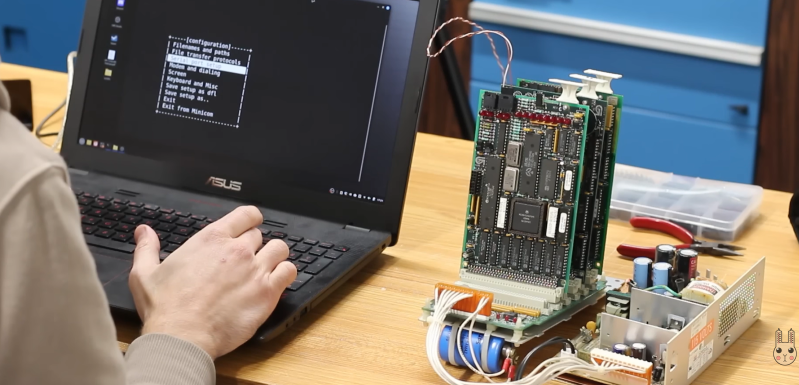
[Dave] over at Usagi Electric has a mystery on his hands in the form of a computer. He picked up a Motorola 68000 based machine at a local swap meet. A few boards, a backplane, and a power supply. The only information provided is the machines original purpose: gas station pump control.
The computer in question is an embedded system. It uses a VME backplane, and all the cards are of the 3u variaety. The 68k and associated support chips are on one card. Memory is on another. A third card contains four serial ports. The software lives across three different EPROM chips. Time for a bit of reverse engineering!
[Dave] quickly dumped the ROMs and looked for strings. Since the 68k is a big endian machine, some byte swapping was required to get things human readable. Once byte swapped, huge tables of human readable strings revealed themselves, including an OS version. The computer runs pSOS, an older 68k based real time operating system – exactly what one would expect a machine from the 80’s to run.
The next step was to give it some power and see if the gas station computer would pump once again. The LEDs lit up, and a repeating signal showed up from one of the serial ports. The serial connections on this machine are RS-485. Not common for home computers, but used quite a bit in industrial embedded systems. Unfortunately, the machine wouldn’t respond to commands sent from a terminal. The communication protocol remained a mystery.
Since this video has gone up though, several people have provided a wealth of information at the vintage-micros channel over on [Dave’s] Usagi Electric Discord.
Gas pumps are a bit of a departure from [Dave’s] usual minicomputer work. We’re no strangers to embedded systems here though.












This article reads sort of werid, it also feels like an AI wrote it.
AI-generated slop has a tendency to be syntactically perfect but semantically suspect. The artical has two comma violations and a sentence fragment. Likely human written.
(just be cool… fragment and misspelling above are intentional)
last i checked hes definatly not an ai…………….. goes back to beating rocks to make bitts and bytes
Can it run old Macintosh System files? I’d imagine the EPROM would need to be changed to have Mac codes for booting up.
Since you decided to censor my original post, I will try again.
This article reads weird as if it was AI generated, Especially when it starts talking about trying to send commands to it, which never occurred in the video. Additionally it claims David got it from a swap meet when in actually he says in the video his buddy “rescued it from the scrap heap”
Please put a disclaimer if your going to start posting AI generated articles or explain why this one is not written as a human would and is factually incorrect.
I’ve checked this article using gptzero and quillbot ai text detection services and both showed that the text is 100%, not even a single percent was written by AI according to results. I think this is just a case of common human error
is 100% human*
So you used AI to try and detect AI. Wow. Also doesn’t explain them censoring my first comment asking why it weirdly doesn’t read like a human wrote it, and asking if it was AI>
You were probably detected as spam. If you look at the bottom of the page here you’ll see that the website uses Akismet to reduce spam. I don’t know hoe you wrote you comment initially, but it could have been low quality enough to trigger the bit.
to your surprise – yes, in fact i did use ai to detect ai because it is actually good at doing it
Yah, that’s pretty much the most accepted method for detecting AI. Where ya been? I’m looking forward to the Youtube video of how you built that nice home under the rock.
“I am being silenced” screams the top commenter multiple times.
You’re not censored. You’re just not very bright.
No disclaimer needed. I’m 100% human last i checked. This article and all mistakes within it are 100% human generated.
It reads very human to me, and quiet pleasant to read!
But like John Carpenter’s the thing it’ll be distrust amongst humans that will bring us down!
Well this you need to watch out for how you word things, since this reads like ChatGPT output with non-sense errord it makes. So you going to correct all the errors or just leave them up?
Considering half the words in your comments are misspelled and not even a single sentence is grammatically correct, I’d say you shouldn’t throw stones.
Are you an AI?
Oh, no thanks, I’m just watching. I’ll hold my own beer.
I think it might have been useful fitting a reset button to the CPU card (just onto the RST pin) so he could more quickly/immediately restart after changing some settings and seeing if it helps any.
Odd card style. Most VME bus boards are much bigger. Those were definitely designed for specialty embedded work. And RS422 is about right. Both it and RS423 are still used in specific environments. Oh and for a while the Mac used it to communicate with its peripherals.
The VME bus was (and still is) a quite capable bus. With the 3U cards you had 24 address bits (16 Mbytes) and 16 data bits that allowed you to have typical bandwidth of 20 MBytes/s. At CERN they developed an interface from the compact Macs to the VME bus by opening the bottom of the Mac and connecting a board:
https://cds.cern.ch/record/174983/files/p249.pdf
The great advantage of the bus was its simplicity: you could design a slave board with just a PAL and a couple delay lines (plus some buffers). There is a complete open source implementation of the PCIe-VME bridge available:
https://cds.cern.ch/record/2305653/files/tuapl03.pdf
Given that it is still widely used in the aerospace and transportation industry, the VME bus will probably span a relevant part of this century.
I believe in the video someone pointed out the computer is a Gilbarco TS1000.
In 1996 I worked in a company who managed gas stations and used similar technology for their pumps but with a 8086 based electronics, programmed with a mixture of Pascal and Assembler… they made their own pumps by the way and where one of the only companies in Mexico allowed to sell or re-sell gas pumps.