Standalone Microcontroller Based LUA Development Platform

lua
Hack-A-Day reader Bogdan Marinescu does a better job summarizing his project than I ever could. You can get his source code, schematics and more details by following the “read” link.

This project is a truly stand-alone development platform. What does that mean? Well, you plug-in a PS/2 keyboard, a 320×240 LCD, and start typing code. The code is written in LUA. The compiler and interpreter for LUA run from the microcontroller. The code also contains a small editor (for the code), support for FAT12/FAT16 on MMC/SD cards, support for remote connections and a new FLASH-friendly embedded file system. The platform is ‘self-reproducible’, i.e. you can transfer code from one platform to another. The LCD/keyboard/MMC are optional, so you can have a big ‘development’ platform with everything in it and a lot of bare ‘production’ platforms that ‘reproduce’ their code directly from the development platform. A M16C microcontroller and an external 512K SRAM chip are all that is required to build the bare platform, the other components are just for interfacing different peripherals. Hope you’ll like the idea. The code is 95% functional, but it needs some more work and a lot more testing.

Continue reading “Standalone Microcontroller Based LUA Development Platform”

Rogue Server In A UPS

ups

InventGeek‘s newest contributor, Dan Williams, has just posted his first project: hiding a server in a UPS surge protector. Dan found himself with a dead UPS surge protector and decided to do something fun. The brick has two built in RJ-45 connectors and power so he figured he could easily hide a server in it. There are three main components involved: a 4-port router, an NSLU, and a USB enclosure for a laptop hard drive. The router and the NSLU were both stripped of their cases to save space. The wall warts were stripped of their cases as well. There aren’t a lot legitimate reasons to make one of these. It is still a fun project and if a burglar runs off with your laptop, but not your disguised file server, you might feel a little better.

[thanks Jared]

Continue reading “Rogue Server In A UPS”

Gumbrix: Gumstix LEGO Controller

gumbrix

Derek Anderson enjoys building robot prototypes using the LEGO Mindstorms kit, but he found his progress hampered by the RCX’s minimal processing power and connections. He decided to build a custom LEGO style housing for a Gumstix waysmall computer. He has experience milling custom LEGO parts so this was an easy first step; he does wish he would have used a material more rigid than Delrin though. Derek has several future articles planned to cover how to integrate and interact with the system. I’d prefer to wait for the new Mindstorms NXT coming out in August or March if I’m lucky.

[thanks William Cox of GoRobotics.net]

Continue reading “Gumbrix: Gumstix LEGO Controller”

5 Foot Long PATA Cable From Cat5e

pata

Not one to be constrained by specifications, Montac decided to construct an ATA cable that was well over the 18 inch maximum length.  PATA cables use 80 conductor wire, even though they only have 40 pin connectors. The extra 40 lines are all tied to ground. The cable was constructed from 10 pieces of Cat5e with one line from each twisted pair going to ground. The construction is as tedious as it sounds and at each end there are a few signal lines that also need to be pulled to ground. Once the cable was finished with heat-shrink tubing it was tested. The cable performed as well as, if not slightly better than the standard cables.

[thanks Luke Skaff]

Continue reading “5 Foot Long PATA Cable From Cat5e”

Stirling Engine From Aluminum Cans

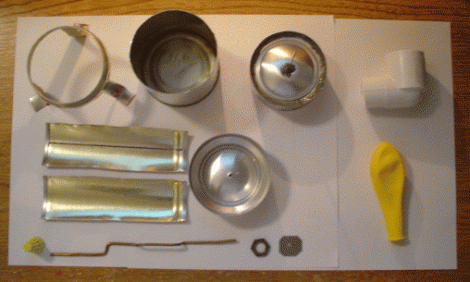
The Stirling engine seems like an odd-ball design when you’ve only encountered gas and Diesel engines. Even though the Stirling engine is piston based it doesn’t use valves. It has a sealed working fluid and no exhaust gas. Stirling engines aren’t very common, but are being produced commercially as cryocoolers and for use in solar farms. Here are some thorough plans for constructing a model Stirling engine from aluminum cans.

[thanks haq]

Continue reading “Stirling Engine From Aluminum Cans”

Magnetic Stripe Card Emulator

magnetic

This is a proof of concept magnetic stripe card emulator. Adron embedded a thin strip of metal into track 2 of the magnetic stripe. The ends of that strip are wrapped with thin copper wire to create a solenoid. The solenoid is driven by a PIC microprocessor and some transistors to boost the signal. The software provided can pulse a test pattern and any additional card numbers you supply.

Continue reading “Magnetic Stripe Card Emulator”