

Anyone who has spent any amount of time in or near people who are really interested in energy policies will have heard proclamations such as that ‘baseload is dead’ and the sorting of energy sources by parameters like their levelized cost of energy (LCoE) and merit order. Another thing that one may have noticed here is that this is also an area where debates and arguments can get pretty heated.
The confusing thing is that depending on where you look, you will find wildly different claims. This raises many questions, not only about where the actual truth lies, but also about the fundamentals. Within a statement such as that ‘baseload is dead’ there lie a lot of unanswered questions, such as what baseload actually is, and why it has to die.
Upon exploring these topics we quickly drown in terms like ‘load-following’ and ‘dispatchable power’, all of which are part of a healthy grid, but which to the average person sound as logical and easy to follow as a discussion on stock trading, with a similar level of mysticism. Let’s fix that.
Loading The Bases
Baseload is the lowest continuously expected demand, which sets the minimum required amount of power generating capacity that needs to be always online and powering the grid. Hence the ‘base’ part, and thus clearly not something that can be ‘dead’, since this base demand is still there.
What the claim of ‘baseload is dead’ comes from is the idea that with new types of generation that we are adding today, we do not need special baseload generators any more. After all, if the entire grid and the connected generators can respond dynamically to any demand change, then you do not need to keep special baseload plants around, as they have become obsolete.
A baseload plant is what is what we traditionally call power plants that are designed to run at 100% output or close to it for as long as they can, usually between refueling and/or maintenance cycles. These are generally thermal plants, powered by coal or nuclear fuel, as this makes the most economical use of their generating capacity, and thus for the cheapest form of dispatchable power on the grid.
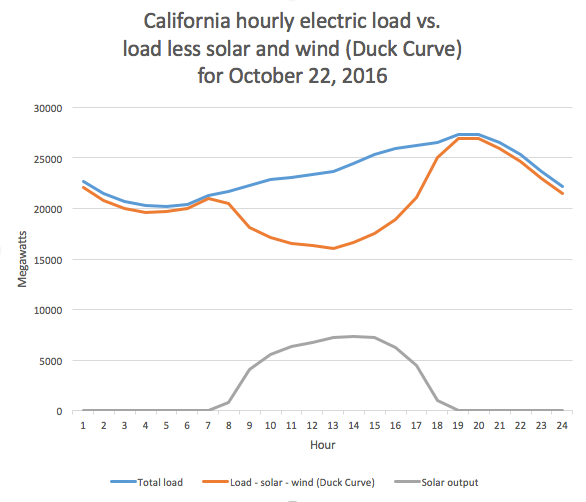
With only dispatchable generators on the grid this was very predictable, with any peaks handled by dedicated power plants, both load-following and peaking power plants. This all changed when large-scale solar and wind generators were introduced, and with it the duck curve was born.
As both the sun and wind are generally more prevalent during the day, and these generators are not generally curtailed, this means that suddenly everything else, from thermal power plants to hydroelectric plants, has to throttle back. Obviously, doing so ruins the economics of these dispatchable power sources, but is a big part of why the distorted claim of ‘baseload is dead’ is being made.
Chaos Management
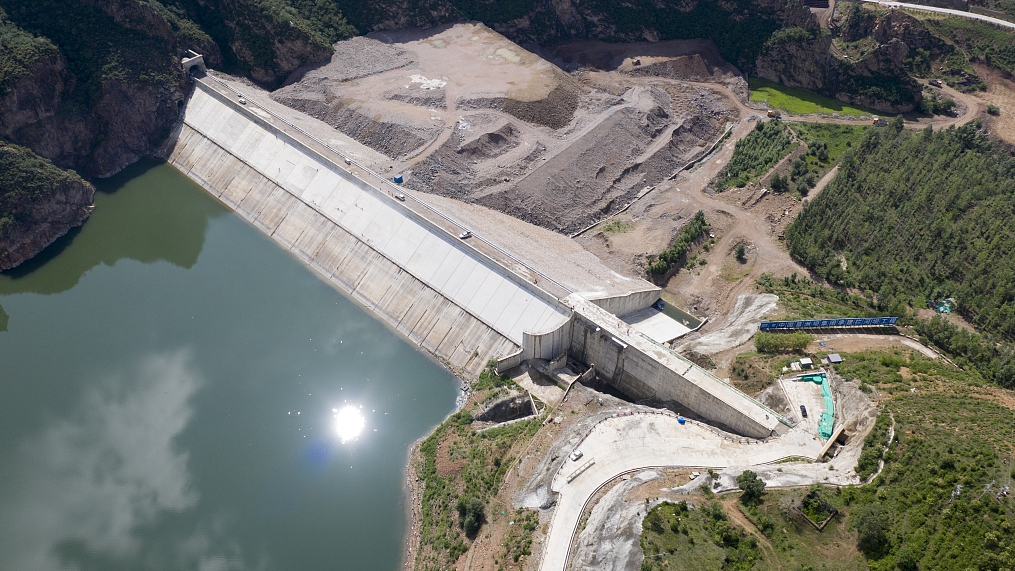
Suffice it to say that having the entire grid adapt to PV solar and wind farms – whose output can and will fluctuate strongly over the course of the day – is not an incredibly great plan if the goal is to keep grid costs low. Not only can these forms of variable renewable energy (VRE) only be curtailed, and not ramped up, they also add thousands of kilometers of transmission lines and substations to the grid due to the often remote areas where they are installed, adding to the headache of grid management.
Although curtailing VRE has become increasingly more common, this inability to be dispatched is a threat to the stability of the national grids of countries that have focused primarily on VRE build-out, not only due to general variability in output, but also because of “anticyclonic gloom“: times when poor solar conditions are accompanied by a lack of wind for days on end, also called ‘Dunkelflaute’ if you prefer a more German flair.
What we realistically need are generators that are dispatchable – i.e. are available on demand – and can follow the demand – i.e. the load – as quickly as possible, ideally in the same generator. Basically the grid controller has to always have more capacity that can be put online within N seconds/minutes, and have spare online capacity that can ramp up to deal with any rapid spikes.
Although a lot is being made of grid-level storage that can soak up excess VRE power and release it during periods of high demand, there is no economical form of such storage that can also scale sufficiently. Thus countries like Germany end up paying surrounding countries to accept their excess power, even if they could technically turn all of their valleys into pumped hydro installations for energy storage.
This makes it incredibly hard to integrate VRE into an electrical grid without simply hard curtailing them whenever they cut into online dispatchable capacity.
Following Dispatch
Essential to the health of a grid is the ability to respond to changes in demand. This is where we find the concept of load-following, which also includes dispatchable capacity. At its core this means a power generator that – when pinged by the grid controller (transmission system operator, or TSO) – is able to spin up or down its power output. For each generator the response time and adjustment curve is known by the TSO, so that this factor can be taken into account.
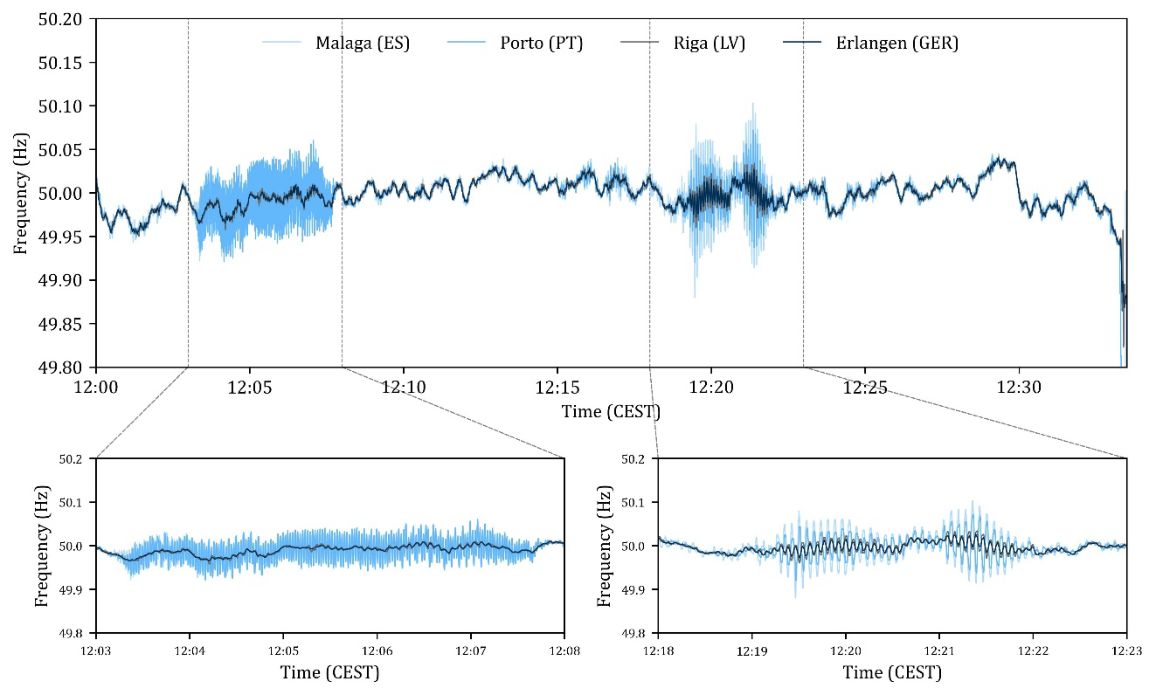
The failure of generators to respond as expected, or by suddenly dropping their output levels can have disastrous effects, particularly on the frequency and thus voltage of the grid. During the 2025 Iberian peninsula blackout, for example, grid oscillations caused by PV solar farms caused oscillation problems until a substation tripped, presumably due to low voltage, and a cascade failure subsequently rippled through the grid. A big reason for this is the inability of current VRE generators to generate or absorb reactive power, an issue that could be fixed with so-called grid-forming converters, but at significant extra cost to the VRE generator owners, as this would add local energy storage requirements such as batteries.
Typically generators are divided into types that prefer to run at full output (baseload), can efficiently adjust their output (load follow) or are only meant for times when demand outstrips the currently available supply (peaker). Whether a generator is suitable for any such task largely depends on the design and usage.
This is where for example a nuclear plant is more ideal than a coal plant or gas turbine, as having either of these idling burns a lot of fuel with nothing to show for it, whereas running at full output is efficient for a coal plant, but is rather expensive for a gas turbine, making them mostly suitable for load-following and peaker plants as they can ramp up fairly quickly.
The nuclear plant on the other hand can be designed in a number of ways, making it optimized for full output, or capable of load-following, as is the case in nuclear-heavy countries like France where its pressurized water reactors (PWRs) use so-called ‘grey control rods’ to finely tune the reactor output and thus provide very rapid and precise load-following capacities.
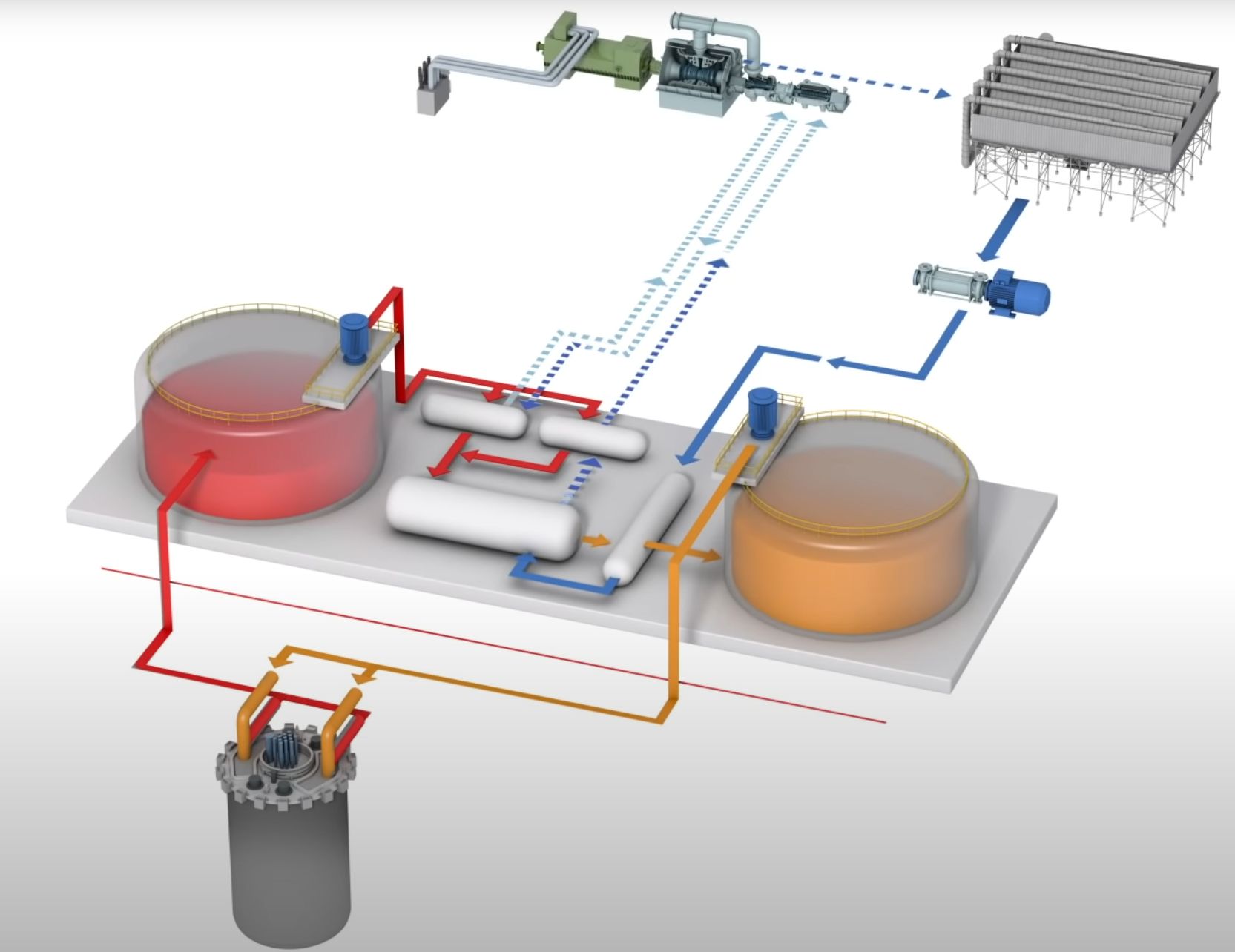
There’s now also a new category of nuclear plant designs that decouple the reactor from the steam turbine, by using intermediate thermal storage. The Terrapower Natrium reactor design – currently under construction – uses molten salt for its coolant, and also molten salt for the secondary (non-nuclear) loop, allowing this thermal energy to be used on-demand instead of directly feeding into a steam turbine.
This kind of design theoretically allows for a very rapid load-following, while giving the connected reactor all the time in the world to ramp up or down its output, or even power down for a refueling cycle, limited only by how fast the thermal energy can be converted into electrical power, or used for e.g. district heating or industrial heat.
Although grid-level storage in the form of pumped hydro is very efficient for buffering power, it cannot be used in many locations, and alternatives like batteries are too expensive to be used for anything more than smoothing out rapid surges in demand. All of which reinforces the case for much cheaper and versatile dispatchable power generators.
Grid Integration
Any power generator on the grid cannot be treated as a stand-alone unit, as each kind of generator comes with its own implications for the grid. This is a fact that is conveniently ignored when the so-called Levelized Cost of Energy (LCoE) metric is used to call VRE the ‘cheapest’ of all types of generators. Although it is true that VRE have no fuel costs, and relatively low maintenance cost, the problem with them is that most of their costs is not captured in the LCoE metric.
What LCoE doesn’t capture is whether it’s dispatchable or not, as a dispatchable generator will be needed when a non-dispatchable generator cannot produce due to clouds, night, heavy snow cover, no wind or overly strong wind. Also not captured in LCoE are the additional costs incurred from having the generator connected to the grid, from having to run and maintain transmission lines to remote locations, to the cost of adjusting for grid frequency oscillations and similar.
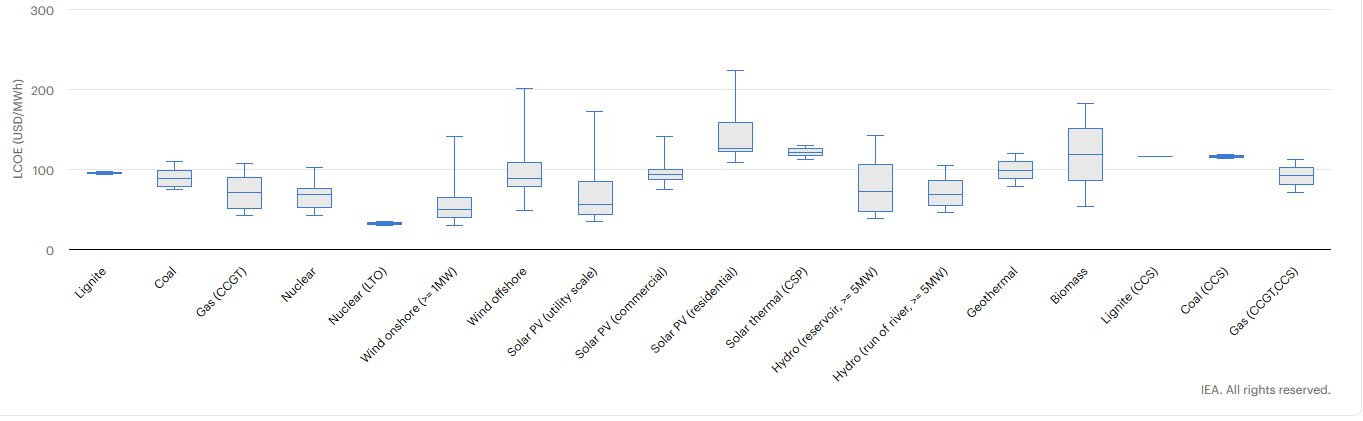
Ultimately these can be summarized as ‘system integration costs’, and they are significantly tougher to firmly nail down, as well as highly variable depending on the grid, the power mix and other variables. Correspondingly the cost of electricity from various sources is hotly debated, but the consensus is to use either Levelized Avoided Cost of Energy (LACE) or Value Adjusted LCoE (VALCoE), which do take these external factors into account.
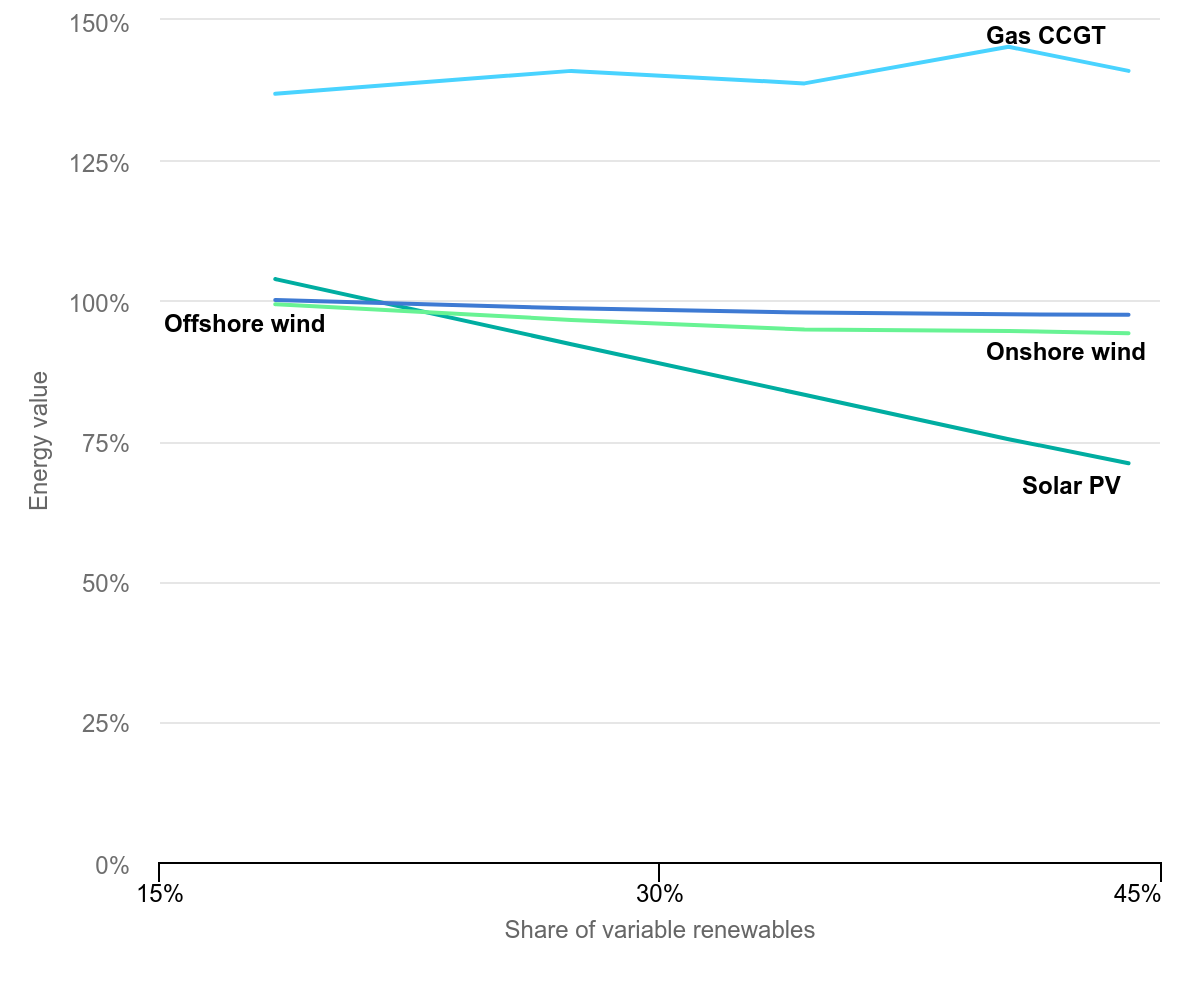
As addressed in the linked IEA article on VALCoE, an implication of this is that the value of VREs drop as their presence on the grid increases. This can be seen in the above graph based on 2020-era EU energy policies, with the graphs for the US and China being different again, but China’s also showing the strong drop in value of PV solar while wind power is equally less affected.
A Heated Subject
It is unfortunate that energy policy has become a subject of heated political and ideological furore, as it should really be just as boring as any other administrative task. Although the power industry has largely tried to stay objective in this matter, it is unfortunately subject to both political influence and those of investors. This has led to pretty amazing and breakneck shifts in energy policy in recent years, such as Belgium’s phase-out of nuclear power, replacing it with multiple gas plants, to then not only decide to not phase out its existing nuclear plants, but also to look at building new nuclear.
Similarly, the US has and continues to see heated debates on energy policy which occasionally touch upon objective truth. Unfortunately for all of those involved, power grids do not care about personal opinions or preferences, and picking the wrong energy policy will inevitably lead to consequences that can cost lives.
In that sense, it is very harmful that corner stones of a healthy grid such as baseload, reactive power handling and load-following are being chipped away by limited metrics such as LCoE and strong opinions on certain types of power technologies. If we cared about a stable grid more than about ‘being right’, then all VRE generators would for example be required to use grid-forming converters, and TSOs could finally breathe a sigh of relief.









One nice thing about the shape of the duck curve is that you can run an air conditioner heavily before 4 PM, when power generation often exceeds demand, and pre-cool your house at minimal marginal power generation cost.
Unfortunately, my local power company has time-of-use rates based on total demand, not net demand (the duck curve), so the prices are sensibly highest from 5 to 8 PM, but they’re also elevated from noon to 5 PM, at the bottom of duck curve, so you’d have to pre-cool before noon, when there isn’t as much solar generation, and your house won’t stay cool until 5.
It costs everyone more to get the math wrong. Ideally time-of-use rates would be based on real-time net demand. The smart meters they use have Zigbee radios that can broadcast current electricity prices so that appliances can adjust their settings to match power costs.
My power company is adding capacity charges, which means you pay extra based on the peak demand of the day, not just the time of day, so that prevents me from cooking and washing clothes etc. all at the same time while the power prices are low.
And for good reasons. If more people were chasing the spot price with variable loads, it would lead to a feedback oscillation. There’s a 15-30 minute lag in the system price updates, so too many people may switch on before the system responds to the increase in demand. Then too many people would switch off before the system can tell them that the price went down again.
Because the price doesn’t respond linearly to demand, and there’s no coordinated effort to manage demand, the whole system is prone to becoming unstable. Solving this would mean you need a central authority to ration energy and dictate how much everyone gets and when they can have it, which is obviously not a popular option.
That is, your peak demand, not the grid peak demand. The capacity charges apply to the household peak demand.
If I had an EV charger, it would also mean I’d have to limit it to level 1 charging only, and make sure I’m not using too many other appliances at the same time. Level 2 charging would hit the capacity charges.
While it is obviously impossible to use the price directly, one can define a correlation between frequency and price. Then a frequency counter is all you need to tell the actual price and the demand situation, instantaneously. Even better, one can sell the existence of a grid connected utility using power depending on frequency.
No.
Frequency changes reflect instantaneous power balance.
First derivative of load, not load.
Perturbed badly by anything falling over, stopping or starting.
Not the current system price.
Which is more about the current marginal unit’s bid into the pool.
You could adjust the last spot price based on frequency changes.
It would be a WAG, a neural net ‘fit’ at best.
Getting progressively worse as the spot prices age.
Frequency is also fine tuned at the end of the day, so the actual # of cycles for the day is spot on.
You’d get better data from the actual instantaneous voltage.
Yes.
yes, and Joe Average integrates this for the time between the bills, and the integral over the derivative is…?
Currently the system (or the business part of it) integrates over the price weighted by power used between the bills. The fine tuning of the grid time would work as usual.
No.
1. that swings about a hundred times between sqrt(2)V_eff and -sqrt(2)V_eff
2. (what you probably thought of) the effective voltage doesn’t tell you about the load, but about the impedance of your connection point.
You forgot that local frequency changes do not reflect the state of the entire network. Different points of the network lead and lag each other by varying amounts depending on the amount and direction of power flow, and as the flow changes the local frequency goes up and down to build up that phase shift.
The power utility is looking at the entire regional power pool to determine your price, while you’re seeing only the end of your own branch.
… are small and short time, and appear as a result of load changes, to adjust the phase shift corresponding to the new load pattern. If this local frequency change is outside the no-adjust range mentioned in the other comment, you already are in big trouble (but it may be a good idea to simulate such a condition before deploying the new system).
Frequency is not linked to price. The price is set ahead of time separately on a bidding market, and the frequency follows what the system operator wants it to do. The grid can maintain 50 Hz bang on no matter what the demand – it just costs more money.
E.g. if you assume that higher frequency means oversupply and lower prices, you’d be wrong, because the utility may be deliberately pushing more power in order to keep the daily average frequency from drifting too far off 50 Hz. If you would start drawing more power, you’d be doing so against rising prices.
Yes, currently frequency and price are not linked, but if you want to leverage the price to move load, you kind of have to do that. Pushing the frequency for time keeping would then include announcing a different price/frequency coupling coefficient, maybe a frequency range with no price difference in which the time keeping utility can adjust unaffected by the ones watching the price. (Currently the no-adjust frequency range is +/-10mHz, in which the timekeeping works. One could easily stick with that, e.g. no price difference within 10mHz of mean frequency.)
Or you could just communicate the price directly to the users without having them guessing by measuring something which may change for any number of reasons unrelated to the signal you’re trying to send.
I.e what they’re already doing. The fundamental problem is still that the price doesn’t change instantly in lock-step with the true supply and demand situation, yet it’s feedback coupled to it.
that is much too slow for regulation: you need to determine the actual power needs, encode them into a price signal, encrypt in a secure way, transmit to thousands and millions of consumers (with all the latency of a bad internet connection), it must then be decrypted, verified and acted upon — the same moment this scheme has a measurable effect on grid scale, you get oscillations so bad that you probably have a widespread blackout before being able to send a second price signal
Actually at the moment the price/frequency coefficient is determined on a 15 minute base and a 60 minute base, and the power delivery is adjusted by measuring the frequency. What would be new is that not only some power plants may participate, but everyone. Only problem is, no one is offering such contracts to the consumers (the benefit is too low, too much administration compared to the actual situation). It is much more profitable to sell “smart” whatever, because a lot of people pay premium (or are mandated to buy), because new and computerized is always so much better. I don’t even believe in data selling schemes, there is much more useful data already available at lower cost. You just have to keep the smart part out of the central regulation loop.
Yep, and for that you need information of the entire system, and a prediction of what it’s going to be doing in the next 15 or 60 minutes, which you cannot have by simply measuring some local variable like grid frequency or voltage.
Which is the entire problem. Load response by feedback does not stabilize the grid – it destabilizes it – or more appropriately, it creates feedback resonances that can be triggered by grid events.
The reason for having such feedback is in the attempt to avoid cost by having the consumers adjust to the availability of energy, which reduces the value of the power to the consumers because they can’t use it when they want it. It’s an attempt to mask the problem of VREs by pretending that the problem itself is a solution. It’s far better if the users simply get an hourly price, or a fixed price, than any attempts at making the demand follow the supply which is trying to follow the demand….
Besides, if you want to use the grid frequency to signal system price, you have to do so by adding or removing power, which affects system price…. So you’ve got this double triple nested feedback going on to deliver real-time information to the consumer.
The real problem isn’t how fast you’re updating – the problem is the feedback itself. To kill the oscillations, you actually need to damp the response, which means slowing the system down. That in turn means it cannot respond in time to the rapid variations caused by VREs: you have to make a compromise between response time and tendency to run into oscillations.
… which frequency is, and voltage is not. The 15 and 60 minute price reflects, how much error in the predicted power balance is expected, the regulation itself only follows the frequency.
Every regulation uses feedback to stabilize the regulated value, dead time until response destabilizes the system. And response via price alone has an awful lot of that.
so we fully agree on what I said in my first comment in this thread
That is done by rotating masses (or other components acting like rotating masses) and components naturally reacting to frequency changes. The corresponding metrics on grid scale are Anlaufzeitkonstante and Selbstregelkoeffizient (don’t know the proper translations out of my head, sorry). Consumer reaction to frequency improves the second one.
Wonderful piece Al, seriously. Great to see some objectivity on the energy front, and the explanation was clear, but detailed enough to keep my interest. Completely unrelated, I think you meant “incurred” here:
additional costs occurred from having the generatorThanks, fixed that typo :)
I did a word search on this article and batteries comes up twice. Just as solar was once thought to be too expensive and not widely applicable, batteries are similarly thought of. Based on what is happenning in China I believe batteries will plummet in price and change the economics of centralized power generation and grid sizing.
Yeah, the new sodium ion batteries are a game-changer and the west is largely ignorant of them so far. And no, I’m not talking about the ones you can buy on amazon.
They would have to be truly cheap to solve the issue I outline below. Not just marginally cheaper, but 10-20 times cheaper on all metrics, money, energy and materials.
There are also batteries that run on iron and water. Basically it’s reversible rust. Those are cheap materials.
With energy densities roughly in the 20 Wh/kg range, they need to be cheap because you need a lot of them. If state of the art lithium batteries can reach 300 Wh/kg then it’s roughly 15 times more batteries. So again, it needs to be 10-20 times cheaper just to meet lithium, and after that you need to solve all the other problems.
Other disadvantages include high overpotential in charging, which leads to relatively low charging efficiency around 65%, and then high self-discharge rate of around 20-30% per month which further reduces efficiency in use and prevents seasonal load shifting.
In personal use for an off-grid home, it’s a robust and effective technology, but you do have to mind the limitations. It lasts practically forever, but it throws away half the energy you put into it.
‘Throws away’?
100% efficient at making heat!
Same as incandescent lights.
But yeah, ‘batterie’s everywhere for everyone’ people are innumerate hippies.
I’m holding out hope that flow battery tech (such as the iron and water battery you mentioned) will mature to the point that it solves the scalable grid storage problem.
They are much more serviceable. Power and energy can be scaled independently (more cells or more tanks). There are flow battery chemistries that use cheap and relatively safe electrolytes too.
Batteries have two open questions: the fundamental technology, and whether our supply chains can keep up with demand. Even if it’s cheap enough, making more really fast is going to cost money because the price of a battery must pay for making two, three, however many more going forward in order to keep scaling up.
And, there is one more hidden gotcha with batteries, which is ESOEI or energy stored per energy invested. Thought otherwise, it can be seen as the energy efficiency of a battery – depending on its use.
Batteries reach maximum ESOEI when optimally utilized. If you only ever charge and discharge a battery once, the energy used to make it is far greater than the energy you get to store, which means the energy efficiency is extremely poor. If you try to charge and discharge the battery extremely fast to get as much through as possible, you wear out the battery rapidly and don’t achieve as many cycles as the technology would permit.
Taking lithium batteries as an example, the energy cost is somewhere between 200-400 charge cycles, and the endurance is somewhere around 3000-6000 cycles optimally loaded. In other words, the best ESOEI case represents around 95% energy efficiency. If cycled daily, it also represents about 8 – 16 years of use which matches the technical calendar life of the battery, although a compromise has to be made between cycling and calendar life – but, to simplify the argument let’s ignore that and assume both can be achieved at the same time.
Now, the point is: a relatively small number of batteries is needed to bridge daily variations and gaps in production. This is manageable. More batteries are needed to deal with longer term variations to average VRE production over a week or two – alright, but that also means the bigger battery is charged and discharged much slower, achieving fewer charge cycles within its calendar life. Instead of 3000 – 6000 cycles it now reaches 300-600, which means the energy spent to manufacture it eats into the efficiency and drops it closer to 50%. Go further, into even larger batteries for larger amounts of energy to shift production from summer to winter, or from one year to the next year, and this huge battery now gets cycled only 8-16 times before it ages out and has to be replaced, which means the efficiency to do so is around 5% at best. You spend far far more energy to make such batteries than you ever get out of them, yet they present a huge part of the energy system, dealing with a quarter to half or more of the total energy we would consume because of the mismatch between when energy is most needed and when it become most available.
This is part of the cost of scaling up, or the marginal cost of adding one more percentage point of VREs on the grid. Even if the cost of batteries goes down, scaling up causes the efficiency go down, which means we need to have more batteries and more VRE generators, which negates the gains.
There are technologies that don’t have this issue, that have fixed costs per unit of energy stored over unit of time, such as turning the output of VREs into synthetic hydrocarbons – fuel – which is inefficient but gets better with efficiencies of scale. Crucially, it is far more efficient over the time scale of months to years than any battery system is likely to become, so we might just see our excess output from VREs turned into synthetic oil and put in big storage tanks to be used in the winter during Dunkelflaute, because it’s simply more efficient overall.
Also note: the popular narrative is talking about battery endurance in terms of cycle life, rarely in calendar life, because that’s the nut they haven’t really cracked yet. Degradation of the materials simply by time hasn’t gone up the same as specific energy or cycle endurance.
So when you see someone saying a Tesla battery goes for a million miles – sure, if all you’re doing is driving all the time. For the average driver, 15k miles by 10 years is 150k miles. If the optimum efficiency of the battery would require that million miles, you’re going to be falling way short. If 300 miles is one cycle, then the battery gets 500 cycles only before it gets scrapped. That’s awfully close to the amount of energy that it took to manufacture the battery in the first place.
It means the true efficiency of it is somewhere around 55-70% and not 95% as would be assumed by optimal use. Add in other systemic losses like grid and charging efficiencies and you can scale that down even further. It starts to become comparable in efficiency to some high efficiency alternatives to BEVs, such as solid oxide fuel cells (SOFC) using synthetic fuels. It would still be good – but – if we were also going to be storing massive amounts of energy as synthetic fuels anyways, there’s a high chance that BEVs turn out to be just a transitional technology and we’d go back to driving on liquid fuels. It would simply make sense, as using the BEVs would be indirectly consuming a portion of those synthetic fuels anyways, so you might as well skip the battery.
Synthetic fuels close the loop and use existing infrastructure. Bridge or just stick with natural gas for the 5-10% of electrical generation not cheaply supplied by solar, wind, and short duration batteries, existing nuclear, run of river, etc. 90% clean is sufficient until other issues are addressed. Overbuild the cheap renewables to create seasonal abundance and fill the gloom with energy dense and largely lossless fuels. Also add high efficiency transmission. These all become reasonable alternatives to the exponentially costly cycling dilemma of batteries and extreme overbuilding. They would also prove valuable investments for many other reasons.
That’s an important point. By closing the loop, we mean the ability to use the energy to manufacture the materials that went into building the generators, such as steel, glass, semiconductors, diesel fuel for long haul transport, mining… electricity is not directly useful in many cases.
Strategic reserves being one of them. If your energy system is operating hand-to-mouth with battery reserves lasting only days, a big hurricane or a war can bring you completely to your knees because you run out of energy before you can repair and rebuild. Getting power to a disaster zone using batteries is a difficult proposition.
Nothing is happening in China. And even if it is, a price plummet in 10 years doesn’t help for designing the grid for today.
erm the point of the article is that solar IS too expensive and not widely applicable. The only way it stops seeming so is via greenwashing and silly ignorant measurements. Batteries? saaaame deal.
I feel like the ideal solution to things like solar variability is for every country on the planet to connect their electric grids together and spread solar farms worldwide. The sun is always shining on half the planet afterall and transmission losses don’t matter if the electricity is effectively limitless.
That is unlikely to ever happen. It’s a hard technical problem to transfer the amount of power needed from say Americas over the oceans to Asia and Europe-Africa. And then comes the War aspect. Few countries would give other countries that power over their civilisation, and the last few years have made it clear that large countries can’t be trusted to play nice on the world stage, and that ‘accident’ happens with pipelines and undersea cables.
That’s why it’s the ideal solution and not necessarily the practical one.
Though I think the technical difficulty might as well not exist compared to the political difficulties. Also I think the issues of cable accidents is also rather minor considering the group could punish countries attacking the grid with removal. But that “benefit” would also be why no one would really join up because it could be used for all actions that are disagreed with.
That’s basically the DESERTEC plan.
It had this little problem of neo-colonialism over areas in North Africa and Middle East that would have to be controlled with an iron fist to stop unfriendly regimes from simply bombing the solar farms and transmission lines.
No, I don’t think that lines up.
You don’t need worldwide grids, just across hundreds of km is enough.
The Natrium design is like putting $2000 worth of supercapacitors in front of your $20000 battery to avoid stressing or over cycling it.
It has been quite interesting in Sweden this winter, and completely predictable. Been minus Celsius all January and looks to continue, and the lake ice in southern Sweden is 20cm thick. Thick clouds were you can’t tell where the sun is, and low or no wind for most of the time. Solar panels and Windturbines have been pretty much useless, which happens most of our winters, when we really need electric power. And this applies to a lot of neighbouring countries too.
Was actually in the news last summer that large windfarms in the north are not economical, and one was selling for 0.1€ per installed Megawatt hour. No takers. Because no longer any subsidiary, and they would have to be maintained since they’re getting old, blades need replacing, and the cost of scrapping will be very high. Many wind farms have cost money during winter, since they’re need to be heated and supplied with some power when there is no wind.
Sweden could have way more electric power, lower prices and such, which would help introduce electric cars, charging at home and more environmentally production of steel and such. Certain people just don’t like what that actually means and work hard to block that. The Environmental Party have worked hard to destroy Hydro power for the last decades, and of course Nuclear, when hydro power is basically the least worst option for the environment. They don’t want to actually say loud that we might need to rebuild some of those dams they hate, and their suggestion about pumped hydro to work as storage for wind and solar of course means building large dams, in places where the might be a certain rare frog or such, since it sort of need to be close to where that power is needed. Because of course power lines are evil and ugly. Their plan of large scale hydrogen storage charged by wind and solar, and biofuel like ethanol and biogas, have predictable issues, especially on the scale needed and normal climate. Somehow they think they can double the energy production to 2030 or latest 2035. Their motto is still ‘renewable energy, is cheap energy and faster to build’.
Well, not if it won’t work. We have slowly tried their plan for the last 40 years, and look where we are.
To add injury to insult, a wind farm standing still at -20 C calm consumes megawatts of power to heat the hydraulic oil and the blades to keep them from icing over and the bearings and generators from seizing up.
If only the Social Democrats hadn’t replaced the board of Vattenfall with their party members, and then at the behest of the Green party upped the tax on nuclear power. Who could then have predicted that Vattenfall (owner of the Nuclear reactors in the south, where most energy is needed…) would declare nuclear power is no longer financially viable and thus decommissioned very early (in fact just shortly after some renovations had been done) 4 reactors, whilst at the same time the Social Democrats could proudly declare they didn’t close the reactors, it was 100% Vattenfall’s commercial decision.
Yes the party of red is very good at telling little lies, which are told sufficiently that they become the truth :)
sometimes I feel like we in the US don’t appreciate Europe’s (esp Northern Europe’s) struggle on renewables enough. in most areas, y’all have little going for you on energy, frankly, but you’re still trying, and trying a lot harder than we have to. all I do is slap some solar panels in the yard to a modest LFP setup w/inverter. my big project I very much want to try out and document is to run a house entirely on DC with low-voltage (per electrical code) 48V rails going throughout the house, using RV/marine appliances — but this is a few years off for me, still, but I think it is entirely feasible.
of course, this also means we have incredible potential here for an economic transition, but we are presently busy with facebook for AI agents and desperately trying to expand enough coal & LNG turbines (and experimental NPPs) to power them.
As the demotivator says:
‘It may be that the purpose of (Sweden/Germany/Spain)’s energy policy is to serve as a warning to others.’
Don’t listen to the greenies or this will happen to you!
It’s going to be a bad time when those “renewable” generators are experiencing a calm, cloudy day.
There is never a calm, cloudy day everywhere unless you are a very small nation.
Sure but there’s a cost in transporting energy from A to B, and I don’t mean just $$$s. Where I am local peeps and environmental groups killed a transmission line project to bring hydropower from Canada to the New England area. The route needed to go through a beloved scenic area and was opposed by locals who saw little to no benefit but would have borne the “cost” of ugly deforestation and towers. Probably a bunch of loons also worried about EM radiation mutating their DNA.
Environmental groups opposed the cutting of trees and that the electricity would come from hydro generators, now deemed bad for the environment. There were other concerns as well and the project was killed in 2019.
So the clear, rational answer to move power from A, where it’s cheap and relatively environmentally conscious, to B, where those aren’t true, isn’t always possible in the real world.
And thats a cost we always bear. You think they built coal or nuke plants on every corner? Youur argument doesnt make sense past about 1920 and before any grid was built. We’ve already proven the ability to move electricity around the country between widely separated states economically.
ok so why was it stopped?
100, even 50 years ago, building infrastructure through communities and nature was easy. Want to build a motorway straight through the middle of a city? No problem. Submerge a town to create a reservoir? Go ahead! Build power lines everywhere? Who cares?
Try that now, and you have nimbys (in many cases with very sensible arguments) but also those that object with less than credible reasons but manage to stop infrastructure projects.
Pretty much. The average grid transmission distance from power plant to house in the US is somewhere between 100-200 miles. The actual median distance between a generator and a consumer is probably closer to 20 miles, but the long inter-city and interstate transmission lines skew up the numbers.
Most people live close to some smaller generator, like a 50 MW gas turbine or a coal plant where those still exist. If I draw a 20 mile circle around where I live, I can find at least three thermal power plants that burn all sorts of stuff.
The trick is, the consumers aren’t distributed randomly. They’re usually concentrated in these things called towns and cities, which are usually built around some sort of industry or commerce that uses power and usually generates it as well, because transmission adds cost and losses.
The nordics are currently asking you to hold your beer…. What’s that, 0 wind this week? Winter it the north? So no solar then either (not helped by panels being covered in snow either for the few rays that do make it down).
Another interesting consequence of variable renewable power, and the speed at which it varies, is that hydroelectric turbines in Norway are experiencing turbine failures due to having to adjust too rapidly.
https://norwegianscitechnews.com/2015/05/preventing-hydropower-turbine-failure/
Gee when you start to operate infrastructure equipment outside its design it fails earlier, who woulda thought?! facepalm Turbine blades installed in the 60s and 70s have depreciated long enough to be worthy of new designs and replacements that are properly designed for the new task.
@daveb
Who should then pay for this? The turbines are still good for what they were originally specced for. Thanks to somebody else’s bright ideas they are having issues. Seems like the renewables ought to foot the bill for early replacement of turbines (or at least a proportion based on any scheduled future replacement) but yeah that’s not going to happen.
Indeed. The trouble is, even the new blades keep failing because it’s not a trivial task to design a turbine that can withstand rapid repeated pressure variations.
Besides, it’s not just the blades – it’s the entire turbine from the gates to the pipes and turbine housing that needs to be re-designed to optimize for rapid adjustments.
https://www.researchgate.net/figure/Average-distance-and-correlation-coefficient-for-the-first-derivative-of-wind-speed_fig3_293314128
There is significant correlation in wind speeds over large geographic areas. Two locations A and B must be around 600 km apart before the correlation disappears, i.e. they’re not following the same weather front. That doesn’t mean both places can’t be calm or windy at the same time, and it fact this regularly happens anyways – it’s just going to be random.
To leverage the argument that it’s “always windy somewhere”, you must go further out because you want negative correlation, i.e. when one place is calm the other is windy. That only happens at continental scales. Even Texas isn’t big enough for that alone.
If you take Northern Europe as an example, from northern parts of France and Germany to the Baltics, up to Finland, Norway and back through the UK, combining all the wind power available in that region only reduces the variability of output by half. If any one location might switch between 0-100% the whole area combined would swing between 25-75% for the average day assuming linear distribution. Wind power does not have linear distribution, but more like 20/80 distribution where 20% of the time you get high power and 80% of the time you get low power or no power. It’s “peaky”, so the effect is rather that increasing your area of distribution means overlapping many narrow spikes as the weather front advances over many wind farm locations. Eventually that starts to smooth out, but not until you have truly vast collection areas.
You don’t need to have precisely calm zero wind days to get into trouble. If the power grid is operating at -20% from the demand, that is many gigawatts of missing power and there’s going to be a big panic and a scramble to get more from anywhere and anything with spot prices shooting through the roof. If the situation is expected to last a few days but no more, that’s even worse because the mothballed coal plants and other big fossil fuel generators take just as long to boot up and then have to be shut down again, so they can’t be used.
“It is unfortunate that energy policy has become a subject of heated political and ideological furore, as it should really be just as boring as any other administrative task”
Not really. It’s the plan.
It’s clear that the future is about spot pricing.
And we’re just tying yet another fundamental human need to financial wealth so conglomerates milk us for profit.
It’s all bulltish.
two things.
that graph looks completely different in another state that doesn’t have sunny weather 98% of the year and mountainous desert regions with ample updraft.
solar works during the day when all your industry is operating. its actually a pretty good complement to baseload where it has high availability. then burning natural gas for the other 2% isnt such a bad deal.
its easy too look at this problem with california colored glasses and argue how backward everyone else is. but other people in other places need other forms of power better suited to their local. if that’s unavailable nuclear/coal/gas is always there. if you have access to a renewable so much the better, but not everyone does.
” if you have access to a renewable so much the better, but not everyone does” : If only this truth could be imprinted into the brains of politicians everywhere. As I posted elsewhere in this thread, it’s hard (technically) enough to transport energy from A to B without the politics getting in the way. MA and other states try to emulate CA in being “green” but lack the natural resources to effectively do so. Yet they try, imposing huge costs in the effort. It’s all vanity.
Don’t let perfection be the enemy of good.
High demand industry, such as steel and aluminium production, making cement, etc. operate around the clock. They can’t easily modulate the energy demands of the process, because doing so would mean the converters run cold and require extra energy and time to restart after a pause. By the time the heat is back up, it’s night again and the supply goes away.
Indeed, the best place to use fully renewable power for industrial activities such as aluminium smelting is one where hydropower is overwhelmingly available. That’s why here in Europe Norway is the best place for such smelters, which are generally located near a few of such big hydropower dams to also save on transmission costs and increase reliability.
That’s an economic choice more on the point that hydroelectricity in Norway is dirt cheap, because the entire country is one big mountain with rivers flowing everywhere.
Norwegian hydroelectricity costs between 0.2 – 0.9 cents at the generator. The world average is between 3 – 6 cents, give or take the exchange rate between USD and EUR.
Long as droughts are under control, then hydro will be viable.
Unfortunately droughts are not under human control.
Invariably (in the past) the local area sucks up the power and the dam is no longer producing surplus (e.g. Grand Coolie damn in the USA was basically attached to ALCOA for decades).
The big old hydro project in Iceland is nice as they just can’t F fast (protip: slow) enough to raise their population and suck up all that power.
Also Dude isn’t exactly right about aluminum smelting, it needs a ‘baseload’ amount of power to keep the cells from freezing off, but beyond that the load is ‘dispatchable’.
About 75% of the maximum load is variable, assuming it was built to do it, but they all are.
‘Dispatchable load’ is a real world thing for decades now.
Sometimes it’s binary, but often analog, like aluminum smelters.
They bid into the pool, pay us $ to curtail our use.
For things that make a big mess when losing power, they bid a very high price.
Or build their own generation and play from that side too.
At some point the poors will get into the act, pay us to turn off our power.
They call it the ‘peak corps’ here, but only cut AC, that will change.
Protip:
The curtailment boxes on the AC power line use RF.
You can get the better rate and stay cool by wrapping the box in used deflector beanies.
Most hydro can be thought of as a fixed total power source per year, based on the water available in the year.
They aren’t freely dispatchable, at all.
Minimum flows (river can’t run dry).
Maximum flow rate of change (no walls of water or air).
Periods of required low flow, to support migrating fish downriver.
Europe largely has the wild salmon problem licked (almost gone).
Also some hydro is not dispatchable at all.
Just run of river.
When I did grid modeling, we generally broke each hydro unit in two.
One ‘run of river’ variable baseload, one constrained dispatchable w total power per ‘dry season’ (which can be all year in some places).
In some cases, after analysis, one of those was small enough to be ignored.
Also they cascade down river systems, which further constrains them, some have no pools and just run at the dispatch of the upstream units.
Those are generally best wrapped into one combined generator, to give the model a break.
Digressing again.
It’s mighty expensive to keep using 25% of the load and produce no aluminum for it.
If you want to run the process on VREs, you’ll be spending the majority of your time doing just that: waiting for the sun or the wind. After all, half of every day is night, and you get 1-2 good windy days in an average week.
was mostly more on about california being a very convenient location for renewables while being able to draw power from hoover dam in nevada. they are kind of well situated sort of like in the way how steel manufacturing in pittsburgh was conveniently situated between canadian ore and appalachian coal. too bad we let it rust. geographical convenience is a huge and under represented factor.
On relying on the Hoover Dam, you can build as much renewable power as the dam can… you know, dam. Once the gates are shut, the power can go no lower. Likewise, it cannot replace more than its capacity of renewables. Hydroelectricity also has the issue that the river must flow, or the dam will overflow. To let VREs in, you must lower the level of the water to create headroom in the reservoir, which means the efficiency and power of the dam are reduced, and the up and down level of the water will result in faster erosion and filling up the dam with silt.
Then there’s the issue of yearly variations in water availability, and the timing of that. Hydroelectric plants too are variable, so the amount of “adjustment” you get out of them depends. Often in springtime, you get too much water, and you also get high winds and plenty of sunshine coinciding with low demand between the heating and cooling seasons, so everything is pushing power at the same time and nobody’s using it.
Interesting point there is that California actually has countless gas turbine plants, to the point where they brought mothballed units back despite violating environmental regulations due to a lack of capacity on the grid. California is also importing a lot of power from surrounding states.
So yes, technically there’s a lot of of very reliable solar in CA, but even there it causes mostly big problems with grid management, drives up electricity costs and results in a dirtier grid than if they had simply kept their existing nuclear plants open and built a few more big plants.
The irony is thus that CA doesn’t work even as a best-case scenario for VRE, never mind a country like Germany, which has the dirtiest grid in the EU after mostly-coal-power Poland.
Not only gas turbines, they’re building huge 50-150 MW diesel engines that run on natural gas and a squirt of fuel oil to ignite it. Engines the size of a small apartment building are used for rapid load following, because the up-ramp part of the duck curve is too steep even for gas turbines.
I remember listening in to the conversation back in the day, this was over 20 years ago, and the Republicans basically said: if you’re going to transition the grid to wind and solar, what you’re actually doing is transitioning to 80% natural gas power, because of the low capacity factor of the VREs. That’s also why they didn’t mind the transition and largely didn’t vote against it – it’s just business as usual for the fossil fuels industry while the urban hippies and rich techbros pretend to be green.
Capacity factor is the average over nominal output, and you can’t build your nominal capacity much beyond what you and the neighbors can buy when it happens to be producing at full power, so what you can technically fit in the grid can never supply more than a small part of the demand. All the rest of it has to come from rapidly dispatchable sources such as gas turbines.
To add to the absurdity, California is also placing policies that ban gas appliances in newly constructed homes, so the people would have to buy the electricity, which uses 2-3 times more natural gas to generate because that’s where it’s mostly coming from.
It’s nominally 52.7% renewable, but that’s just accounting, because much of the VRE power is exported to the neighboring states, yet counted as if it was actually used in California.
Speaking of a ‘base load’ this article is a base load of bs.
Theres lots of scalable power storage coming online. From heat, to pumped hydro, to battery and more. Trying to posit nuclear as being in any way affordable is just daft and only someone thats overly influenced by their investment money and lobbying would write otherwise.
A lot relative to almost none before, but on the grand scale of things it’s just not very much.
The yearly US electricity demand is 4000 TWh and rising as we transition to electrify everything that was running on fuels before, which is about four times more. Covering just 1% of that with batteries is 40 000 000 megawatt-hours so you’ve got your work cut out right there.
The biggest batteries we have built so far are measured in the hundreds of megawatt-hours, and pumped hydroelectric dams in the single gigawatt-hours, so we’ve got to scale up by a factor of 1,000-10,000 and do it rather quickly just to make a tiny difference.
Thats misleading however because those tools are only ever intended to be interim solutions. They’re not even being considered for taking on that full electricity demand. Those batteries don’t have to big enough to do that they have to be there for long enough to make up for demand exceeding supply until another form of supply can be put online.
Also.. we dont ‘have to’ scale up by a factor 1000s.. we can also put limits on the one factor thats putting the majority of the strain on the system and porting public money toward private profits, that being AI data centers. Put limits on their consumption and/or make them pay for renewable methods to supply that consumption and you get a better future than any other option.
Again, one day of backup power on the grid is around 10 million megawatt-hours of batteries. That is the interrim solution you’re reaching for, the bare minimum hand-to-mouth situation that can meaningfully reduce the reliance on fossil fuels to keep the lights on.
you didn’t read it, obviously. the whole point is that the LCoE measurement used to say nuclear is so expensive is total BS.
Short version: When politicians, greenies, climate priests, and scammers overrule the engineers who have to keep the world working reliably and efficiently… shyt goes sideways. I’m pretty sure that [ignored] grid engineers have been warning for decades that free energy isn’t
Yeah I want to know if the people who have been baselessly chanting “base load is dead” (for obvious ideological reasons) have any connection to the people who convinced Germany to close all their nuclear plants, and if so how can we remove them from power and keep them away from power indefinitely, and also pull every dollar of funding from the grad school programs they oozed from.
Unfortunately at least in Sweden it’s looking like this years elections are going to be a poop show, and I’d hazard a guess it’s not that different elsewhere in Europe. The basic idea being the Greens and right/nationalists are polar opposites of each other. What this boils down to is when the tick/tock of governments goes from the right to the left we end up with needing support of the greens to get policies passed – and that doesn’t come for free. So we get their wonderful dreamy ideas propagating into reality, like scrapping nuclear and covering the planet in ‘green’ windmills.
This, in Sweden is simply crazy as the current government wants nuclear and put out support in the form of loans for companies willing to build. But who would be stupid enough to build a nuclear reactor that the next/next+1 government will want to shut down before it gets near completion.
The Social democrats who used to have a majority for decades are now still the leading party but with around 30% and with the lefty parties and the centre party hover around 50%. They say they are pro-nuclear (having declared at the last election 4 years ago that nobody wants nuclear as it’s too expensive, i.e. don’t vote right if you want cheap electric haha). As they need the support of the greens, how will that then work? Then the centre party say they won’t join a coalition with the left party, so yeah post September will be fun!
Politics is like riding a bicycle. If you want to turn right, you can’t just turn the handles clockwise because it’ll sweep the bike from underneath and you’ll fall face first to the left. You have to turn left first to counter-steer, because the government moving left moves the political center-of-mass of the population towards the right in relation.
When the government moves left and, the people become disillusioned about their arguments and their attitudes move away towards the right. That is when you start turning the handles towards the right to pick up a new trajectory that way. In fact, if you don’t turn back hard enough and instead follow up with a sort of lukewarm centrist “let’s everyone be friends and make deals” compromise of a government, the people might run ahead of you and start forming far-right parties of their own.
If you’re in a gridlock trying to wrestle between split public opinion, reversing policy cycle after cycle and causing economic and social paralysis…. then let the socialists mess it up real good. Give them the rope to hang themselves with. As long as their politics are based on no sound principles, and they’re simply whining about some made up injustice and blaming the opposition to get elected, they’ll fail instantly when given any power and responsibility.
Works both ways. If you want to get rid of a populist right wing party, give them the responsibility of government and watch them make complete asses out of themselves.
Flagrantly leaving out the actual cause of politicization of utilities. Also buries the lede by doing that thing where you pretend to occupy the unbiased default. As if “how an entire country produces all their energy” is a subject which will ever be politically neutral, detached from the dirty world of how groups of people compete over finite resources and the future. That particular trick is starting to look more and more disingenuous.
so is this along the lines of Germany completely abandoning nuclear energy and paying the price for it? or is this along the lines of “climate change doesn’t exist hurr hurr.” kind of politicization?
Whether climate change exists or not, or whether the renewable energy policies actually accomplish any CO2 reductions is neither here or there, because the point of it was never the climate to begin with. The point is gaining political power and making money with it.
There’s a reason why they say “green on the outside, red on the inside”. It’s not just American political paranoia; most of the anti-nuclear sentiment in western Europe and in Germany in particular was spread by Soviet/Russian gas and coal salesmen, whose interests just so happened to align with the aims of the budding VRE industry lobby and the green political lobby, or groups like Green Peace. It’s had to tell exactly where one group ends and the other begins.
All of them were and still are trying to sabotage the system to force their own. All of their interests join on the point of centralized state control of at least parts of the economy, justified as environmentalism. That’s why we get useful idiots like Greta Thunberg whose point isn’t thinking about useful solutions and constructive criticism to solve the energy and resources problem, but using environmentalism and humanitarian narratives as an excuse for anti-capitalism.
Never mind the ‘murkin unit, how can you trust AI when it can’t get a football field length (of any continent) correct? That’s gotta be be one of the simplest things to be correct about, even for AI, and it blew it.
Also speaks poorly of the person who posted it, for not immediately recognizing it as idiocy.
Bogan rules.
Football oval 135-185 meters long, 110-155 wide.
Full kegs on sidelines, must be drained during game or team disqualified.
The words “distorted claim” link to an article titled “Baseload power is functionally extinct”. Why “distorted”? The article seems to give a pretty good explanation and the author seems to be a “PhD candidate … researching optimisation of electricity systems”, so should know what he’s talking about?