
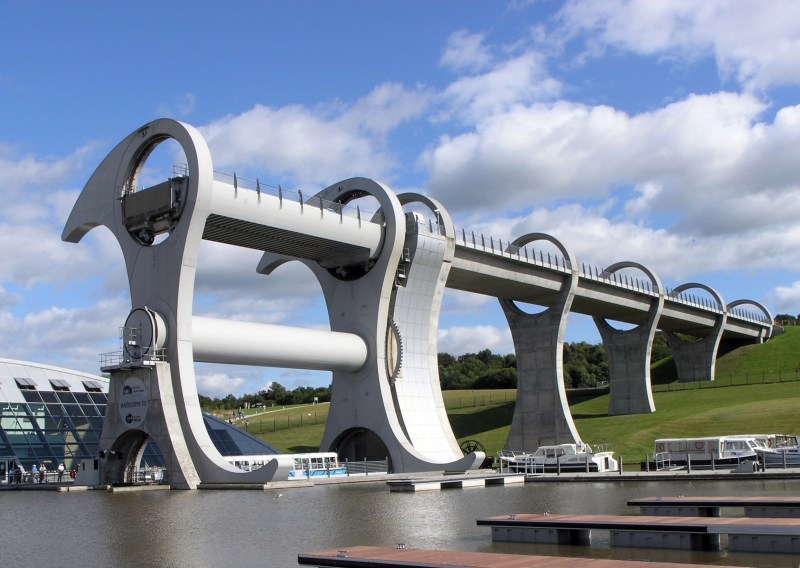
We live in an age where engineering marvels are commonplace: airplanes crisscross the sky, skyscrapers grow like weeds, and spacecraft reach for the stars. But every so often, we see something unusual that makes us take a second look. The Falkirk Wheel is a great example, and, even better, it is functional art, as well.
The Wheel links two canals in Scotland. Before you click away, here’s the kicker: One canal is 35 meters higher than the other. Before 1933, the canals were connected with 11 locks. It took nearly a day to operate the locks to get a boat from one canal to the other. In the 1930s, there wasn’t enough traffic to maintain the locks, and they tore them out.
Fast Forward
In the 1990s, a team of architects led by [Tony Kettle] proposed building a wheel to transfer boats between the two canals. The original model was made from [Tony’s] daughter’s Lego bricks.
The idea is simple. Build a 35-meter wheel with two caissons, 180 degrees apart. Each caisson can hold 250,000 liters of water. To move a boat, you fill the caissons with 500 tonnes of water. Then you let a boat into one of them with its weight displacing an equal amount of water, so the caissons stay at the same weight.
Once you have a balanced system, you just spin the wheel to make a half turn. There are 10 motors that require 22.5 kilowatts, and each half-turn consumes about 1.5 kilowatt-hours.
Not Lockless
The wheel actually raises boats up 24 m, so the remaining 11 m still requires two locks. But this is a far cry from the eleven locks the system replaces. The structure has a foundation with 30 concrete piles down on the bedrock. The wheel itself uses 14,000 bolts to avoid welds that might fatigue under stress.
As you’d expect, the caissons have to turn with the wheel in order to stay level, somewhat like a Ferris Wheel. This works using three 8-meter gears. It takes about four minutes for the wheel to make a half turn. You can watch it work in the video below.
Why?
We were a bit disappointed that there doesn’t seem to be any reason to connect the two canals except as a tourist attraction. On the other hand, about half a million visitors go every year, so it does have an economic impact. As far as we know, this is the world’s only rotating boat lift. It certainly is artistic compared to, say, the historic Anderton Lift.
We love big engineering. Even the ones that seem commonplace.
Featured image: “FalkirkWheelSide” by Sean Mack.












‘We were a bit disappointed that there doesn’t seem to be any reason to connect the two canals’ – So you can take your canal boat from one system to the other…
Yeah, there are plenty of canal systems in the world that operate only for pleasure boating or tourism. The Rideau Canal and the Trent-Severn Waterway in Ontario, for example.
The Peterborough Lift Lock on the Trent-Severn is one of the gravity-powered locks he mentions near the end, and was the largest in the world for a long time.
For clickable convenience Peterborough Lift Lock using two tubs and hydraulics: https://www.pc.gc.ca/apps/dfhd/page_nhs_eng.aspx?id=486
Not to diminish the Falkirk Wheel….. cool looking operation!
“Because it’s cool” is a valid reason
I rented a narrowboat a few years ago and toured the Union canal. The day we went up was easy just pull in lash off and then back out shortly after.
On the way back down, it was quite windy. The boats ahead of us struggled a bit to get into the slot so the large tourist boat offered to hip lash us and do all the steering. This kept my amateur shenanigans from slowing things down.
Nearby is the Kelpies which is another neat attraction.
Archimedes would have loved to see this.
I think you mean “caissons”.
Oddly, I had it right twice and wrong twice. Spell checker liked all of them ;-)
Amatuer.
I spelled the same word three different ways (all wrong) on one hand written page in school.
Mom kept it.
How do the gates work?
They open and close
The doors rise vertically to close off the caisson and the entrance.
I’ll spare you the simple arithmetic, but 1.5 kWh to move 500 tons of water, boat, plus structure 35 meters vertically makes the assembly in excess of 97% efficient.
Sure, it’s all in the balance, but that’s still impressive.
I suspect that the balance in intentionally imperfect such that the descending caisson is slightly heavier than the rising one, which might skew your numbers a bit.
Well, assuming the wheel rotates CCW from the point of view of the photo, this could be done by making the decorative “horns” on the wheel watertight, assuming they actually enter the water on the bottom side, which is not obvious.
As viewed from the photo, this would tend to give the wheel a CCW bias when the pods were aligned vertically (heavier, upper left, more buoyant lower right) which would convert to a braking action as wheel turned and the horn on the other pod started entering the water at the bottom of the circle, becoming more buoyant than the one in the air.
Or you could watch a sub 3 min video and rest all your armchair assumptions
It does rotate CCW as you say. The space where the bottom gondola sits is dry. The horns do not fill with water.
The wheel alternately rotates CW and CCW, if I remember correctly.
You had me excited for the return of Tom Scott for a second before I realized the age of the video. The man is a legend, and absolute machine for the upload schedule he maintained.
you should take a look at the old locks in Canal du Centre near Thieu in belgium. pneumatic balanced caissons from the late 19h century. there are four of them, but they are decommissioned. there was a 68 meter hight difference to negotiate. its a nice wrought and cast iron construction an the chaissons sit on two massive pneumatic pistons, connected by a pump.
Or the nearby “Hellend vlak van Ronquières” and the giant lifting construction.
I’ve tried to leave a long answer regarding how the gates may work, but the “nonce verification failed”, so I’ll say only that I miss Tom videos and I’m wishing him well.
A moment of remembrance for the Butterley Company.
I had a similar thought. I just about remember them celebrating their 200th anniversary when I was a (local) kid. I think they lasted about another 19 after that. I guess they had a good run. I wonder if in 200 years there will be anything left of Google and the like. At least even now there are still plenty of structures out there with a cast plaque bearing the Butterfly name. When Google disappears it will leave little tangible behind.
I’ve visited this one donkeys ago with a late friend of mine, it’s really impressive!
“The wheel itself uses 14,000 bolts to avoid welds that might fatigue under stress.”
Um, what?
The bolts are just as likely to fatigue as welds are.
You just have to design your structures properly.
More likely the bolts are to reassemble it after it was built 300 km away, then taken apart for transport to the site.
Design is one thing, getting the welders to actually weld it properly and then inspecting the work is another thing.
If the weld isn’t done properly, the heat affected zone is easily more prone to cracking under repeated stress than a bolted joint. Bolts don’t require highly trained and skilled specialists, and they’re easier to inspect for correct installation, and if bolts start to show signs of failure you can simply replace them.
Bolts suck in sheer.
They basically have to hold the thing together so tight that surface friction holds the sheer force.
I’d assume the engineers involved knew this and built steps into the contact surface.
In 1990 they had field inspections of high stakes welds down pat.
Structural steel, not trying to weld magnesium.
Also: Thermite welding is cool, a good excuse for playing with thermite.
There are no bad reasons for playing.
What is cool about the Falkirk Wheel is this ingenuity of the design. I see no reason it could not have been built in 1822, when the two canals were linked, it’s just that no one thought of it. Locks were the assumed option.
interesting. Then what is the function of the horns?
I’m just guessing but they might be there to ensure there is no debris in the path of the ring holding the descending caisson.
(Reply to DavidP)
My reply/question was to the previous comment that the wheel can rotate either way. But the horns (whatever their function) would only work in one direction.
I’m guessing, based on the comments in other videos, that the horns are purely stylistic.
To make you ask questions.
Ah, the function of all good Art.
I’ve seen it in action. It’s cool, but extremely slow.