
When it comes to knowledge there are things you know as facts because you have experienced them yourself or had them verified by a reputable source, and there are things that you know because they are common knowledge but unverified. The former are facts, such as that a 100mm cube of water contains a litre of the stuff, while the latter are received opinions, such as the belief among Americans that British people have poor dental care. The first is a verifiable fact, while the second is subjective.
In our line there are similar received opinions, and one of them is that you shouldn’t print with old 3D printing filament because it will ruin the quality of your print. This is one I can now verify for myself, because I was recently given a part roll of blue PLA from a hackerspace, that’s over a decade old. It’s not been stored in a special environment, instead it’s survived a run of dodgy hackerspace premises with all the heat and humidity that’s normal in a slightly damp country. How will it print?
It Ain’t Stringy
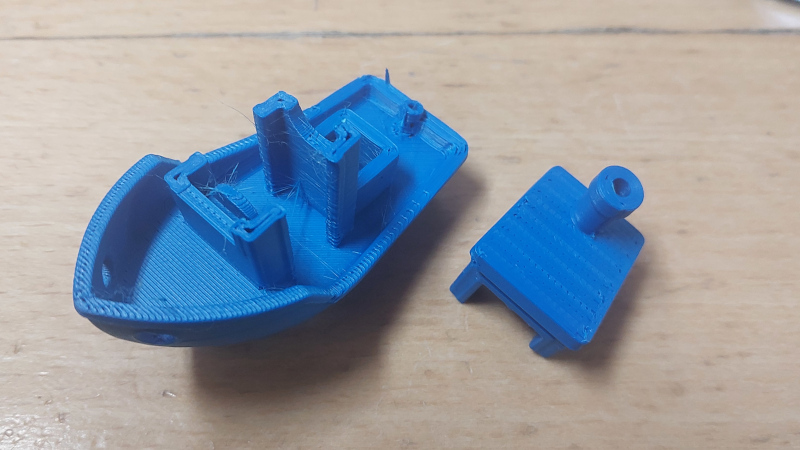
In the first instance, looking at the filament, it looks like any other filament. No fading of the colour, no cracking, if I didn’t know its age it could have been opened within the last few weeks. It loads into the printer, a Prusa Mini, fine, it’s not brittle, and I’m ready to print a Benchy.
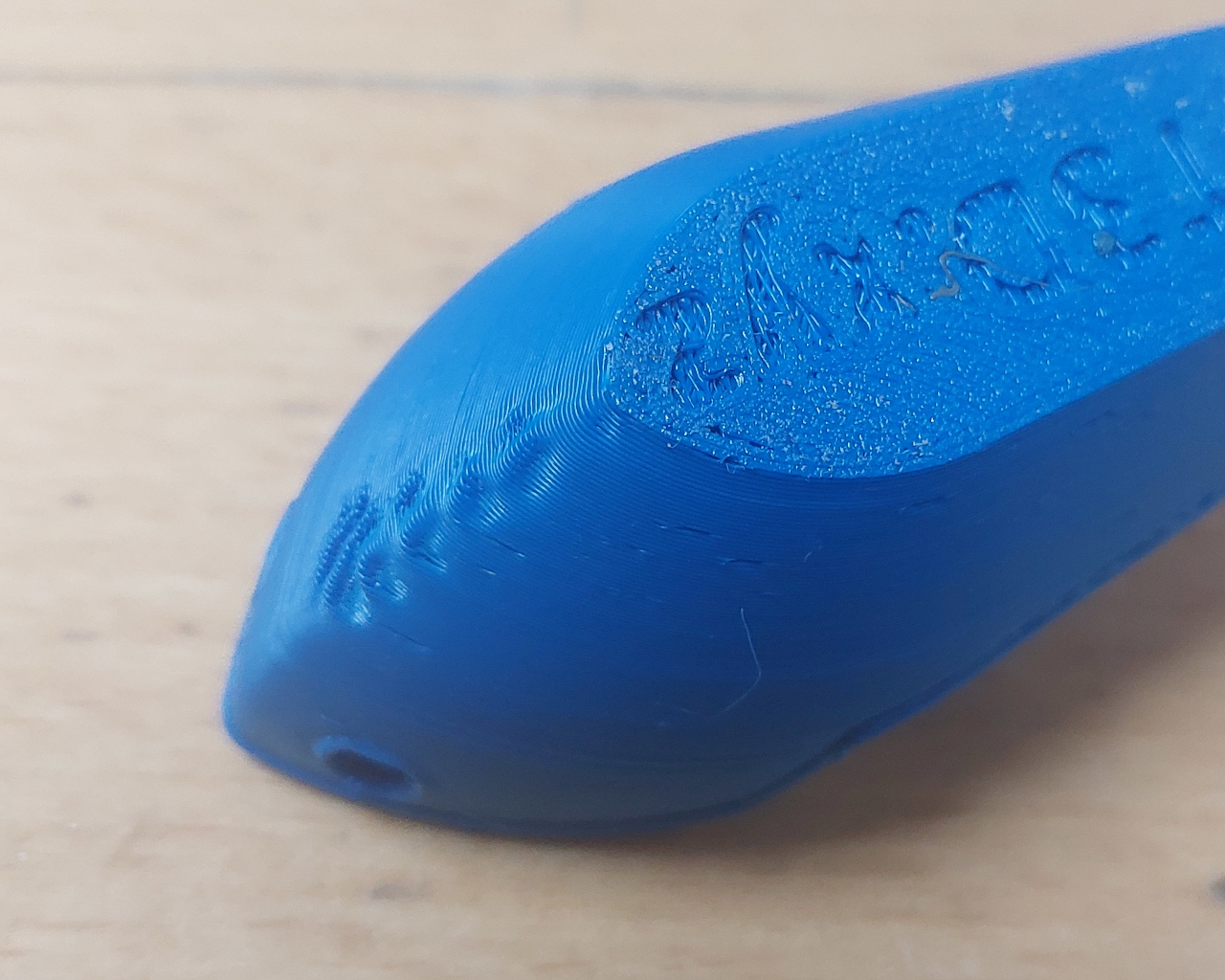
My first surprise on printing the Benchy is that it’s a pretty good print. Received Opinion tells me that PLA is hydrophobic, and if you leave some out for a decade it will absorb so much moisture as to be unusable. In fact I was expecting a very stringy print indeed because I’ve seen that before with filament left out for about a year in the damp British climate. But this Benchy had almost no hairiness, its only flaw was a little bit of collapse along its prow line. I know the Mini isn’t at fault here as I’ve seen it print a flawless Benchy with new PLA, so that’s strike one to the ancient plastic.
Manipulating the Benchy, I found strike two. This is a reasonable print, but with not-too-hard pressure on the cabin I could snap it. The layer adhesion wasn’t as much as it is with a new-filament Benchy, and it has broken cleanly along the layer lines in the cabin pillars. Since snapping a Benchy isn’t a quantitative measure of how much the layer adhesion had degraded, I decided to formulate a test for layer adhesion. If I print something designed for measuring layer adhesion failure in both this old PLA and some new PLA, I can compare the two. It’s not perfect as I don’t have a new reel of the same formulation as the old stuff, but it’ll be close enough.
Punishing Prints, And Risking Holes In The Floor
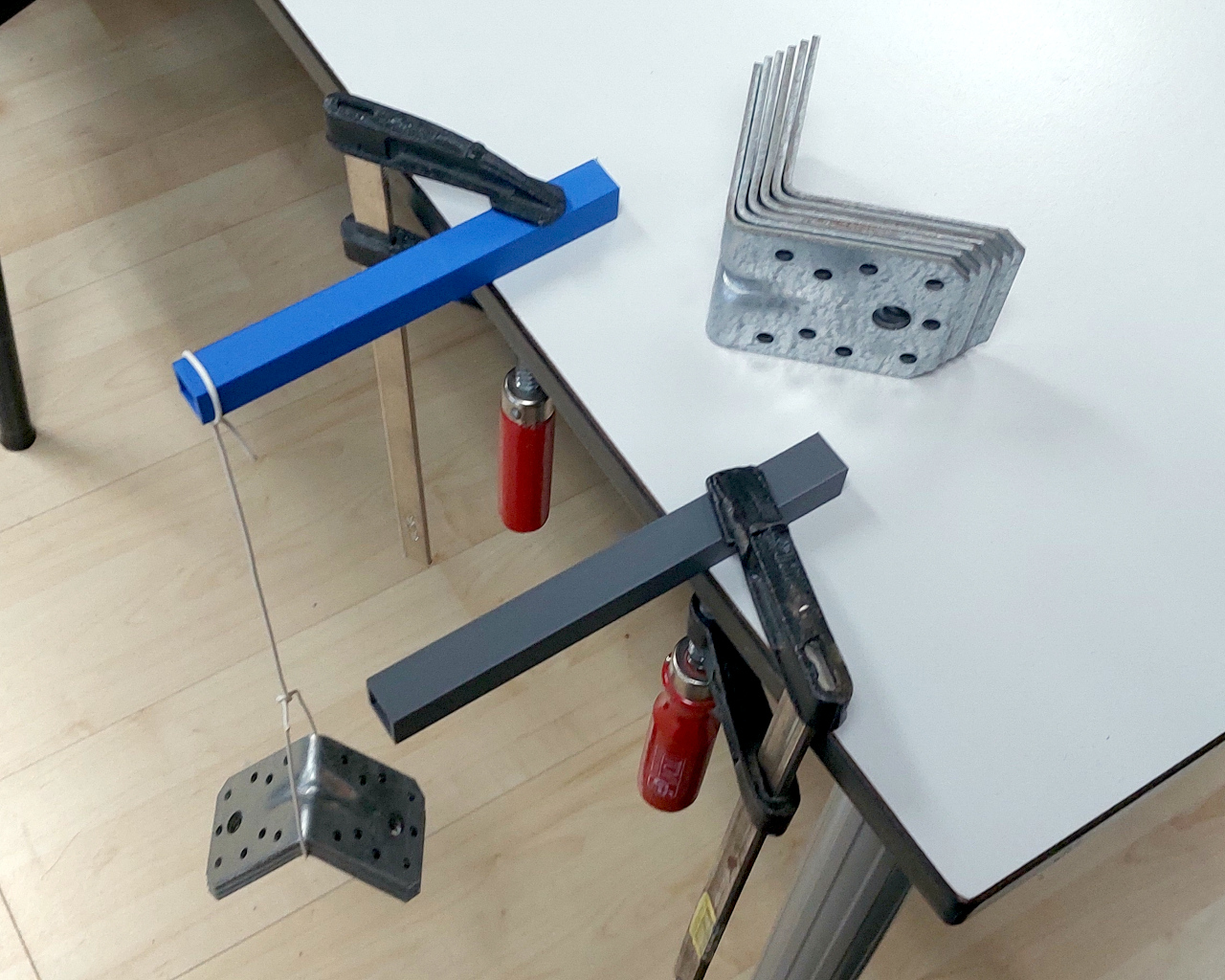
What I have come up with is a 150 mm long box section with a 2 mm wall. If I clamp the first 5 0mm to the edge of a table, I can apply a force to the far end of the 100 mm poking out into free space, and find its breaking point. To that end I’ve printed two, one in my blue old PLA, and another in brand new grey PLA. I’m dangling a collection of angle brackets each of which weighs 130 g from the end of the box section, and adding brackets until it breaks.
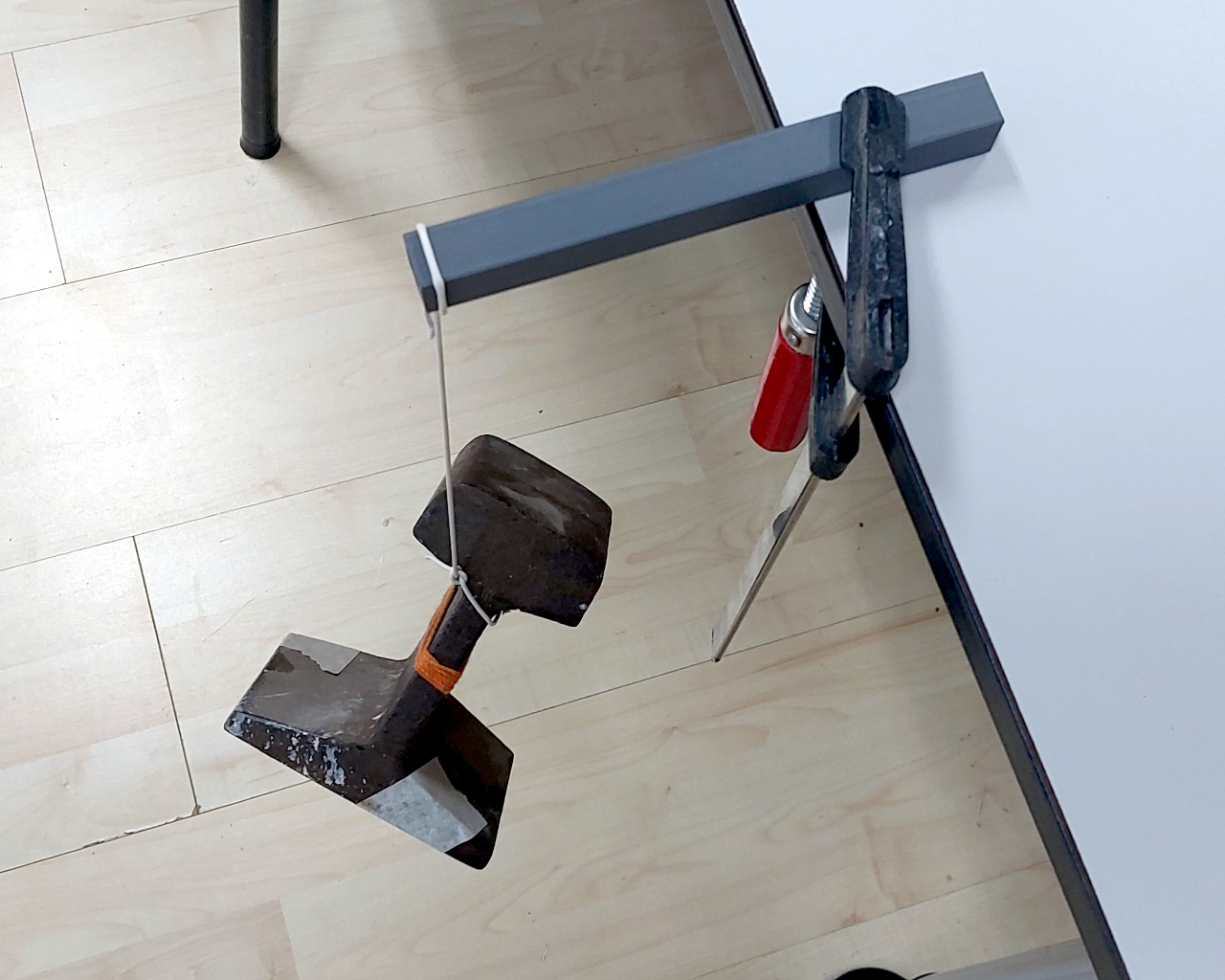
I had only twenty brackets, and as expected the old PLA broke first, at ten brackets, or a 1.3 kg load. My back of the envelope calculation from high school physics gives me about a 130 N force on the top edge of the layer boundary over the fulcrum on the edge of the table to do this. I ran out of brackets and other hardware to try to break the grey box section, and finally admitted defeat when it refused to break with a 3 kg piece of rail I’ve been hoarding to make an anvil dangling from its end. I have proved that layer adhesion with ancient PLA is more than three times weaker than on the same printer with new PLA. It’s interesting when examining the break, the layers have parted very cleanly, this is not tearing of the PLA but simply poor adhesion between layers.
In doing these experiments I’ve discovered, not unexpectedly, that ancient PLA isn’t as good as new PLA. I am assuming that this was as good a PLA as the modern stuff when it was new — indeed I remember printing back in the day and my prints seemed just as good as today. What does surprise me though is that how it’s deteriorated isn’t what I expected. It produces good prints in terms of their physical form, without the hairiness I was expecting. In turn I didn’t expect the prints with this stuff to be weak, so what’s going on?
When The Volatiles Depart, What’s Left?
PLA filament is not pure PLA, instead it has chemicals added to modify its properties. The most obvious one in this reel is the blue pigment, but others might modify its plasticity or melting characteristics, to name two possibilities. These are not going to be stable solids like the polymer, instead they will be volatile compounds which are capable of evaporating over time.
I’m no polymer chemist, so I’ll draw my engineer’s conclusions here and prepare for a roasting from the chemists if I’m wrong. What I think has happened is that the volatile additives in the filament have departed over the years, and both the stringiness in damp newer PLA and the strength in prints made with new PLA are as much due to their presence or absence as to the PLA itself. In my tests here I think I have seen something closer to PLA alone with the additive chemistry absent, and along the way I may have touched on why the manufacturers add it in the first place.
It’s likely few of you are printing using ancient PLA, so while interesting, these results have limited direct relevance to your printing. But I have to wonder whether there’s a lesson to be learned in filament storage, and perhaps using a warm environment to stave off moisture might hasten the departure of those volatiles. Perhaps the best thing is not to be a hoarder, and to use your filament up as quickly as you can. Meanwhile, this isn’t the first time we’ve ventured into backyard physical measurements.











Confusingly water makes PLA brittle (and nylon too!).
What would be really interesting is testing this hypothesis by drying the old PLA reel, and printing again – I’ve had success turning a reel of cheap white PLA which was so brittle I couldn’t load it, back to “normalish” with desiccant and warming.
My thoughts pretty much exactly. Either its “obvious” that she dried it first, or she didn’t dry it and should for a fair comparison. Its entirely possible shes correct that it wouldn’t matter, that volatiles would be even more likely to bake off, and drying would make it worse. But….we don’t know. I don’t know which it is, did she dry it or not?
No drying occurred, this reel was exactly as given to me.
Would you consider drying it and updating the article?
I actually have a similarly old roll of black PLA that I got alongside an Ender 3 Pro that was never used but unwrapped and I’ve been meaning to dry it out and see how it prints, I’d love to know if I’m wasting my time buying a filament dryer or if I’m not going to make it any better.
You’re not going to repair brittle PLA by drying it – it’s not the mere presence of the water that makes it brittle (although that causes other print problems), it’s all the polymer bonds that the water broke over time.
How could this be a valid test? We know that even different colors from the same manufacturer have different physical properties. Then comparing a 10yo PLA formula with a newer one is also not valid.
Layer adhesion? Print at higher temperature. Maybe that 10yo filament was also requiring a higher print temperature for better layer adhesion, even when new.
Comparing apples and pears, and botching the meaning of hydrophobic on top of that….
I’ve had experience with nylons (bolts, specifically.) in dry climes. Boiling the nylon for a short period was a common (and effective) solution for brittleness.
So I’m surprised that you’re saying that 3d print nylon gets more brittle as it absorbs water. Do you know why?
It’s possible volatiles have left and it’s just plain weaker.
My impression, though, is that it’s actually just calibration. Rule of thumb: layer adhesion is calibration. I would run it through my filament dryer anyways, but it doesn’t sound like you’re seeing obvious signs of moisture. You probably need to increase temp and maybe increase over-extrusion factor. It might be slightly smaller diameter than nominal. There may be another deficit in the PLA that is original to its manufacture and not a result of age. It may also have picked up a coating from its storage environment, such as the deposited on the surface of everything if you burn scented candles.
PLA is garbage but (without any data to back it up) nonetheless i believe that re-melting it brings it back to its like-new (i.e., will be brittle soon) condition. And i’ve never known it to have poor layer adhesion…even things that bust mostly along a layer line from being aged to brittleness in use, i see tearing of individual layers.
PLA is great. It’s inexpensive, non-toxic, extremely rigid, and easy to print.
That said I much prefer PETG unless rigidity is of utmost importance and the design dimensions can’t be changed to add rigidity.
hydrophobic means afraid of water, quite the opposite of absorbing moisture
We know Jenny really meant to type “hydrophilic”.
Hydrophilic would make more sense if it was immersed in water. I think you want hygroscopic, which describes the ability to absorb moisture from the air.
The best pedants are the correct ones.
I can’t tell if this is supposed to be funny or a concession but speaking as a pedant, I can confirm it’s true.
I have a few ancient spools of temu (literally; i had a coupon and so it was a couple bucks for like eight 250g rolls) PLA and after rediscovering it in the back of a closet I dried some out for 8 hours and it was brittle.
So I dried it for an additional 12 and it’s /still/ brittle.
I can print with it but it just shatters very easily coming off the spool so I guess it’s just extremely tired at this point in its life.
Yeah, this is my experience. Old PLA is brittle to the point of worthless, and can’t be recovered.
I don’t know what might be in British hackerspace air that preserves PLA so well.
The brittleness comes not only from water, but also from crystallization. Plastic like this is a glass with amorphous crystals in it. Heating it up a little to drive off moisture will speed up further crystallization. What might help (no experience there), is to heat the roll up to the beginning of the glass transition temperature, where it gets soft. if it is hot enough the crystals will break down, resetting the brittleness.
But the other contributing factor is hydrolysis: the polymer chains break down aided by the presence of water. These broken bonds will not repair, so it pays off to store your filament bone dry. This process will go from the outside in, so your layer adhesion will suffer first (no mixing in the nozzle).
I got a big airtight box I keep spools of filament in. and a bunch of large sacks of silica balls to absorb the moisture. I opened it up a few months ago and several spools of 5-10 year old PLA were empty, with the filament in tiny pieces on the bottom. It became so brittle it just turned itself into tiny pieces of superdry noodles. The humidity sensor in the airtight box said it was 12%. Meanwhile, a print I made around that time with that PLA filament is still working fine, constantly submersed inside the water of the toilet tank, redirecting water as a replacement of the original piece. The benchy in PLA I burried 10 years or so is still going strong. Ground here is very wet. Ground water starts around 10/20cm deep, depending on the time of year (several meters below sea level).
If I understood that correctly, you just answered my main question: Aging makes the PLA worse as a material for new prints, but doesn’t (so much) degrade things that were already printed.
What was the diameter of the shattered filament? I have worked with both 1.75 mm and 2.85 mm printers and filaments. I have only had 2.85 mm filament shatter as described (into small fragments), and the 1.75 mm will snap, but not into fragments.
As an engineer who has worked with polymers, I would hazard a guess that 2.85 mm filament has a greater buildup of stress across the diameter of the filament, both from cooling during manufacture, and from moisture adsorption during storage.
One other comment about comparing old and new filament when you don’t have the original formulation-loss of volatiles is one valid hypothesis, and anyone with really old plastic kitchen storage containers may have seen similar behavior. However, I believe the early PLA filaments had different molecular weight distributions because they were using PLA developed for injection molding-the earliest target markets were for disposable tableware with considerable concern about finished products distorting during shipment in warmer weather. One major manufacturer of PLA pellets had, at most, one or 2 grades of PLA. Over time, additional grades have been developed for different applications, and the grades aren’t necessarily modified only by additives.
IME printing since the dawn of reprap, old PLA tends to go brittle not just from humidity but also from UV. Even if I dry that old reel, the outer wraps that were exposed to light are so brittle they shatter in my AMS.
This one was afaik stored in the dark, at least.
As a multidecadal resident of the US, I have never heard anything about poor dental health in the UK. Did you mean mental health? I ask because you all go around asking each other “are you mental?” I’m thinking it must be a common problem.
I’m kidding… I’m not that thick.
Plastic also oxidizes, and I was under the impression that moisture exposure can irreparably damage some resins over time. As to which ones, I can only speak to the ones used in my automatic dishwasher and electric kettle (insert conspiracy theory here) for example chlorine destroys acetal, but they sure love to put it in the municipal water supply, so why are we making faucet parts out of it?
Also, where are these chemists we were promised?
“… where are these chemists we were promised?”
They are laughing so hard at us they can’t type.
It seems like this is more evidence that the exact recipe of any given polymer product can vary wildly, regardless of labelling.
That particular spool of blue PLA survived surprisingly well, but who knows how the next batch from that same manufacturer might have behaved?
They have a formula that’s so good that when printing a benchy, you’ll get a calibration cube instead. That’s the magic of plastic!
I have half a dozen spools of various branded filament from 2016 that was used with my old Monoproce printer and still prints flawlessly today on a Centauri Carbon.
It’s a bit brittle and likes to snap if I leave it loaded overnight, but after being run through the extruder has no issues whatsoever. I don’t live in a particularly humid area but I’ve always thought the warnings about pla and moisture, while real, have been greatly exaggerated.
What I’d really like to see is how that same filament prints after being dried in a good dryer for a week or so. Eliminate one variable.
I have loads of 10+ year old filament. Most from 3 different suppliers. From 2 suppliers are still great, 1 is brittle to where swapping filament breaks it.
None of it has been stored dry. One of the good suppliers is colorfabb who still exist. Faberdashery no longer seems to exist, but that filament also stayed good for me.
Moral of the story, the milage may vary. And one test says little.
Drying the filament won’t help it be any less brittle, once it’s old and brittle it remains so.
PLA is hygroscopic as in it absorbs moisture, not hydrophobic as resisting water absorbsion.
Wait….so there ARE dentists in England??!?
have you checked the diameter?
old filament had less quality control and consistency
My experience with old PLA filament is that it all depends on the manufacturer. I got my first printer about 10 years ago, and used it often for about 6 months until the control board burned up.
My filament went into a box in the garage and the printer got taken apart and repurposed for other projects.
Now I do live in a pretty dry area so the humidity is typically low, but the garage would range in temp from about 15F in the winter to 105F in the summer, but we do get a little bit of a monsoon season in the spring.
I just recently got a new printer and pulled all of my old filament out. I wasn’t expecting great results with it being 10 years old and protected only by a flimsy box. All of the filament I had bought from a large manufacturer still in business today printed perfect and seems to have all the same structural qualities as my new filament. The roll of red PLA I bought from a local long defunct vendor was a different story.
The color had faded to a slightly milky pink color and while printing no matter how much tuning I did was blobby with very inconsistent extrusion. I took the spool off of the spool holder, and being old and clumsy, I fumbled it and it dropped onto the concrete in the garage. The filament shattered right on the spool like glass into little 2-3 inch long sections. Three months later and I am still finding bits of it in the garage.
A reputable vendor is very likely to add stabilizing additives to there PLA and I think that is why most of my old filament seemed as good as any of the new filament I have bought.
The smaller vendors and importers likely skimp on the additives and so their filament is very likely to have a shorter shelf live.
YMMV.
Old PLA is probably more ‘pure’ than some newer PLA+ and other newer PLA variants. Print temperature and speed make a huge difference in layer adhesion too, probably more so than filament age.
And what about a brand new spool of filament X that’s 5+yrs old? How do we expect filament to age if sealed?
Thanks Jenny for this article! I’d be happy to learn more about the anvil making techniques (from scratch or from a ready made item (including which tools to sue to modifyl such item etc….)) if that’s an idea you’ll find worthy of an article
One day :)
Hydrophilic is the word you’re looking for. That means it would absorb water. Hydrophobic means it repels water.
Did you consider drying the filament on the printer bed with a box over it or an enclosure. I would try that before I started jumping to conclusions about chemicals leaching out of the filament
Hydrophobic also means it has rabies.
Could just surface contamination – cooking oil mist, fine dust, nicotine – cause these adhesion problems?
PLA, PETG, and ABS all cost about the same. I really don’t understand why anyone prints anything with PLA. If there’s even a remote chance a print will end up sitting in the sun or in a car for any length of time, PLA is going to melt. If you don’t care if it melts, why are you bothering to printing the object at all? The only good use I can think of for PLA is as support material for PETG prints (and stuff you’re going to throw away 10 minutes after it’s printed, like tugboats and starwars junk).
I hope all those people with Etsy shops and at craft fairs selling PLA prints to the suckers are warning them about the objects melting.
I don’t want my 3D printed knick knacks to outlive me. I like the idea that I can just leave them in the garden for a few years and they will go away. There are also plenty of indoor items that will never see ultraviolet light or high/low temperatures.
PLA is not that kind of biodegradable. Stefan from CNCKitchen did a few experiments on this.
I haven’t gotten PETG to print as nicely as PLA. Particularly bridges and overhangs aren’t as clean. It’s pretty close, I’m still trying.
ABS is a different story. I’ve used it in the past but it’s too smelly and too prone to warping.
Cost is the smallest factor. Ease of use is the greatest.
This line reconciles quite a large inner struggle I’ve been dealing with. Too much variety. Too many “what if i want a little bit of neon green?” moments.
I found the same thing – my old PLA spool is brittle and totally unrecoverable. Drying doesn’t fix the brittleness. I’ve switched to PETG for long-lived parts like shelf brackets.
A bunch of my electronics gadgets with 3D printed case using PLA corroded to the ground. This thing is very corrosive! Not sure if only certain PLA is having this issue but I am staying away from it now.