

If you’ve been even casually following NASA’s return to the Moon, you’re likely aware of the recent Wet Dress Rehearsal (WDR) for the Artemis II mission. You probably also heard that things didn’t go quite to plan: although the test was ultimately completed and the towering Space Launch System (SLS) rocket was fully loaded with propellant, a persistent liquid hydrogen leak and a few other incidental issues lead the space agency to delay further testing for at least a month while engineers make adjustments to the vehicle.
This constitutes a minor disappointment for fans of spaceflight, but when you’re strapping four astronauts onto more than five million pounds of propellants, there’s no such thing as being too cautious. In fact, there’s a school of thought that says if a WDR doesn’t shake loose some gremlins, you probably weren’t trying hard enough. Simulations and estimates only get you so far, the real thing is always more complex, and there’s bound to be something you didn’t account for ahead of time.
Do Not Pass Go
So what exactly is a Wet Dress Rehearsal? In the most basic of terms, its a practice launch where everyone involved does everything exactly the way they would on a real launch, except when the countdown hits zero, nothing actually happens.
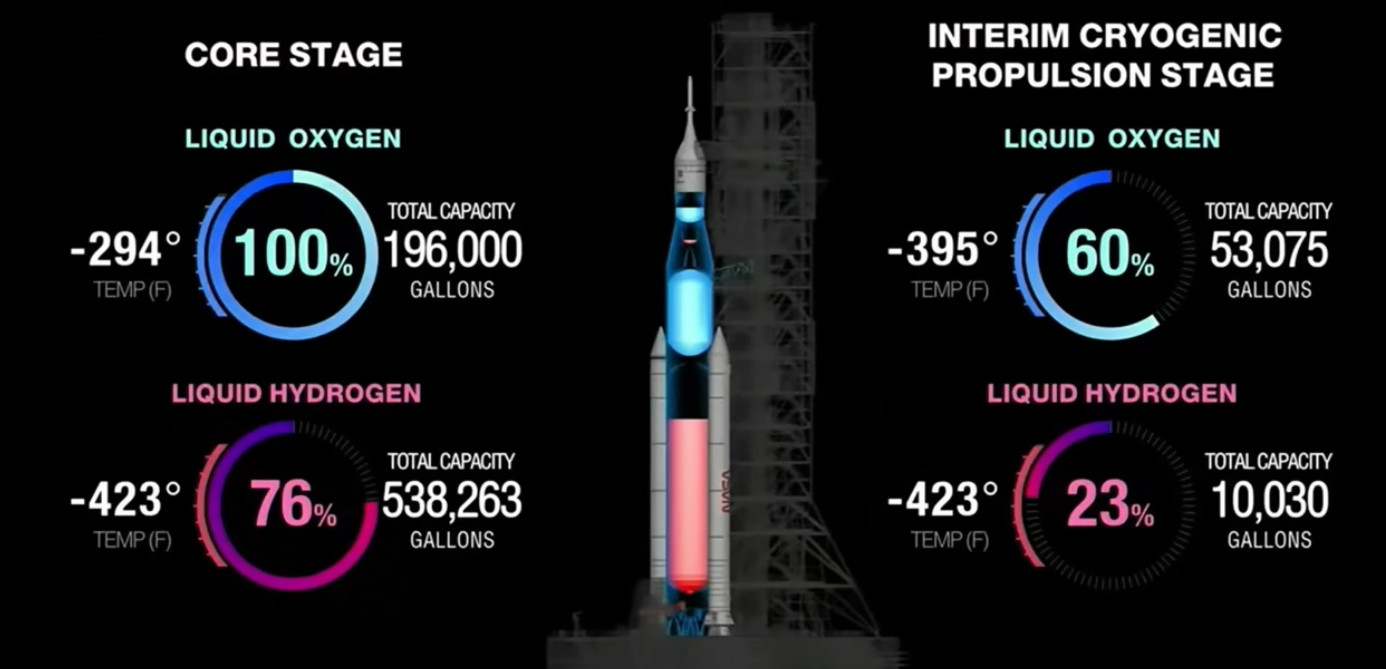
It’s the final test of the vehicle and the ground support systems, the last check of fit and function before launch. But there’a also a logistical element. In other words, it’s not just a test of whether or not the vehicle can be fully fueled, it’s also a verification of how long that process takes. Many of the operations that are performed in the WDR would have already been tested in isolation, but this may be the first, and only, time to practice running them concurrently with all of the other elements of the countdown.
There’s also the human element. Hundreds of individuals have a part to play as the clock ticks down to zero, from the team in mission control to the driver of the astronaut transport vehicle. This is where the Wet Dress Rehearsal truly earns it name. In a sense, launching a rocket is a bit like a theater production. Every player needs to not only have their individual role memorized, but they need to work together effectively with the larger ensemble on the big night.
Although a WDR is meant to simulate an actual launch as closely as possible, the rules are slightly different. If the rocket was actually going to be released there are other variables to contend with, such as the launch window, which is the period of time in which the rocket can actually leave the pad to reach its intended orbit. On a real launch, a delay significant enough to keep the vehicle from lifting off during its pre-determined launch window would generally result in an automatic abort. There is no such constraint for a rehearsal however, which gives teams more flexibility to conduct tests and repair work.
It should be noted that the Artemis II astronauts were not aboard the vehicle for the recent WDR, although ground teams did simulate the process of loading the crew into the Orion capsule. This is partly for the safety of the astronauts should something go wrong during the rehearsal, but is also due to the fact that the Moon-bound crew is kept in quarantine until the actual launch day to reduce the likelihood they will get sick during the mission.
Light the Fires
As mentioned above, for the purposes of the Wet Dress Rehearsal, nothing actually happens when the launch clock hits zero. It’s a test of the pre-launch activities, so actually starting up the engines isn’t part of the exercise.
But of course, testing the engines is an important aspect of launch preparation as well. Such a test is generally referred to as a static fire, where the engines are briefly run while the vehicle is physically held down so as not to leave the pad. Operationally, a wet dress rehearsal could proceed directly into a static fire. On the other hand, a full WDR is not required to perform a static fire.
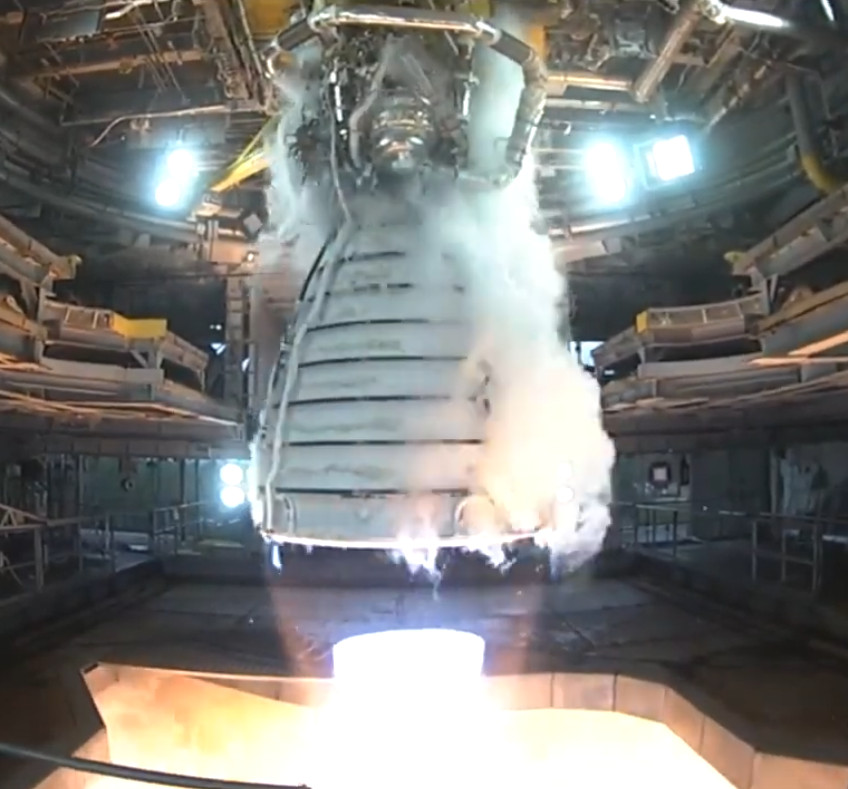
While static fire tests are common for modern rockets such as the Falcon 9, NASA has decided not to conduct them during the Artemis I and II missions. The SLS rocket uses lightly modified RS-25 Space Shuttle Main Engines (SSMEs), which are not only flight proven, but were individually tested before integration with the vehicle. There is also an argument to be made that a full-up static fire on the SLS, like the Space Shuttle before it, isn’t truly possible as the vehicle’s Solid Rocket Boosters (SRBs) can only be ignited once.
The Artemis I rocket did however conduct what NASA calls a Green Run back in 2021. This saw the first stage of the SLS fire its four RS-25 engines for eight minutes to simulate an orbital launch. The first attempt at the Green Run saw the engines shut down prematurely, but they did run for the full duration in a subsequent test.
Although such a test wasn’t conducted for Artemis II, and are not expected for any of the future SLS rockets, NASA is preparing for a Green Run test on the Exploration Upper Stage (EUS). This is an upgraded second stage for the SLS which is intended to support more ambitious missions after the Artemis III landing, although the timeline and status of those missions is tenuous at best.
The Road to the Moon
According to NASA’s latest update, the issues during the Artemis II Wet Dress Rehearsal has pushed the testing campaign back until at least March, at which point they will run a second WDR. But that certainly doesn’t mean it will be the last.
 While admittedly no two missions are the same, Artemis I went through four WDRs before it flew. Even then, the last one was aborted before the countdown was completed. Interestingly it was a hydrogen leak that caused that final rehearsal to be cut short, indicating that it may be a more dynamic problem than NASA realized at the time.
Even if the second WDR for Artemis II goes off without a hitch next month, that doesn’t mean the actual launch won’t be hit with its own delays due to technical glitches, poor weather, or any one of a myriad of other possible issues. Getting a rocket off the ground is never easy, and it only gets harder when there are humans onboard and the destination is farther than anyone has flown since the 1970s. An almost endless number of things need to go exactly right before we’ll see Artemis II lift off the pad, but when it goes, you definitely won’t want to miss it.












Ok, but you didn’t explain why the “wet” part in the acronym?
fuel is wet
Fuel.is.liquid. may not be wet because it is below freeze point of water. Wet is archaic term for the first floating of boat hulls. Hull doesn’t sink or fill with water, proability is that it will float for a long time
Are people honestly flummoxed by this or are they pretending? We’ve measured the weight of vehicles “wet” and “dry” for over a century, it means with a full tank and an empty tank. I thought everyone knew that. You guys can’t possibly get lost in redditoid semantics rabbitholes here.
The fuel is liquid. Liquid is wet. Even if it’s cold. Who the heck is talking about a boat
Wet is whatever becomes wet of a liquid, like a wet rag. That’s why we talk about wetting which means liquids adhering to surfaces. Notice how the liquid itself doesn’t define wetness, but the combination. We don’t say a drinking glass is wet of water when it’s full, because the water pours right out and doesn’t stick to it, leaving the glass dry. We say the glass is wet when there’s droplets of water remaining on it. Without the glass, water isn’t wet. It’s just water.
Saying that water is wet is sort of like the common mistake of saying “ice is cold”; it has no such property. Frozen water is cold relative to things that are warm, and warm relative to things like liquid nitrogen.
On an adjacent note, how do you explain guitar effect pedals adjusting their output between “wet” and “dry”?
There’s many possible meanings here. Things like engines or motorcycles etc. are often shipped “dry” which means without oils and coolants or batteries. The “wet” weight of an engine, or whatever contains the engine, includes whatever is needed to operate it but doesn’t say how long it should be able to operate. I.e. there’s no defined fuel loading – just how much the engine or the vehicle weighs when it’s ready to operate.
It’s to recruit a bunch of new viewers who google search for “wet dress”
Only reason I’m here, what a waste of time
I had to wiki’ed this as well.
“A wet dress rehearsal[1] is called “wet” because the liquid propellant components (such as liquid oxygen, liquid hydrogen, etc.) are loaded into the rocket during the test. In a pure wet dress rehearsal the rocket engines are not ignited”
https://en.wikipedia.org/wiki/Launch_vehicle_system_tests
Wet Dress Rehearsal? What is this NASA or Sea World? Also how do they defuel after the test? I assume it’s not the way they would during launch.
Either there are dump-valves that allow open thermal boil-off or the pumps are reversed(or other pumps are engaged) to withdrawn the cryogenic liquid from the vessel into a reservoir for recycling or disposal; or both. (probably pumps)
Well, in this particular example, one has to wonder how “qualified” engineers with over a half-century of experience in handling cryogenic liquids can’t seem to factor thermal dimensional variance into their designs for the ground support equipment where it mates to the vessel…….. when they experienced the exact same phenomenon on the last go-around and made no changes in the interim.
Don’t forget these are the same managers that ok’d a launch of another system with a known helium leak – and we know who had to come to the rescue of the humans once in orbit (after the known helium leak(s) went sideways – like duh! wtf were they expecting ?? idiots ! like the Dilbert pointy
haired crew in charge).
The “culture” hasn’t changed much – bureaucratic buffoons at the helm.
Same mindset that were making decisions regarding saving for posterity, the remnants
of the Apollo program (“nah, we don’t need those reel to reel tapes, just throw ’em
out in the trash”, old engine parts ? get rid of ’em, blue prints ? toss ’em !)
The other matter of heat shielding also has a “waiver” – should be interesting ….given that the
contractor admits making design changes in the interest of “efficiency” (and knowing that results
were ‘non-optimal’ as compared to the original design that worked).
It is not the NASA engineers, but the fake wannabees collecting someone else’s salaries. NASA still hires some of the brightest people on Earth to do Real Work, just far, far less of them (relatively sepaking) compared with half a century ago.
Each and every NASA bureaucrat thinks he/she is The Next Chris Craft (who, btw, had PROPER education to start with – and PROPER experience to go with that). Most bureaucrats I run into whilst visiting few places (Goddard, etc) were pen pushers and hot air generators. Chris Craft, ha, good luck filling his shoes with pen pushers – it will take 100 of them just to fill the void.
Having said that, it was previous administrations who cut NASA budgets, first in half, then down to 1/10, and then Artemis was basically a back burner project of nearly zero national importance compared with … nothing of particular comparison in scope. SpaceX saw the opportunity, so did Blue Origin, but NASA had to make do with the shoestring budget – while already being saddled with the White Elephant (ISS).
It is actually amazing that they finally have a thing that works now, and not another 25 years in the future. The flak should be flying towards politicians with their petty games of no importance.
Cryogenics are always going to be a pain.
SLS has just four engines on the core…stage-and-a-half-to-orbit
Problem resolved?
https://m.youtube.com/watch?v=Z0SS5p3AHBc
I am a proponent of wet workshops:
https://en.wikipedia.org/wiki/Skylab_II
https://m.imdb.com/title/tt28809307/releaseinfo
What a lot of people don’t know is that the SLS core had an 1,800 km apogee—-much higher than than the Polaris Dawn Dragon capsule…the one where a biker in riding leathers poked his motorcycle helmet out and called it a spacewalk?
Ha!
The SLS is joke. It costs a fortune.All in per fight cost around 5X Saturn 5 even after using previously designed left-over shuttle engines that can’t be reused. In sks since the rocket is thrown away. I wouldn’t ride anything produced by NASA these days. Real engineers put men on the moon using slide rules and computers with orders of magnitude less power than a $50 Raspberry Pi. I hope it succeeds because if there’s a catastrophy politicians will shut it down. and we’ll watch the Chicoms land on the moon. There doesn’t seem to be any urgency to get that junk working. Years between launches? Did they fix the heat shield?