Welcome To The Petacentre

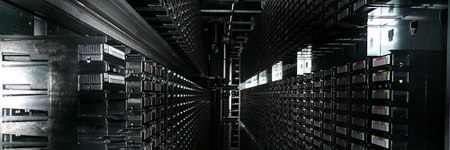
[Cory Doctorow] obtained access to a few data centers that deal in petabyte storage. The demand for data storage and processing doesn’t show any sign of stopping. It’s especially relevant when people need the resources to manage not only things like Google searches, but also email, customer transactions, and in the case of CERN, physics calculations. [Doctorow] drew an interesting conclusion from his experiences with the data centers; any innovation that the petabyte centers work on will eventually drift on down to the ordinary user, in laptop or desktop innovation. The petabyte center is easily duplicated with materials that are available for purchase to the average computer user; the only obstacles are price and space.

[via Boing Boing]
New Drobo Has Firewire Support, Old Model Drops In Price


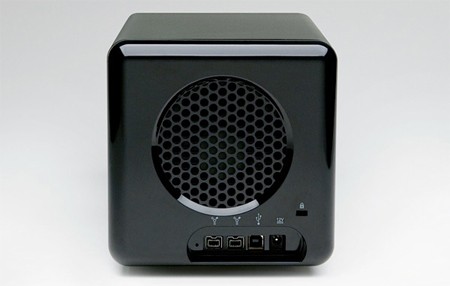
Data Robotics has released an updated Drobo with two Firewire ports and an updated processor, allowing for faster data transfer and daisy chaining multiple Drobos. The new models of this storage and backup device also features a quieter and larger case fan. The case itself has been modified slightly but to great effect, looking sleeker than ever. Sadly, they still start at $500 without any hard drives.

One nice side effect to the announcement of the new Drobos is the price drop for the old ones. Starting at $350, these still make great storage solutions, and hanging on to $150 isn’t bad either. Still, if the idea of buy anything for this purpose curls your toes, build your own network attached storage.

Data Manipulation With Sprog


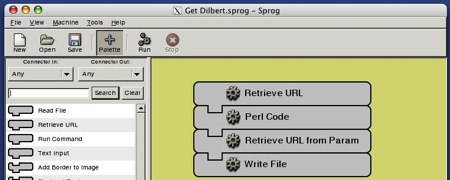
Linux Journal’s [Mike Diehl] pointed out an interesting tool for manipulating data: Sprog. Sprog lets you assemble machines to complete specific data processing tasks. You snap together gears that read input data, process the data in different ways, and then output the results. The input could be a file, URL, database query results, or even MIDI notes. For processing you could be matching patterns, selecting csv columns, converting to uppercase, or executing arbitrary Perl code amongst many other options. Finally the output could be shown in a text window, inserted into a database, written to a file, or sent to your spreadsheet application. Sprog’s site has a section for user uploaded gears and a recipe section for examples like this crossword puzzle solver. Everything Sprog does could be done with scripting, but this is a simple graphical tool that could help you solve a problem without having to know the gory machinery behind it.

Read Every Bit On A DVD

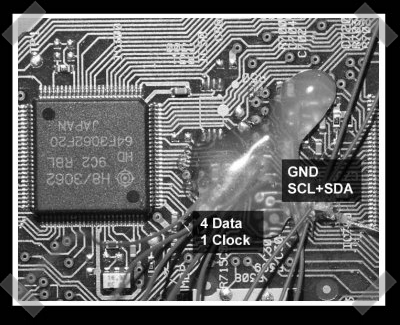
If you are curious about reading all the bits on a DVD, [tmbinc] has devised a hardware hack that uses a Pioneer DVD drive with leads soldered onto it and a Cypress FX2 microcontroller board to grab the flow of bits and push them over USB2.0. My favorite part of this tutorial is when you slow the spinning DVD down very slightly with your finger with a scope hooked up over what you believe to be the raw data stream from the disk. If the data rate slows when you physically slow down the disk, you probably are grabbing data from the correct pin. [tmbinc] even put together a software tool to process the resulting raw DVD data.