Godot’s New Contributing Policy Adds Barriers For AI Slop

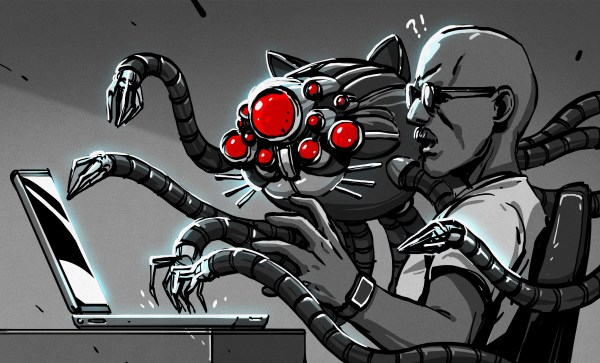
Like so many large and popular open source projects these days, the Godot game engine struggles with an influx of pull requests. The situation has become increasingly dire due to the advent of AI-generated code. More specifically, the issue involves the inverse relationship between PR code quality and the number of PRs, which wastes a lot of time on the side of a limited number of (volunteer) reviewers. This has now forced the project to update its contribution policy.

An interesting point raised in the announcement article is that of the demoralizing effect of AI-generated PRs on reviewers. Often the human behind such a PR isn’t interested in being educated, or may even be an automated agent which isn’t capable of productive discussion on pros and cons of certain coding approaches — never mind in becoming a more permanent maintainer for the project.

This problem has led to new rules being instated, which include a ban on autonomous AI agents and vibe coding, a ban on substantial AI generating of code, and a ban on AI-generated text in human-to-human communication. It also codifies the requirement that all PRs are to be reviewed and approved by a human being before merging.

In many ways this new policy is similar to that of the Mesa project, which demands code comprehension on the side of the submitter, although it doesn’t go as far as NetBSD, which just outright treats LLM-generated code as ‘tainted’ due to potential licensing and other concerns. Other projects like the Linux kernel opt to make the human submitter responsible for any AI tool usage by forcing them to declare it.

Meanwhile there are also indications that such ‘AI tool’ usage is reducing useful interactions with open source projects. What the future will bring here remains to be seen, but at least as far as open source projects go these tools are clearly increasingly being banished.
ABCCAD Is Voxels Meets LEGO In AR

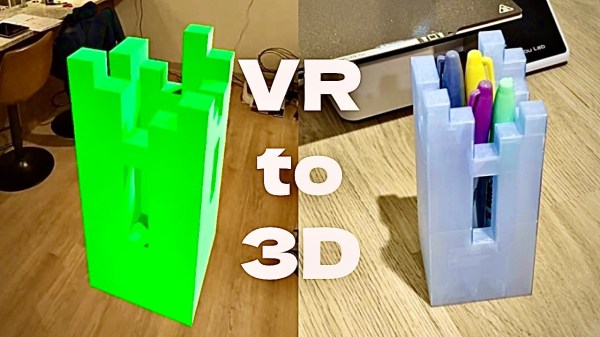
We get it, CAD software can be daunting to learn. Somehow [Boaztheostrich] found it so daunting he procrastinated his way into a AR voxel-based CAD app he calls “ABCCAD”, written in Godot for the Meta Quest 3.

The app is simplicity itself: pressing A or X on the controller spawns a cube, which you can place wherever you like in virtual space by moving the controller in real space. The trigger then saves the cube position. Grabbing a cube uses the controller’s grab buttons. You can even change colors (with B or Y), but like in OpenSCAD it appears that’s not actually going to have any effect on the exported STL. Check it out in action in the demo video embedded below.

As far as CAD applications go, this is as simplistic as it gets, but there’s a certain charm to its simplicity. It’s almost like virtual LEGO. Besides, TinkerCAD wasn’t much more complicated when it started out, and look at it now.

Sure, one could say if [Boaz] wanted to do CAD he’d have been better off putting the time into learning good old OpenSCAD or FreeCAD (which can now get you SolidWorks certs, apparently), but this is a fun little app that let him stretch his chops in Godot, another great open-source tool. ABCCAD is, itself, open-source under an MIT license.

We seem to have a paucity of posts under the Godot tag, so if you’ve got a hack that uses the open-source game engine, please send us a tip.

Continue reading “ABCCAD Is Voxels Meets LEGO In AR”

Git Good, By Playing A Gamified Version Of Git

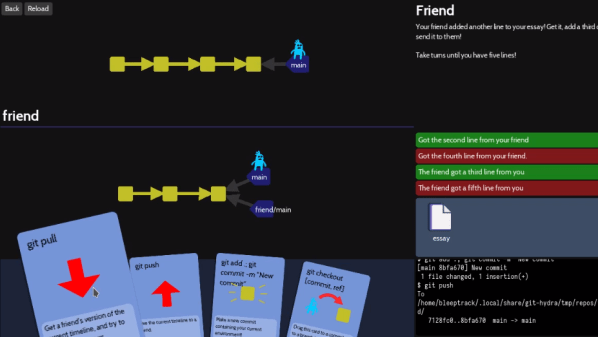
What better way to learn to use Git than a gamified interface that visualizes every change? That’s the idea behind Oh My Git! which aims to teach players all about the popular version control system that underpins so many modern software projects.

Git good, with a gameified git interface.

Sometimes the downside to a tool being so ubiquitous is that it tends to be taken for granted that everyone already knows how to use it, and those starting entirely from scratch can be left unsure where to begin. That’s what creators [bleeptrack] and [blinry] had in mind with Oh My Git! which is freely available for Linux, Windows, and macOS.

The idea is to use a fun playing-card interface to not only teach players the different features, but also to build intuitive familiarity for operations like merging and rebasing by visualizing in real-time the changes a player’s actions make.

The game is made with beginners in mind, with the first two (short) levels establishing that managing multiple versions of a file can quickly become unwieldy without help. Enter git — which the game explains is essentially a time machine — and it’s off to the races.

It might be aimed at beginners, but more advanced users can learn a helpful trick or two. The game isn’t some weird pseudo-git simulator, either. The back end uses real git repositories, with a real shell and git interface behind it all. Prefer to type commands in directly instead of using the playing card interface? Go right ahead!

Oh My Git! uses the free and open-source Godot game engine (not to be confused with the Godot machine, a chaos-based random number generator.)