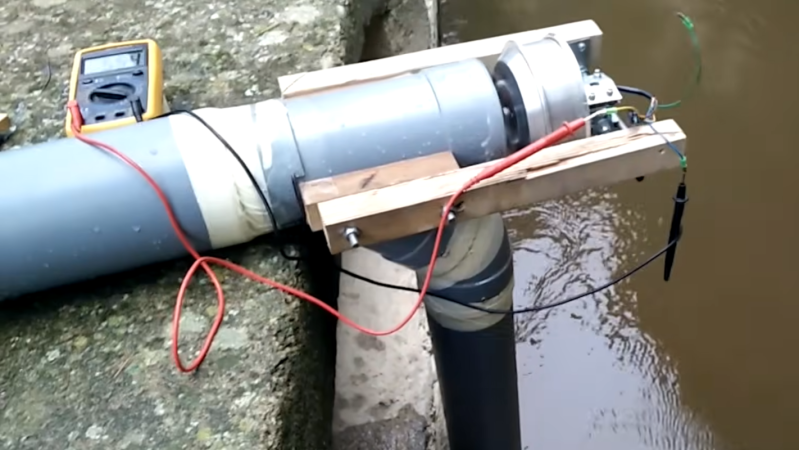
Engineering design makes all kinds of tradeoffs. Power trades off with torque, strength trades off with weight, and cost can trade off with quality. For designing a hydroelectric turbine, one of the main tradeoffs is hydraulic head with flow rate. Many large dams meant for bulk power generation will go with high head (or medium) designs, and for small dams with low head it’s usually not cost effective to build any generation. But if you’re really determined, you’ll want to build a low head water turbine like this one.
The build aims to use easy-to-find materials and simple tools. It uses 110mm and 160mm PVC pipe to not only siphon water up and over a dam, but to house the turbine as well. The turbine is built from a computer fan and sits inside the pipe with a shaft running through a Y-type fitting to the generator. The generator is built from a scavenged hoverboard wheel, and outputs a reported 3.3A DC at 60V for around 200 watts of power with only around 3m of head. The design allows the turbine to be placed at the point in the pipe that best suits the environment.
[OpenSourceLowTech], the creators of this project, make a compelling case that this build is cheaper than a 150W solar panel and it might even be able to produce more energy as well over certain timeframes, provided there’s a reliable source of water available and the owners of the dam don’t mind someone siphoning water over it continuously. The build video is worth a watch as well if for nothing else than the animation, which documents the build in excellent detail. Generating usable energy from hydropower doesn’t even need this big of a dam; if all you need is to charge your phone this tiny waterwheel will get the job done.
Thanks to [Keith] for the tip!
Continue reading “Low Head Turbine Generates Plenty Of Power”