
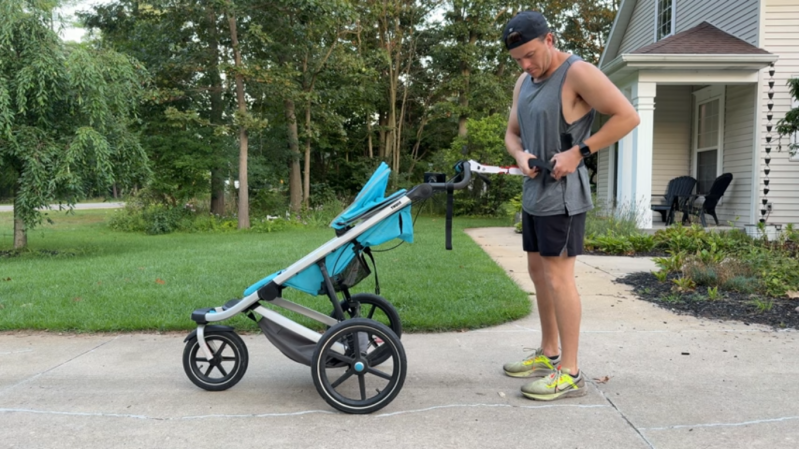
Although the jogging stroller is a fixture of suburban life, allowing parents the opportunity to get some exercise while letting their young children a chance for some fresh air, it would seem like the designers of these strollers have never actually gone for a jog. Requiring a runner to hold their hands at fixed positions can be incredibly uncomfortable and disrupts most people’s strides and cadence — so [John] attempted to solve the problem after finding one of these strollers on the secondhand market.
While there are some purpose-built strollers that attempt to address these issues, they can be pricey. Rather than shell out for a top-dollar model, [John] got to work with his 3D printer and created a prototype device that allows him to attach the stroller at his waist while leaving his hands free. There were a few problems to overcome here, the first of which would cause the device to buckle under certain loading situations. This was solved with some small pieces of rope which act as flexible bump stops, keeping the hinge mechanism from binding up. Another needed to be solved with practice, which was that it took some time to be able to steer the stroller without using one’s hands.
As an added bonus, [John] also included a system that tracks the distance the stroller has traveled. Using a hall effect sensor and a magnet attached to the wheel, a small microcontroller is able to quickly calculate distance and display it on a tiny screen mounted near the handlebars. Although smartphones are handy, their GPS systems can be surprisingly inaccurate, so a system like this can be a better indicator since it’s being directly measured. All in all, not a bad few upgrades to a secondhand stroller.









