
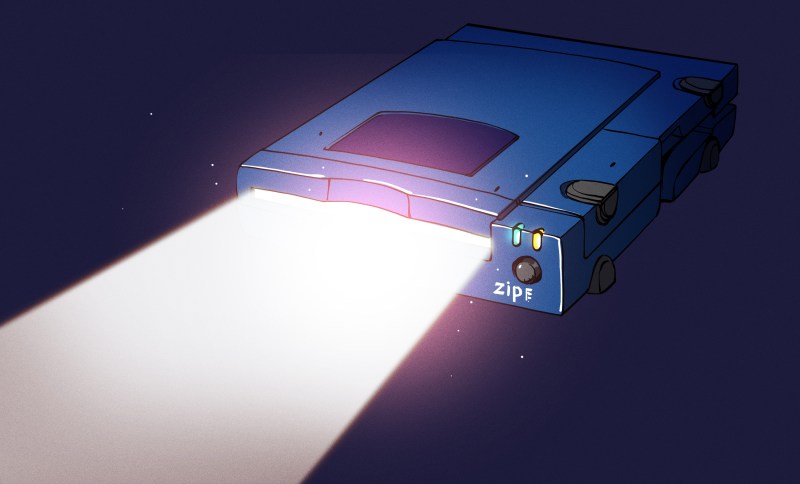
If you were anywhere near a computer in the mid-to-late 1990s, you almost certainly encountered a Zip drive. That distinctive purple peripheral, with its satisfying clunk as you slotted in a cartridge, was as much a fixture of the era as beige tower cases and CRT monitors. Iomega, the company behind it, went from an obscure Utah outfit to a multi-billion-dollar darling of Wall Street in the span of about two years. And then, almost as quickly, it all fell apart.
The story of Iomega is one of genuine engineering innovation and the fickle nature of consumer technology. As with so many other juggernauts of its era, Iomega was eventually brought down by a new technology that simply wasn’t practical to counter.
The House That Bernoulli Built
Iomega was founded in Utah, in 1980, by Jerome Paul Johnson, David Bailey, and David Norton. The company soon developed a novel approach to removable magnetic storage based on the Bernoulli effect. The Bernoulli Box arrived in 1982, which was a drive relying on PET film disks spun at 1500 RPM inside a rigid, removable cartridge. The airflow generated by the spinning disk pulled the media down toward the read/write head thanks to the eponymous Bernoulli effect. While spinning, the disk would float a mere micron above the head surface on a cushion of air. If the power cut out or the drive otherwise failed, the disk simply floated away from the head rather than crashing into it—a boon over contemporary hard drives for which head crashes were a real risk. The Bernoulli Box made them essentially impossible.
Early Bernoulli Box drives offered 10 MB and 20 MB of removable storage at a time when a fixed hard drive might hold 30 MB. Bernoulli Boxes were never really aimed at the home market, but found a devoted following among power users—publishers, CAD users, and anyone who needed to move serious amounts of data between machines. Sales were strong, and by 1983, Iomega hit the stock market running with an initial public offering raising $21.7 million.
As hard drive prices continued to dive over time due to economies of scale, though, the expensive Bernoulli Box became a less attractive proposition even despite its portability and greater storage. By 1986, Iomega had sold over 70,000 units and more than a million cartridges, but sales had peaked. The company had racked up serious debt and slow sales left the company saddled with undesirable inventory that wouldn’t move. Upgrades came thick and fast as Iomega pushed to keep up with the rapidly-changing storage market, which was enough to keep Iomega relevant if not flourishing. By 1993, the largest Bernoulli carts could hold 230 MB if you had a suitable model drive to read them, though the expensive drives mostly remained the domain of large corporate and government users.
Zipping To The Top
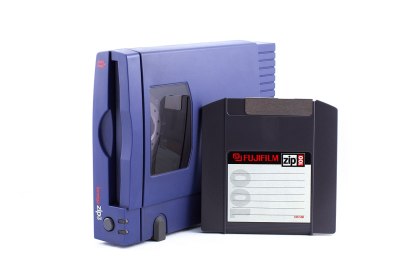
The next phase for Iomega saw the company reach its greatest peak. The Zip drive launched in March 1995, and aimed to be a more affordable solution to high-capacity removable storage. It hit the market with 100 MB cartridges priced at $19.95 each, in an era when the standard 3.5” floppy could only hold 1.44 MB. For anyone regularly shuffling large files between home and office, or backing up a hard drive that might only hold a few hundred megabytes, it was a great leap forward. The iconic external model became popular in businesses, universities, and homes, and before long, OEMs like Apple, Dell, and Gateway started offering internal Zip drives as factory options. It became as close to a defacto standard for removable storage as a proprietary storage solution could ever be.
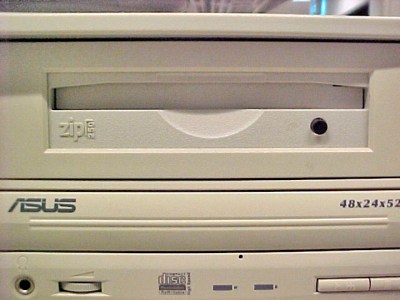
When the Zip drive hit, the sales numbers were staggering. Iomega’s revenue leapt from $362 million in 1995 to $1.2 billion in 1996. At its peak, Iomega was valued at nearly $7 billion. The company’s stock became a darling of investors addicted to massive gains. For a time, they appeared to be an unstoppable tech juggernaut, hanging on to a sizable chunk of the removable storage market without any obvious competitors on the horizon.
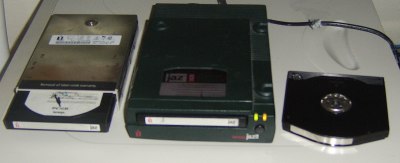
Iomega chased the success of the Zip drive with the even higher-capacity Jaz drive, which could store 1 GB in early models on hefty cartridges that contained rigid drive platters not dissimilar from those in contemporary hard disks. They were a great solution for power users moving what was then considered a lot of data, but their higher price meant they were never a consumer-grade darling like the cheaper Zip drive itself. The later “Clik” or “PocketZip” drive came along later in 1999, with a diminutive form factor and 40 MB disks. It too failed to gain the foothold of Zip, however, with a low install base limiting the usefulness of the removable format.
It wasn’t all smooth sailing, of course. A serious blow to Iomega’s reputation came from its own engineering. Some Zip drives developed a fault that came to be known as the “Click of Death.” The term referred to a clicking sound of the drive heads bouncing off their end stops when they became misaligned. In extreme cases, misaligned heads in a bad drive could damage disks, which would then damage the next drive they were used in. It was a mark against the technology that was supposed to be robust enough to be used as mobile storage. A class action lawsuit was filed in September 1998 and eventually settled in 2001, but the reputational damage remained.
Downfall
It wasn’t the Click of Death debacle that doomed Iomega, though. It was merely the march of competing technologies that made its storage solutions less attractive over time. CD-R drives, which had been expensive curiosities in the mid-1990s, became dirt cheap just a few years later. By 2000, blank CD-Rs were retailing for as little as fifty cents each, and they held 650 MB a pop— more than six times the capacity of a Zip disk, on media that cost a fraction of the price and didn’t require proprietary hardware. They were so cheap, the write-once nature almost failed to matter. It was far more attractive to many customers to just burn another cheap CD that anyone could read than to go out and buy a Zip drive, an expensive 100 MB disk, and hope that whoever you were sending the disk to also had a drive that could read it. The CD-RW followed soon enough after, and writable DVDs would then take storage capacities well into the multi-gigabyte range. Zip drives jumped to 250 MB and then 750 MB, while the Jaz line was upgraded to 2 GB, but by and large, consumers were choosing writable optical discs over Iomega’s proprietary solutions.
USB flash drives would then prove to be the final nail in the coffin. They were compact and cheap, and required no special hardware whatsoever. You could just plug them into any USB port on any computer and your files were right there. They too would become cheap enough to be disposable, in a way that Iomega’s bespoke drives and mechanically-complicated cartridges would never be.
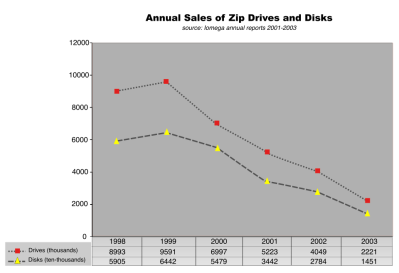
By 2002, the Jaz drive was dead, and the Zip drive followed soon after in 2003. It was CD burners that did the most damage, with the leap to DVD and the rising prominence of the USB drive that promised there would be no way back for removable magnetic cartridge media. These solutions were far less mechanically complex and a lot cheaper in terms of cost per megabyte.
Iomega was, at this point, a lumbering corporation with hundreds of employees, a dying product line, and a bleak future ahead. The company pivoted to other storage solutions, like selling rebranded optical disc drives, external hard drives, and network-attached storage devices. However, none of these products were particularly unique or competitive, as Iomega went from dominating a specific niche to fighting in a market segment where it had no particular competitive advantage. They became a small, sickly fish in a big pond, competing against dozens of other established storage brands that were far more renowned in their fields.
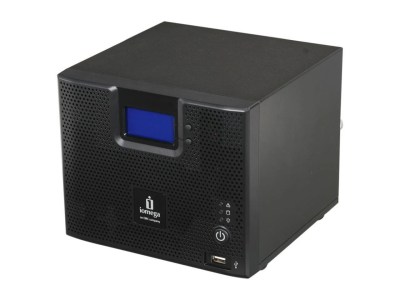
The end came in April 2008, when EMC Corporation announced plans to acquire Iomega for $213 million — a tiny fraction of the company’s peak valuation. EMC saw lingering value in Iomega’s small office and home office customer base, and kept the brand alive for a few years, slapping the Iomega name on NAS boxes and media adapters. These weren’t iconic products unique to the brand, so much as middle-of-the-road options that had no technical edge or promise to speak of. In 2013, EMC formed a joint venture with Lenovo called LenovoEMC. Iomega’s remaining products were rebadged accordingly, and the brand effectively ceased to exist. There was no reason to continue Iomega, because what it was built to do was simply no longer relevant in the modern marketplace.
The Iomega story is, in many ways, the archetypal cautionary tale of the consumer technology industry. In the 1990s, the company identified a genuine need—affordable, portable, high-capacity removable storage. It nailed this brief with the Zip drive, which propelled the company’s fortunes into the stratosphere. However, the entire business hinged on a product category that had a shelf life measured in years. Iomega simply couldn’t hold on to its edge in removable storage against so many competitors that were both cheaper and more practical. It’s the same death that Blockbuster died—fail to see the future, and you will inevitably succumb to it.












This story reminds me of a trivia question I heard on a “car repair” radio program some years back: The hosts described the following:
It’s the very early 1900’s (they specified the precise year, I can’t recall) and the American Muffler Company was a strong, profitable company with quality products and responsible management. Yet several short years later it went bankrupt, ironically in the midst of the technological revolution that would become the automotive industry. The question posed was… “Why?”
The answer was that this “muffler” company did not make those sheet metal baffle-tanks plumbed into an engine’s exhaust pipe. The “mufflers” they produced were those fur-lined tubes women stuck their hands inside to warm them when riding in an open-topped horse buggy, in the wintertime.
I think Iomega was a similarly good company, with a similarly good product Likewise, the rapid advance of other technologies pulled the rug out from beneath a product line that suddenly nobody wanted/needed anymore.
CarTalk was a great show. I don’t know if we’ll ever get something like it again
You got it! The Tappit Brothers!
I read that in their voices too
Couldn’t stand them, very annoying like a radio jocks. To each their own. I’ve had friends that like them. Scotty Kilmer is the replacement?
Where else can you find two MIT alums hurting friendly insults at each other while helping people solve real problems? It’s understandable that you might not enjoy that, but it’s a far cry from the typical radio DJ.
I remember it. Blue disks, used copy stuffs from university computer/Internet and take home
Don’t Zip drive like my brother!
Don’t Zip drive like my brother!
Brother can you spare a Zip?
As user of the original “Bernoulli box” system back in the early ’80’s (as I remember was a dial 10MB external drive that needed an EIDE interface card. When a year or so later, Omega came out with the 20 MB carts, and they were no compatible, it was irritating, but our research group made the switch. A couple of years goes by 20 MB carts are expensive, and starting to become too small. Out comes the bigger 90 MB system, really again totally incompatible. By the time Iomega upgraded to 150’s (new drives, but finally would read 90 carts) the new system still offered speed advantages over early CD disks and drives. But we were also busy upgrading computers on the same time frame, with bigger HDD’s, and the reusable 150 platters met needs, which CD’s didn’t, yet. Seemed risky to expect an exposed plastic-coated CD to have much lifetime in the lab! And we had internal ARPANET. So, instead of the ZIP tech, we stuck with the 150 carts, and expected the new “floptical” tech, providing 20 MB on a reformatted floppy format would be a winner, since the drives were little more expensive than a still ubiquitous “A” drive floppy drive. But that died early as the CD-RW capability got fast, and proved as reliable as any floppy. As soon as most everyone had installed CD drives with the computer upgrade cycle, the CD won big.
Part of the lesson Iomega had trouble with was the repeated upgrade incompatibility issue. It seemed, for those witout Interprise deep pockets, that made the ZIP drive interesting mostly to new adopters, which happened as it was becoming clear that optical storage tech could win. And it sort-of did. But needs for bigger faster main storage at affordable prices had let magnetic HDD’s keep pace, until the recent emergence of big, even faster SSD’s arrived and have proved their long term ability to retain critical storage requirements. To some extent, the fact that individual use computer systems have reached a speed peak that muticore systems really are still limited by software, systems and apps.
I remember they were everywhere, I had a drive at work and another at home… plus about thirty disk’s. Then I took three months off when I changed jobs, and the first thing I did at my new employer was buy a drive and a bunch of disk’s… and I never even took any if it out of the box. It went from an essential component of my workday, to dead, in three months or so.
From Zip to Zilch. It was right there…
Click death for starters
.
I worked for a university IT department and we despised Iomega Zip drives and the inevitable click of death. We had quite a few grad student sob stories of lost dissertations. The thing about it was that once a Zip disk was bad it killed other drives where it was inserted and those drives killed other disks. It was almost an exponentially multiplying failure cascade. I absolutely don’t miss Zip, Jaz and Rev drives at all. The older Bernoulli Box seemed more robust but we had very few of them and the medium was in a much larger cartridge and more expensive too.
Only experience I had with these was my Korg Triton rack. It had a SCSI port which you could use to save samples, settings, etc.
Can’t say I had any issues with it once setup…but I sold it with the synth and never tested “long term” storage.
I also used a zip drive over SCSI with my Akai MPC2000. At that time (around 1999) it was the only way to save larger sample files because it just had an internal floppy drive
In 1998 we did a data migration there involved a huge extract job from midrange to mainframe and then zip drives. They were then couriered down to London for the new provider to load up on the new system.
No fat pipes for us, zip drives to the rescue.
90s were an amazing time and people actually owned stuff, not bs cloud storage et. al.
Exactly and very well said. I loved I
I presume the couriers drove a station wagon
Good ol’ Sneaker Net was the fastest way to move GBs of data at that point!
Those zip drives were good well-made kinds that average Sam could afford on a budget. Compared with the burnable CDs/DVDs they were better deal overall and offered reading more than few times before degrading into nothing.
I still own the original Zip Drive together with two dozen zip disks, and half of them still work. Funny has it, I also still have the computer these were used with, rather nice Sony Vaio PC.
Couldn’t resist pun – from Alpha to (i)Omega : -]
When it comes to greek letter puns, you’ll never have a Beta opportunity.
My Gamma is laughing at all you young men’s little jokes!
I had a couple of Jazz drive units and quite a few Zip drives (mostly the SCSI models, but I had a parallel port one or two). Then came the click of death and the resultant lawsuit, The settlement terms were laughable: a ton of cash, payable to the lawyers, and a $10 rebate for more Zip cartridges – as if the consumer was going to run out and get a cart for the zip drive which had failed and will ruin any cart you put into it thereafter…
Mind you, I had never experienced the click of death myself – but I was moving carts between my own systems, not other peoples. Still, I migrated away from using them shortly thereafter.
I was an early adopter of optical media though, having worked for a consumer software company which produced CD titles even before MPC was a thing, and 50KB/sec read rates were the norm.
Oh, and on the settlement, it was ONE rebate per person – so for those who were all-in on the tech, you got nothing more even if you had many drives.
Class action suits and similar legal maneuvers are (usually) almost entirely for the benefit of the lawyers. A close friend joined a class-action suit for polybutylene plumbing. His payout, for a plumbing disaster that caused a huge leak that damaged the insulation in his mobile home — $1.47.
I used to have a zip drive that I loved to carry around with me, that thing was revolutionary. But one more thing that contributed to its downfall (at least for me), was the connectivity: the portable zip drives were so useful because it used the parallel port pretty much all computers had at the time for printers. Anywhere I took the drive, I could find a port to connect it too, even on older computers. But with the rise of USB ports, all other types of connectors started to disappear. Printers switched to USB connectors, and suddenly, parallel ports were no longer needed and were eliminated, so the driver that used to be so universal started to become something restricted to older computers that did not have USB ports yet. USB thumb drives or external hard drives became the new standard for any new computer that only had USB ports, and the Zip drive lost a lot of its attractiveness because it became more restricted.
Strange. From a Mac perspective, it’s the opposite. External SCSI Zip drives were popular and then a number of Macs had internal ones. When the original iMac arrived in mid-1998, one of the first peripherals to appear was the USB Zip drive. They even came in translucent blue.
I had a SCSI Zip drive for my Macintosh Performa 400 (68030 @16MHz) and it stayed with me while I upgraded to a PowerMac 4400 (PowerPC 603e @160MHz). For me it was just at the stage where my hard disk was a bit too small, and so offloading more rarely used apps was super-helpful. Then I swapped it for a PowerBook 5300 (which still used SCSI). And when I finally upgraded to a USB Mac (a 300MHz Tangerine iBook) in 2000 I bought a USB Zip 250.
Both of them still work, along with all of my Zip disks! This means I can transfer data from my MacBook M2 to my Performa 400 (or Mac Plus) in only 2 steps.
They made a USB Zip drive. Worked great. I still have one, though I haven’t used it in years. I used to use it to transfer files from work I downloaded using their high speed DSL line when we still only had dial up at home…
In highschool (1996 to y2k, specifically ’98) i asked parents/santa for a zip drive. i instead got the external/parallel Imation LS120 “Superdisk” drive(LS = laser servo, if i recall right).
I was bit upset until i realized it was able to read and write regular 1.44MB floppy disks “at up to 25x faster!”, I used floppies all the time so this was a win situation.
In those days i was downloading midi/mod/etc small media files over dialup that i could play in Winamp. when i found out that my local library had the ls120 drive in their computer, i was able to download mp3 files over their ISDN.
many friends in my HS years did have the zip drive, but having the ability to use both 1.44MB floppies and the special 120MB in the same drive felt really cool.
Thanks for the reminder, I’d completely forgotten about the LS120 drives. They were exactly the same physical dimensions as an internal 3.5″ floppy drive, as I recall, but connected over IDE/ATAPI.
Again, another clever technology that was completely swept away by the USB flash drive tsunami. I think my first USB “pen drive” (they’re not really called that any more, are they?) was 16MB in size, or it might even have been 8MB.
And here I am now in 2026, downloading 12GB worth of ISOs and writing them to a USB drive that’s physically the size of my thumbnail, and not even batting an eyelid.
(The less said about my first forays into data storage, using a home tape deck to load and save 1KB Sinclair programs, the better, unless we want this to turn into a “Four Yorkshiremen” sketch…)
That prompted a dive into my boxes of old parts … I found my old LS240 drive and it actually still works. I connected the drive with an IDE-to-USB adapter and was able to write both a 120MB SuperDisk and a 1.44MB floppy. If I remember correctly, there was a special mode of the drives, that allowed to write 30MB to a standard 1.44 floppy, but that required a special program.
I remember typing in Sinclair programs, from their magazine, then having to save it to cassette until next month when the corrected program was printed.
Luxury!
…
Tell that to kids today and they won’t believe you.
im a kid today and i believe it
i’m a kid today and i wish i could do that and i believe it too casette tapes are much better than cloud storage i mean true less storage but you actually OWN your OWN data
I once tried to get an old zip drive going, but it had a SCSI interface (they all do internally I understand) and so I though that these days you could get cheap SCSI adapters and it would be easy, except when I looked all the damn adapters were still crazy expensive comparatively. So I never did follow out that idea to completion.
SCSI is oddly elitist, you’d almost think Apple would have an SCSI interface on iphones :)
Come to think of it, I once picked up an old Apple CD player and I think it actually had an SCSI interface. It looked neat though and worked as a CD player.
Re: “Apple CD player” That’s likely the Apple PowerCD. It was slate grey. It could play CDs, CD-ROMs and PhotoCDs. You could take a PhotoCD and using the round (not SCSI) socket at the back, plug it into a TV and show an entire album of photos or more to everyone in the room. Getting photos onto the CD was more tricky, the idea was to send your e.g. 35mm film to developers that would send them to a Kodak PhotoCD processor and then the CD would come back.
Yep, it had a gold colored lighted LCD text display a I recall.
I never had a photoCD to test, I guess if you found one it would be filled with somebody’s boring vacation photos then. Or did they make pre-cooked ones with the grand canyon or something I wonder.
It was the “click of death” that killed Iomega. As the CoD was caused by Iomega cost cutting the quality out of their flagship product. Consumers lost all faith in Iomega and they never recovered.
And after that iOmega released a mini zip drive “Click Drive”. Missing in this article.
That may be, but they do mention the “Clik” drive.
I had one of those, with several disks.
It was quite handy as my dial-up was still metered, while the one at the University (where I have worked) was not. And it became even more useful when the Uni switched to wired Internet connection, something I could only dream of at home…
SyQuest SparQ anyone? I bought this drive some time in 1997-98 (maybe) and thought it was superior to Zip or Jaz drives in terms of capacity. I remember SyQuest support did a replacement for me because the drive was making clicking noise and refused to work. I didn’t know it was a reliability issue for these drives. I thought it was just me due to me bringing the drive everywhere, including university labs where I would plug the drive into a computer’s parallel port, install the driver, and work on whatever I was storing on these SparQ cartridges.
I was flashing back to my own Sparq drive debacle while reading the article. A ‘magneto-optical’ drive with 200 Mb disks? Sounded like it was right out of Star Trek. Mine failed about two weeks too late for the refund that was offered by Computer City (where I bought it). Syquest told me to send the drive and a check for $20 to a “repair facility” but the company was already moribund and they apparently went completely under shortly afterward. I tracked the package – it had arrived at a loading dock somewhere in New Jersey and that was the last I heard of it. A couple of years later someone cashed the check.
I had/have ZIP drive, they were pretty clunky. Later I got a my first thumbdrive from Iomega and then an MP3 player (runs on one AAA) that can also be used as a data storage device (have to use a ‘special’ Iomega USB cable).
My dad was an investigator from the 90’s until he left the force at the start of ’20. The local PD used zip media all the way until he left and might still be using it. Apparently, someone got a bunch of iomega stuff and zip disks for basically nothing back in the late 90’s and since they had cases of the disks and several drives they saw it as a cost saving measure. It’s where they keep evidence of digital crimes and apparently there’s a computer or two at the courthouse with a reader so I guess it works. He asked to swap to tape drives or literally anything else, but policy was to keep backups of evidence on zips. One day they’re going to lose everything, but it hasn’t happened yet. Hopefully they get a new system set up before then.
My parents computer had a Zip 250 drive in it, while I installed an Imation LS-120 floppy drive in my computer. I bought it around 2003, and removed it in 2007 when Microsoft quietly removed the driver to use the LS-120 disks, in service pack 3 of XP, then it just worked like a regular 1.44MB floppy drive, and couldn’t recognize the special magneto-optical 120MB floppies
I just found a zip drive and disks last night while cleaning out my store room.
And I remember installing Bernoulli Boxes when they first came out, but they weren’t around long.
Tech years are worse than dog years.
In some sense this is the happy path for a hardware company; make a novel product, scale out as much as the market allows, and then wind down a few decades later when the product category ceases to exist. There’s no tragedy in that. Companies do not need to live forever.
The alternative is that the company continually burns cash on research and development that may or may no go anywhere. And that cash comes out of the pockets of investors and employees. In hindsight, I’m sure iomega’s investors wish they had paid out dividends instead of inventing the “pocketzip” drive.
We idolize the companies that continually reinvent themselves. But it’s not necessarily better than winding down. Let’s check back in 10 years and say whether Facebook was right to reinvent itself as the metaverse, or Tesla as a robotics company.
The cash comes from the investors. The employees still get paid to research dead end products.
It’s more nuanced than that. Tech employees receive a lot of their pay in stock so they suffer the same tribulations as any other investor.
And in my experience at 3 different fortune 500 companies, when a company’s earnings decline then so do employee benefits & bonuses. That decline could come from lack of innovation, but it could also come from over-spending on fruitless research.
And yes, the people hired to do research benefit from research. But all the other stakeholders (employee or investor) are taking on risk.
IMHO, “Let’s check back in 10 years” is a good yardstick.
The stock market hype around iOmega at it’s peak was ridiculous. The Tesla of the ’90s.
What turned me off about zip drives was they were FAT and clunky. Never got into the medium. My older brother had one and i borrowed it but was no fan of proprietary media vs. the CD-R either. I just saw it as an overpriced computer-based toy with little actual value and practicality for the dollar.
And then came DRM to optical discs. Just read the respective Arch Wiki, how ridiculous this got with Blu-ray.
I don’t care about some artistic screeching on Arch Wiki lol.
What matters is I can buy a USB Blu-Ray drive, write my data on a BD-R and store it. Few years later I will be able to buy another USB Blu-Ray drive and read the data I had. Can’t do this with Zip drives because (like with Apple or Google) it’s all or nothing.
I had a Zip Drive and at one point and needed to purchase a couple of new disks. When I contacted the company they said they were on back order. I asked how long? And rather giving me a timeline they told me the back order was somewhere around 150,000 units. I bought stock in the company the next day assuming the popularity might bring some fortune my way. I was a novice investor but I have to say that it was one of the few stocks I ever made real money on based on a hunch.
I had a zip drive for my powerbook laptop in high school and then when I went to engineering school I got a PC and I could have the zip drive hooked up to both computers and safely access the disk from either one as long as I had unmounted it from the other. but then one day I accidentally tried to access it without unmounting and the drive got corrupted and I lost everything
I had the Syquest alternative 135MB hdd-disk cartridges, because I invariably buy the technically superior but less popular alternative. They were pretty bulletproof, in my experience. I think I stil have ’em in a box at home somewhere…don’t have anything that will host a scsi device any more.
I also have about three-quarters of a cheap box of 250 CDR’s unused at home…I think I paid all of $25 for it…
Your post mirrors my reason for selecting SyQuest myself. Always thought SyQuest was the better tech.
Same.
Never had a problem with my SCSi connected drive or any of my many 135MB cartridges, that I bought to use with an Acorn Risc PC. Still have them all, although after twenty years in the loft of an old British house, not sure if they’ll work (the computer’s lithium battery leaked and I’ve not been brave enough to power it up or try to repair it yet).
Though nowadays, giants rather fail in seeing a future the user (not neccessarily customer) also shares.
I still have a couple of the Zip drives (internal and external), a Jaz with both (including the controller board) in the case and a Clic! pcmcia card with a couple of disks.
Don’t forget the 5MB drive for the early Macintosh. In the days before HFS, when Apple’s 400K floppies had no true sub-directories, you could either format the 5MB cartridge as one big 5MB “flat/no-sub-directories” filesystem but with a small limit on the total number of files, or as five 1MB partitions with 5x the total number of files available.
lol that’s only a little bigger than the size of a LittleFS partition on a $3 NodeMCU — for which I was wondering if I should support hierarchical directory structures in a Linuxesque command line REPL I’ve been building for them and then thought nah…..
I was at college when the iOmega Zip drives were at their peak, 1998-99 all the snob students were like “you are not a digital graphic designer if you are not using a Zip drive for your Adobe Illustrator files”… At the time I got a good offer for a HP CDR/RW burner unit from the guy who owned a small computer store (he sold me my first Nvidia GPU too!)… I started burning my files for Photoshop, Illustrator and Premiere on CD-R disks and turning my assignments on that format and it was amazing, not only I could give the teacher a full copy of all my work containing original material, tests and multi versions of the designs and videos on one single disk due the bigger capacity but it was so cheap to produce that I never truly cared for the teacher to return to me the disk, if I needed another copy I just grabbed another CD and boom it was done, the CD got damaged? no problem, burning another copy like nothing!
I got paid twice by several customers during this period dealing with their backup solutions. 1st for installing SCSI Zip drives, then a few years later, installing their CD drives and moving all the Zip drive backups to CD. Batch files could automate only so much so got paid to sit around and plug n chug every so often.
This article reminds me of the Blackberry. It was (apparently) a revolutionary device in it’s day, but the fine tuned software that made it snappy with limited hardware also prevented rapid growth when phones became much more powerful. Matthias Wandel (from woodgears) has worked for the Blackberry company and he told a few things about this in one of his video’s.
Hey guys. Don’t forget about SyQuest drives.
The original removeable storage device media for the Apple II series of personal computers was a single sided 5.25″ 143k (that’s k, not mb) floppy disk. I know because at one time, starting with my first in January 1983, was eventually using 3 Apple //e pcs (2 in business) with such drives.
It was a great day when someone invented the “Disk Notcher” that let one use the other side of the 143k disk. Twice the storage in the same physical storage space! And I just used scissors to get the same effect.
Too bad that, unlike the IBM PC 5.25″ dounle sided drive, which not only stored 360k per disk side but wiuld let you use the other side as well, you had to pull out that notched Apple 5.25″ drive’s disk, turn it over, and re insert to access the back side of what became called a “flippy” disk to use that back side.
I used to type business documents on an IBM Correcting SelectrIc II electric (not “electronic”) typewriter: it had no memory. Once I shifted to Apple (there was no “Mac” yet) I came home 2 hours a day earlier because word processing saved me all that time correcting typos!
IBM 360K DSDD drives (and disks) stored 180kB per side.
I seem to remember there was another source of the Click on Death. A company offered a Brand X media disk that was cheaper. But it damaged the head is the drive, resulting in the drive damaging the other media disks. It was a mechanical virus. I had a drive on a desktop and also an external drive daisy chained. And I have a box of disks with backups
I’ve still got a SyQuest with unopened cartridges sitting on my “spare parts” shelf, in the original bag.
Granted it’s a niche use which I remember, but the SCSI version was also a convenient way to exchange files between Amigas and PCs. Once the drive (and drivers) were installed in both OSs, you could swap the files between the platforms with no hassle. Other methods back then were painful.
I too owned the SCSI version for my Amiga 1200. It plugged into the card slot on the side. You could format the disks for the Amiga only, or PC format for universal compatibility. I also used Zip disks to exchange data between PC and Amiga.
In 1994, a 500mb internal hard drive cost around $500, and floppies were still in use. Windows 95 & MS Office came on 15-20 floppies. (I can’t recall exact number). So the removable $20 100mb Zip cartridge that appeared a couple years later were the right tool at the right time, and were a relative bargain. Iomega should be the #1 brand name in high quality portable drives of all sorts today.
I had a twin slot 20Mb drive which I used to backup an IBM PC AT file server that ran the companies stock control system. If the server failed I could use the box drive on the workstation it was attached to run the stock control system! It all just worked!
Shortly after LenovoEMC, Dell Inc. would acquire EMC Corp. to form Dell Technologies; with the OG Dell becoming a subsidiary, and EMC becoming subsidiary DellEMC.
I had an external Zip drive, and the MicronPC my mom had at one of her previous employers had an internal Zip drive.
My 1995 Zip drive still works! Actually that’s not quite true. I bought a Zip drive in 1995, which went wrong and Iomega replaced it with a Zip drive that still works. I used it a few years back to bootstrap my then half-complete PowerBook 1400 from eBay into a better working order and install Mac OS 8.
I’d bought a PB1400 for about £65 in November 2022. The passive-matrix display was flakey; and it had no floppy nor CD drive. I backed up its 750MB IDE drive via an IDE-USB adapter, then bought an IDE-SD interface and copied it all back to an 8GB µSD card + several extra 750MB partitions. The first partition had System 7.5.3 as before, but I planned to use the rest for Mac OS 8, which I had on a genuine CD I’d bought back in 1997!
PowerBooks had HDI SCSI connectors, so I needed an adapter for that, which I found! The only SCSI CD-ROM drive I had, was a PowerCD, which needed a special driver, but I couldn’t get the special driver on using period technology. However, I had a SCSI Zip drive. SCSI Zip drives needed OS drivers themselves, but I had a feeling that one of them was bootable, which meant that it had a boot driver on it.
And indeed one of them was! So, then I was able to read the other Zip disks and eventually I found one with a proper Zip disk driver on it. So, I could install that on the PowerBook’s internal drive, which meant I didn’t need to reboot the PB1400 using that original Zip disk! So, then I could start searching the Zip disks again for a PowerCD driver.
And of course, because one ends up with quite a lot of duplication, I did find a PowerCD driver. I struggled for a bit to get the PowerCD to be recognised until I remembered that it clashed with the normal Apple CD-ROM driver, so I switched that out and then I was able to use the PowerCD, install Mac OS 8; find the British Mac OS 8.1 updater on Archive.org update to that; format another partition as HFS+, copy Mac OS 8.1 to that and then reformat the previous partition as HFS+ and copy it back!
Because I have a USB Zip 250 I can also copy from my Mac mini or even my MacBook Air M2 to the PowerBook 1400. But basically I’ve been having quite a bit of fun with that geriatric tech! It’s all been surprisingly reliable!
We had several of the original Iomega cartridge drives. 10MB then upgrade to 20MB. They were fantastic. We had 100+ customers we supported so we had a working copy of each customer’s system on a cartridge on the shelf. Any time we need to check out their system design, take a cartridge down, pop it in, do work and then put it back on the shelf. It truly was an awesome system at the time.
I was an engineer at Iomega during the era of the Zip Drive and had the opportunity to contribute several inventions to that product. It was an exciting time—one where mechanical design, materials, firmware, and system integration all had to come together in very tight tolerances to deliver a reliable consumer storage device at scale.
About 15 years ago (2012), I returned to my alma mater, Bucknell University, to give a talk to the engineering school titled:
“Meeting the Challenges of Innovation – The 1990s Story of the Zip Drive.”
In that talk, I walked through not just the technical challenges, but also the realities of bringing an innovation to market—how design decisions, manufacturing constraints, cost pressures, and field reliability all intersect in ways that aren’t always obvious during development.
One of the more well-known issues associated with the Zip Drive was the infamous “Click of Death.” If you’re curious about the underlying cause, I go into the backstory and technical details on slide 15 of the presentation. It’s a good example of how communication between R&D/Product Development and Manufacturing need to remain fluid even after product ship.
See: https://www.slideshare.net/slideshow/innovation-and-invention-bucknell-presentation-1212012-fct-final/233710391
The father of an ex-girlfriend may have worked with you at iOmega. He was a mathemetician who worked on the jump from 100 to 250, among other projects. He apologized to me for buying their disasterous USB CD-burner. He mentioned that product had a horrible burn rate and was routinely returned, often with angry letters attached.
I remember my burner was incredible at making shiny drink coasters but terrible at working CDs.
I had one of those! I was the easiest way to get CD burner for my Toshiba laptop in 2000. Mine wasn’t too bad…. and any bad CDs could also be explained by Windows 98’s poor handling of removable USB media at the time. I even traveled overseas with that drive so I could, ahem, “back up” other backpackers’ CDs. Friends with Macs borrowed it too. I may still have the purple enclosure somewhere, I think I was planning to put an old HDD in it to try and use as a portable USB hard drive before those were common.
The timing of this after LTT featured iOmega’s attempt at an MP3 player using those disks and one, never been used even got the click of death ten seconds into the first song, lmao
I still have a Zip and several discs. I wish I had a way of seeing what is on those discs.
I worked for an IT department back then and we had regular horror stories of how entire projects stored on Zip disks had been lost. If we were lucky the data loss issue was caused by writing on the disk in amp different drive than where it had been most used. If the original drive was available, recovery tools could get back at least some data.
The click of death could also happen if there was damage to a disk. We had a person who mangled several Zip drives by repeatedly trying the same damaged cartridge in different drives. A bad disk could damage a drive and then subsequent cartridges were in turn damaged by the damaged drive.
It was a relief when USB sticks gained enough capacity to make Zip drives irrelevant. USB sticks can go bad too, of course, but it was easy to copy their important files onto multiple USB sticks.
You’re first mistake was not to use GitHub for keeping project data.
Zip disk or CD-R it’s still IT incompetence if you don’t have your data backed up as git repository.
I had the external USB 259mb drive at first… it was usefull for backing up crucial files for my business back in those days.. It was great for backing up our website, and as an extra backup for photoshop files that were 50mb to 100mb.. then when i setup a new shop backup server… i added a REV drive with 35 GB removable “carts” … but it was junk, an internal SATA drive, that worked twice… sent it to iomega.. got it back.. installed, worked once… then same as before windows couldnt recognize it anymore, despite their “new driver” … waste of hundreds of dollars
Still have three or four 100 MB ZIPs, all parallel port drives and many cartridges. For a while they were the best way to move larger chunks between Compaq Contura 4/25 and various XP boxes. If I ever fire up the old Win95 box (which has both 5.25″ and 3.5″ floppy drives) I’ll probably break out a ZIP to move stuff to the old XP box (with parallel port) in the basement for transcription onto thumb drives.
Never had any click of death issues myself.
Now I still have two things available to me ONLY on Hollerith cards … but that’s a different problem.
Iomega and the zip drive basically put Syquest out of business.
As an original Beta tester of the original 8” cartridge Bernoulli Box, I was a big fan of theirs. I recall Turner Studios of TBS fame was a huge consumer of theirs back in the day of colorizing old black and white films. Each 8” cartridge could hold 2 whole colorized frames…there must be a place somewhere near Atlanta with an Indiana Jones Arc of the Covenant class warehouse full of those old Bernoulli cartridges!
So many good memories shared here about iOmega drives. Mine are similar. I think that even as CD/DVD drives (and even DVD-RAM) drives started to come out, the Zip/Jazz drives still had speed on their side. You could write to a Zip/Jazz drive much more quickly than a CD-R.
I had a Bernoulli drive in the early 90s and Zip/Jazz drives in the late 90s/early 2000s – all SCSI. My friends/coworkers would use them not just for data, but for applications/games as well. Probably not the best of ideas.
They all suffered the click of death – Bernoulli, Zip, Jazz. I was fortunate to have the presence of mind to keep my disks even after the drives failed in the hope that I might recover the data some day. At some point in 2005 or so, I found some fresh drives on eBay for cheap and snagged them. I straight imaged the disks I had as fast as I could. Got to the last disks before the new drives also started to suffer the effects of the click of death.
The Bernoulli disks had an extra layer of fun because they were compressed with MS-DOS 6’s DoubleSpace (precursor to DriveSpace). Somehow I was able to mount the DoubleSpace file and extract my data. Score! Of course, most of the data wasn’t relevant anymore, but memories were revived and a nagging splinter in my brain of data loss was lifted. I learned a valuable lesson in keeping backups (and backups of backups).
In 1982, I bought a dual 10MB Bernoulli Drive from Infax, in George. It had a SCSI interface and I plugged it into my Apple ][+ on one end, and my PC compatible on the other, and went online with a BBS. It was a great solution for cross platform support at a time when the biggest BBS featured 10MB of storage online. I still have the Infax cabinet and one 10MB drive!
Does anyone remember SyQuest drives? Similar in concept to the Zip but larger capacity and much faster. They were removable single platter hard drives in square cartridges. Some were internal other external. Far more reliable and better tech. More expensive. The company also ran into serious cash issues and then adopted “death spiral financing,” whereupon the company diluted it’s share value each time they received a cash infusion. The whole thing imploded and they disappeared without a trace…
The old Commodore 64 1541 drive would rattle similar to the ‘click of death’ whenever you
formatted a disc. I think it was a SOP in the programming, but they kept on working.
I would have liked to see how history would have played out if Sony had released a computer data MiniDisc at the same time they had originally released the audio disc in 1992 or thereabouts.
For much of my working life the adage was to never underestimate the bandwidth of a truckload of tapes. The latency is terrible but the raw transfer rate is enormous.
Believe it or not, I am the last remaining Iomega employee still working for Lenovo. I started at their peak, and “rode the wave” all the way to our sad end.