Skip to content
Logo

Hackaday

  • Home
  • Blog
  • Hackaday.io
  • Contests
  • Submit
  • About

lorm

1 Articles

Mobile Lorm Glove Puts Texting Back Into Everyone’s Hands

March 16, 2015 by Sonya Vasquez 2 Comments

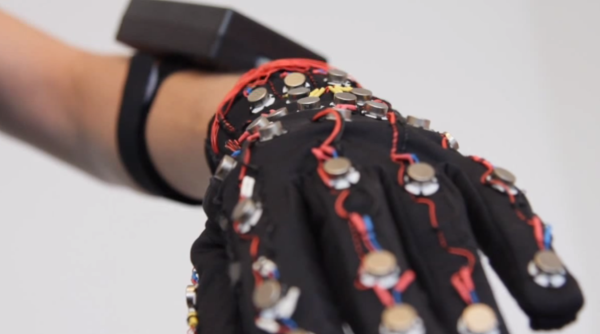
If you’ve been killing time texting or chatting with your pals via smart phone, odds are pretty good that you’re not giving much thought to the two senses that make it happen: your sight and your hearing. Those who are deafblind, however, cannot participate in these activities; and for many, the remote communication that most of us enjoy with our phones simply isn’t possible. Enter Berlin University of the Arts Design Research Lab. Here, they’ve developed the Mobile Lorm Glove, a haptics device that enables two-way remote communication via smart phone.

For the deafblind, Lorm is the tactile technique for communication. Lorm is a series of hand-tracing gestures that map to characters of the alphabet. To communicate with others, the gloved user can trace Lorm directly onto the pressure-sensitive inputs on the palm of the hand. To receive messages, small vibration motors on the back of the hand vibrate to indicate the message encoded in Lorm.

Originally, to communicate with the deafblind, we must first learn Lorm. With the Mobile Lorm Glove, however, we need only know how to send text messages, and the Lorm-decoding is handled with a look-up table running on our classic Atmega328 microcontroller. For the sharp-eyed, the back-side of the glove seems limited in its capability to transcribe continuous finger traces into discrete motor vibrations. However, with four shift-registers and 32 levels of motor-intensities, the designers address each motor with a technique called “funneling illusion” where continuous movement is simulated by gradually changing the intensity from motor to motor. For more tricks and details, take a look at their conference paper.

By wearing the glove, everyday communication can be made far easier with anyone with a smart phone. We’re jazzed that just a Bluetooth module, an Atmega328, and a collection of pressure sensors and motors can enable any cell phone user to circumvent the learning curve and open up a new conversation.

Continue reading “Mobile Lorm Glove Puts Texting Back Into Everyone’s Hands” →

Posted in Tool Hacks, Wearable HacksTagged ATmega 328, deafblind, haptic feedback, lorm, vibration motor

Search

Never miss a hack

Follow on facebook Follow on twitter Follow on youtube Follow on rss Contact us

Subscribe

If you missed it

  • UDP Broadcasting And Easily Finding Network Services

    10 Comments
  • How Airspeed Sensors Work

    21 Comments
  • The Teenage Angst Of 3D Printing: Solidoodle, Printrbot, And Bridges

    34 Comments
  • Flying Cell Towers Are A Thing

    20 Comments
  • The Trains With Rubber Tires

    36 Comments
More from this category

Our Columns

  • FLOSS Weekly Episode 873: Wait, That’s Not Open Source!

    No comments
  • Review: The Tanmatsu, A Year On

    2 Comments
  • Microsoft’s Topological Quantum Computing Claims Once Again In Question

    14 Comments
  • Hackaday Europe 2026 – Building A Retro PC From Scratch

    12 Comments
  • Hacking Routers Like It’s 2008

    17 Comments
More from this category

Search

Never miss a hack

Follow on facebook Follow on twitter Follow on youtube Follow on rss Contact us

Subscribe

If you missed it

  • UDP Broadcasting And Easily Finding Network Services

    10 Comments
  • How Airspeed Sensors Work

    21 Comments
  • The Teenage Angst Of 3D Printing: Solidoodle, Printrbot, And Bridges

    34 Comments
  • Flying Cell Towers Are A Thing

    20 Comments
  • The Trains With Rubber Tires

    36 Comments
More from this category

Categories

Our Columns

  • FLOSS Weekly Episode 873: Wait, That’s Not Open Source!

    No comments
  • Review: The Tanmatsu, A Year On

    2 Comments
  • Microsoft’s Topological Quantum Computing Claims Once Again In Question

    14 Comments
  • Hackaday Europe 2026 – Building A Retro PC From Scratch

    12 Comments
  • Hacking Routers Like It’s 2008

    17 Comments
More from this category

Recent comments

  • Chris Maple on GPU-Accelerated Autorouter Handles Monstrous PCB Designs
  • electron_flow on Retro Gear And The Mystery Of Cables Melting Into Cases While In Storage
  • KC on Positioning Without Satellites Or Base Stations
  • Russell Kent on Building A Micrometer-Level Displacement Sensor With 3D Printed Parts
  • dazzleworth on Positioning Without Satellites Or Base Stations
  • wdwms on Off To The Races With ESP32 And EInk
  • Ashtf on EInk PDA Revisited
  • Gus Mueller on Positioning Without Satellites Or Base Stations
  • Greg A on UDP Broadcasting And Easily Finding Network Services
  • KC on Positioning Without Satellites Or Base Stations
Logo
  • Home
  • Blog
  • Hackaday.io
  • Video
  • Submit A Tip
  • About
  • Contact Us

Never miss a hack

Follow on facebook Follow on twitter Follow on youtube Follow on rss Contact us

Subscribe to Newsletter

Copyright © 2026 | Hackaday, Hack A Day, and the Skull and Wrenches Logo are Trademarks of Hackaday.com | Privacy Policy | Terms of Service | Digital Services Act | Do not sell or share my personal informationCookie Management
Powered by WordPress VIP