Laser Removes Rust Like Magic

If you’ve worked with steel or iron, you will be very familiar with rust. You will have an impressive armoury of wire brushes and chemicals to deal with it, and your sandblasting guy is probably in your speed-dial list.

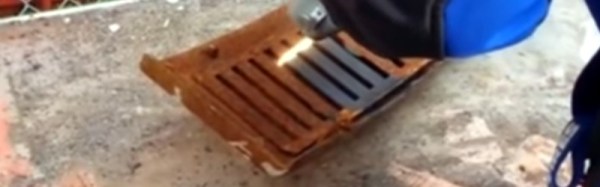
We’ve had more than one Hackaday reader contact us of late with videos showing an apparently miraculous handheld laser unit effortlessly stripping away rust, and leaving a near-perfect surface with little mess. Can it be real, they ask, is it an internet hoax? After all if you have done battle with the dreaded iron oxide you’ll know there is no miracle fix to the problem, however you deal with it there has traditionally been hard work involved.

So after a bit of research, we find CleanLaser, the German company whose products feature in the videos. Quoting their website: “Powerful, very short, rapid and moving laser pulses produce micro-plasma bursts, shockwaves and thermal pressure resulting in sublimation and ejection of the target material”. So yes, it seems they’re real.

The website is at pains to stress the environmental benefits of the devices over comparable sandblasting or similar technologies, but has very little information on their safety. They are available in power ratings from 12W to 1KW which is a hell of a lot of laser power to be projecting, yet the operators seem only to be wearing goggles. Perhaps this comes back to the “Powerful, very short, rapid and moving” bit in the quote above, is there no point source to sear your retina? Laser experts please enlighten us in the comments.

If you work with metal or grew up in a metalworking business, this machine probably has you salivating. Sadly for hackers and makers though it’s probable that it and ones like it will be out of our price range for quite some time. Still, the prospect of a guy with one in an industrial unit appearing in most towns can’t be too far away, and that can only be a good thing

The video shows the machine in action. Rusty fire-grate in, perfect shiny surface out. Perhaps only those of you who have spent many hours with a wire brush will understand.

Continue reading “Laser Removes Rust Like Magic”

Hexagon Cake Cutting

Cake Knife Tessellates Cake

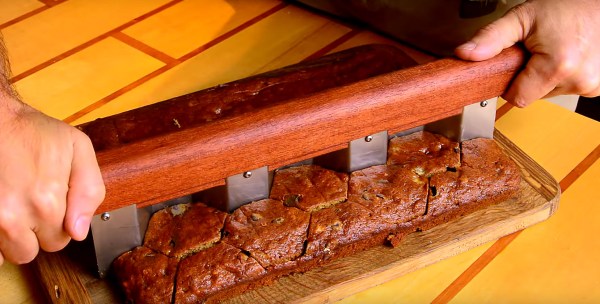
Rectangles? Squares? Pie slices? Who says dessert has to come in that shape? Why not triangles, circles, or even hexagons? Master of all things woodworking [Matthias Wandel] decided to solve this problem, and delved into a bit of metal working.

Using a strip of 26 gauge stainless steel, [Matthias] threw together some wood clamps in order to bend the metal into funky looking blade. He then put slits into a nice wooden handle and assembled the whole thing with a very slight positive curve, allowing you to roll the knife as you cut your confectionery.

As you can see in the following video, it works pretty well — and always, it’s a pleasure to see this man work.

Continue reading “Cake Knife Tessellates Cake”

Adding A Steady Rest To A Lathe

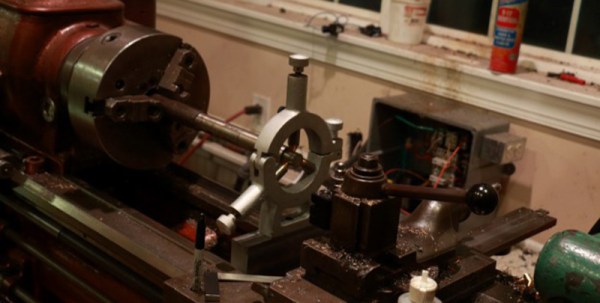
A steady rest is a tool for a lathe, enabling a machinist to make deep cuts in long, slender stock, bore out thin pieces of metal, and generally keeps thin stuff straight. Unlike a tool that follows the cutter, a steady rest is firmly attached to the bed of a lathe. [Josh]’s lathe didn’t come with a steady rest, and he can’t just get parts for it. No problem, then: he already has a lathe, mill, and some metal, so why not make the base for one from scratch?

[Josh] was able to find the actual steady rest from an online dealer, but it wasn’t made for his lathe. This presented a problem when attaching it to his machine: because each steady rest must fit into the bed of the lathe, he would need a custom bracket. With the help of a rather large mill, [Josh] faced off all the sides of a piece of steel and cut a 45 degree groove. To make this base level, [Josh] put one side of the base on the lathe, put a dial micrometer on the tool post, and got an accurate reading of how much metal to take off the uncut side.

With the steady rest bolted onto the lathe, [Josh] turned a rod and found he was off by about 0.002″. To machinists, that’s not great, but for a quick project it’s fantastic. Either way, [Josh] really needed a steady rest, and if it works, you really can’t complain.

Continue reading “Adding A Steady Rest To A Lathe”

3D Printering: The Combo Machines Cometh

There’s only so many ways to squeeze hot plastic out of a nozzle, and eventually witnessing the explosion of 3D printer designs over the past few years gets just a little repetitive. What then, is someone who dreams of a technological utopia, Star Trek replicators, and making a few bucks off a Kickstarter to do?

The answer, of course, is a combo machine. Where the Repraps, Makerbots, and the very high-end Stereolithography machines can only do additive manufacturing by laying down plastic or resin layer by layer, these combo machines can also remove material, be it plastic, wood, or metals such as brass or aluminum.

Continue reading “3D Printering: The Combo Machines Cometh”

Turning A 1942 Lathe Into A Functional Piece Of Art

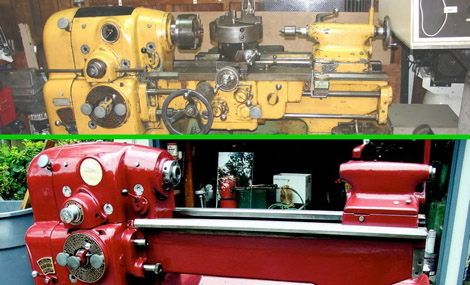
A couple of years ago, [macona] picked up a 1943 Monarch 10EE lathe. This monstrous machine is not only an amazing piece of engineering but an awesome work of art; not only can this lathe manufacture parts with exacting precision, it’s also a wonderful piece of machine age design.

The Monarch 10EE lathe was extremely high-tech for its time, and the War Dept Detroit Ordinance District tag on the cooling pump bears this machines lineage: this lathe was most likely used to make very precise military equipment such as the Norden bombsight.

After 60 years of faithful service, [macona]’s lathe picked up several coats of paint in different colors and generally fell into a state of disrepair. [macona] spent a great deal of time overhauling this lathe by replacing a bent feed rod, troubleshooting the motor problems, and eventually replacing the whole motor with a modern AC brushless servo. You can check out the improvement the AC servo made in a video after the break.

Of course no post about a rebuilt lathe would be complete without a few beauty shots. We’re extremely thankful for [macona] for not only restoring this machine, but also for sharing it with us. Thanks to [macona]’s restoration, this machine will hopefully be around for another 60 years.

Continue reading “Turning A 1942 Lathe Into A Functional Piece Of Art”