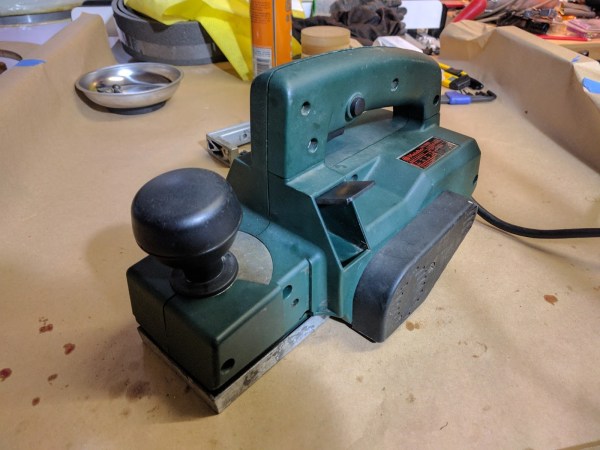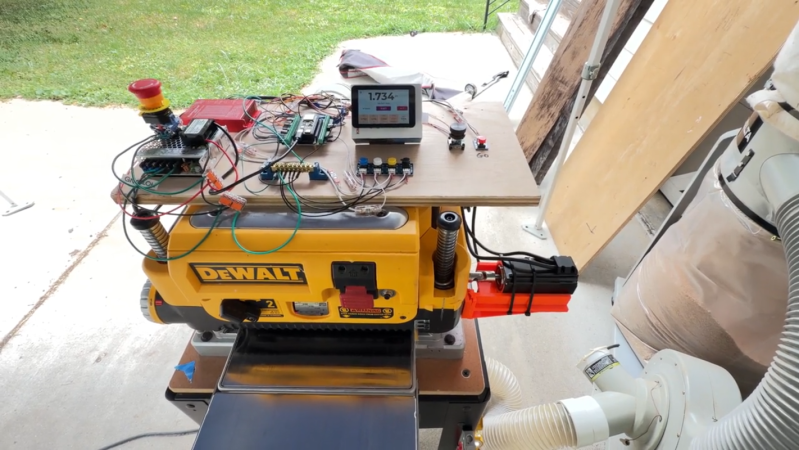
Having access to a planer opens up a lot of options for woodworking. It enables a craftsman to work with much rougher lumber and the finished results generally have tighter tolerances. But as [DendroLabsDev] found out, the height adjustment wheel on a planer needs a lot of turns to go from its lowest to highest position, and this gets tiresome when greasing parts during maintenance. So what started as a quick hack to quickly perform this single maintenance task eventually resulted in this programmable height adjustment that’s in use on the planer full-time now.
The motor attached to the height adjustment for the planer is a stepper motor, capable of around 1000 steps per inch. Since revolutions on this tool with the stock wheel adjust only a small amount per revolution, this can in theory enable very small tolerances to be dialed in consistently. Not only that, but [DendroLabsDev] has programmed it with a few different modes, the first of which allows a board to be planed to a certain thickness by making several passes, mimicking the workflow of a human-controlled machine. Then a device to zero the position was added, and then the ability to save the height adjustments to make replication across different boards was added, and then a mode to step through set amounts per pass.
What [DendroLabsDev] has essentially made is a high-dollar planer control that is actually available in the most expensive planers, but adapted for a DeWalt planer easily available and semi-affordable at many local hardware stores. It is also theoretically adaptable for any planer with an adjustment wheel, and [DendroLabsDev] has some plans to improve the control system and package it with a PCB and enclosure that would allow it to be a more accessible product for other woodworkers. Adding electronics to woodworking tools other than routers is a popular pastime, take this CNC-controlled scroll saw for example.