
FPGA’s have become especially useful to the hacker community of late. Once upon a time, these lovely pieces of dedicated hardware were fabled to only be within reach of deep pocketed graphics card producers working to up their shader and vertex counts. Today they’re often found in the bowels of high end network gear. As reprogrammable arrays of logic gates, FPGAs represent a happy middle ground between general purpose CPUs and dedicated silicon. After the break, we’ll recount some of the more interesting FPGA projects we’ve seen, like the open source graphics card we featured yesterday.
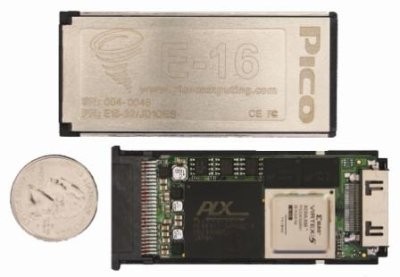
Some of our favorite FPGA work has been done by [h1kari]. We made it to a few of his con talks and his group has released several projects that use FPGAs to crack various encryption schemes. Lately he’s been presenting on cracking the A5 encryption used by GSM cellphone networks. They use fairly high end cards like the Pico E-16, but the code could certainly be adapted for use with lower end hardware.
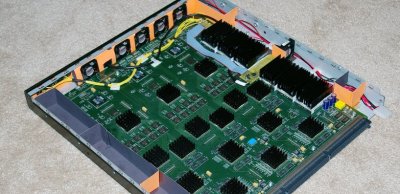
[Sklylark] doesn’t have his web interface up yet (but you can ask him nicely via irc) to allow open usage of his NSA@home project. He re-purposed some HDTV FPGA based encoding boards into a dedicated key cracking system for SHA-1.
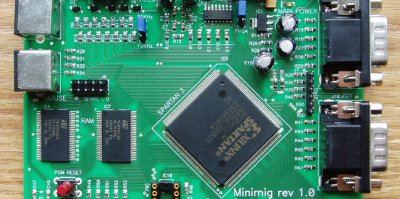
Nothing says high end like completely emulating really old hardware. The minimig (short for mini Amiga) that we featured so long ago has evolved into a production quality board and the full source has been released. Pics of the evolution can be found here.
If you’re interested in getting started with FPGA projects, don’t forget to peruse [John Kent]’s collection of documentation. The closest thing we seen to an entry level project is this 24 channel logic analyzer based on a ~$150 FPGA kit.












I followed the RFID cracking research from that one university for years. They never revealed details for there custom code.
My interests for FPGA are in the form of demos and cracking.
I think the ‘open source graphics card’ link is wrong – it links to the 24 line logic analyser.
Other interesting links on this topic:
http://www.fpga4fun.com/
seem to be a company who make beginners FPGA kits
http://www.opencores.org/
have open source fpga cores (a bit like fpga libraries)
http://www.rowetel.com/blog/?p=40
And it seems that someone runs Asterisk on a CPU in an FPGA.
You can always check out some of Cornell’s fpga projects as well:
http://instruct1.cit.cornell.edu/Courses/ece576/FinalProjects/
Another entry level suggestion:
http://www.fpga4fun.com/ has some nice starter material (and the associated http://www.knjn.com/ has some small FPGA boards.)
Anyone know any sites that list products one might recycle a Xilinx FPGA from? For example, a DirecPC USB Modem uses a Xilinx Spartan.
Also try FPGA Central (http://www.fpgacentral.com), it has some great resource for FPGAs.
Some of these projects are pretty advanced. For some introductory tutorials check out http://www.nandland.com which has many VHDL and Verilog tutorials and examples.