
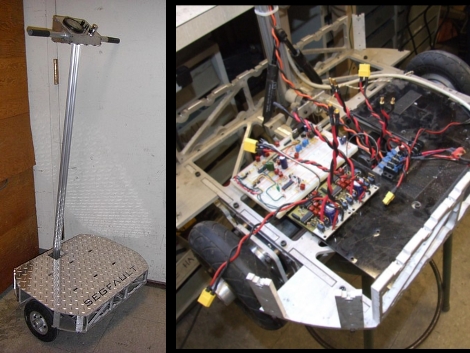
The Segfault is a balancing transport similar to a Segway, but it uses analog comparators instead of digital circuitry. On board you’ll find no less than twelve LMC6484 op amps. They take signals from the gyroscope and the accelerometer, balance and filter them, then drive the motor h-bridges accordingly.
[Charles], the guy behind the Segfault, is also the one responsible for DeathBlades. As with that project he does just as well at documenting as he does at fabrication. Take some time to enjoy his posts associated with this two-wheeled-wonder (especially the build process) and then watch in the video after the break.
[youtube=http://www.youtube.com/watch?v=OmsUr2JLXLI&w=470]
[via Make]












That high pitch motor whine would drive me crazy, but it’s a good exercise in discrete design!
+1 just for the name!
Giving that is the motor that is producing the high pitch sound due to the working frequency of the controller, can’t he just put a capacitor and resistor to make a simple high-pass filter?
I was going to say “awesome!”, but i can’t, my head is hurting because of that hellish screeching.
That’s impossible! According to Dean Kamen the Segway needs a pile of DSPs.
Wow, it’s name is great, analog design vs. segfault vs. Segway… It’s humor. :-))))))))))
“Its name.” Sorry.
very cool. Hmm is that a shopping cart in their shop? Full of ???
+1 for E/c^2 * sqrt(-1) * PV/nR
Haha, this is great. I’m all for microcontrollers and I’ve never done much discrete stuff like this, but I can appreciate the effort and also the balls it takes to do this old school.
Also @MrX, i think the resistor and capacitor would need to be rated to very high currents and so they’d be large and wasteful. Normally you just run these things at a higher frequency and its fine. I don’t yet know a whole lot about the different frequencies, but I know you can go to 20KHz and most people can’t hear it, while staying within the realm of good switching frequencies for these things.
Have to love the 8bitPeoples track playing the the background (Starscream?)
I think it took some ball to stand on that thing the first time.
@Taylor Alexander
Oh. I meant low-pass filter – which ends up being just a capacitor in parallel with the motor.
You have a point regarding the high-current though. For that filtering frequency, the cap must be in the nF scale where standard caps are small and “weak”.
Best programming language is soldering ;)
On the bright side instead of compiling and recompiling, you just adjust a few trimpots.
i hate people with blue hair