
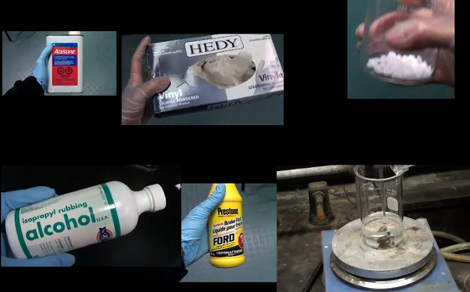
What to make your own chemiluminescent material? Check out this process that uses common household goods to synthesize luminol. You’ll need some lab equipment, and [NurdRage] mentions some precautions to take as luminol is not itself toxic, but some of the fumes and intermediary chemicals found during the process are.
Start by cutting up some vinyl gloves and boiling them with some rubbing alcohol to extract diethyl hexyl phthalate. After filtering, that gets boiled with water and some drain cleaner. The goal here is to continue the process until you have pure phthalic anhydride. Almost done? Not even getting started. This is a very complicated process, but fascinating to watch. After the break you’ll find the full video, or a five-minute abridged version for those that just want a taste of this experiment.
When we looked at the quantum dot manufacturing process a couple of days ago we asked for more chemistry hacks. This is exactly what we were talking about and are thankful that [Rob] sent in the tip. Keep them coming!
Short version:
[youtube=http://www.youtube.com/watch?v=lB_g2ddZZYk&w=470]
Long version:
[youtube=http://www.youtube.com/watch?v=58Ve69s0qD0&w=470]











Breaking bad?
LOL I was thinking the very same thing!
Well it’s the only way to make money as a chemist…. In Australia any way …. damn forklift drivers get paid more than technical chemists here… and yep I got my forklift ticket, 4 years applied science in applied chemistry … a waste for employment opportunity … but a great hobby !
So… What is luminol?
Luminol is the glow-in-the-dark stuff used in Glow Sticks, which glow when mixed with Hydrogen Peroxide released by breaking the internal glass vial (or by mixing more peroxide into a used-up glow stick).
Luminol is also used on police crime dramas (Dexter, etc.) to detect hidden blood spatters when spayed with Luminol and exposed to UV light.
No and no. Luminol isn’t used in glow sticks. It also doesn’t need UV light to emit a blue glow when reacting catalitically with the Iron ions in blood. I suggest you consult Wikipedia for further information on the reaction mechanisms.
Wikipedia is not a accurate web site as it can be edited as I learned in eighth grade
Cyalume is the stuff used in Glowsticks. but that is just the brand name stuff. anyone can make it if they have the weird combination of chemicals to get the colors. the peroxide is still there, but the cyalume is the magic behind the mystery
Wow, you almost sound intelligent until you quote Wikipedia as a legit source.
…but you are confusing chemisluminescence with triboluminescence. Two different mechanisms of glow in the dark. My personal favorite is phospholuminescence, it recharges with light and can be reused unlike luminol.
Triboluminescence isn’t right either. None of the chemicals / devices mentioned so far exhibit that effect.
David — What supporting evidence do you have to dispute my claims?
Actually, some glow sticks DO use luminol, and some use oxalates instead, depending on what color you want. Also, on CRIME DRAMAs (i.e. fiction) they DO use UV light to show the luminol. Dexter is one such show that “mis-uses” luminol in such a fashion.
Don’t be such a punk, dude!
vvvvv (see below) vvvvv
actually dexter doesnt mis-use the way luminol is used because when dex is looking for the blood and spraying luminol, the flashlight he uses you can clearly see is xenopus electronix crime scene uv flashlight, so there goes saying dexter does use luminol correctly
Just so you know, Luminol reacts with iron ions in blood and gives off a blue glow. It does not need a UV light to glow. In forensics, UV lights are used to detect certain body fluids (such as semen), which is probably why it is used in shows like Dexter. Not sure if UV light will enhance the glow, I’ll try that the next time I use it.
Actually, you’re both wrong. It is a chemical that reacts to iron that investigators use in a crime scene to see if there is blood (since blood is full of iron)
Your wrong is actually hemoglobin
Iron is found in the bloods hemoglobin. Maybe everyone here should do some research before leaving comments. So, far no one has been 100% accurate, just a lot of half truths. I now feel dumber for having read this banter of bullshit.
If you are correct about the iron, would it not show the iron in nails? That would not hold up in court as evidence of blood if true.
a substance that detects blood
It is a white to slightly yellow crystalline solid that is soluble in most polar organic solvents, but insoluble in water. its what CSI uses to find blood, reacts to the iron
Great synthesis !
I would see an other chemical hack in similar manner as this one about making photopolymer at home to be used in a DIY 3D printer based on projector (seen some months ago). I think that I am not alone with this desire :-).
Greg
I’m not much of a chem nerd, but it is nice to see what the other hackers are up to :) Keep up the goo work, hackaday
Yeah, he was working with “goo” at one point in the video… ;-)
Dude, clean your lab.
Inorite. My OCD was flaring off the chart.
Neat…I bet he has a method for making Lysergic acid diethylamide using things he found at the local auto parts store!
Great work, seems pretty straight forward to me :) lol
Neat! Pretty similar to the to a common o-chem lab, except that instead of starting with phthalic anhydride it is prepared from “homemade” o-phthalic acid. If anyone wants to know where he got this one from, check out sciencemadness – nurdrage is a member and likely got the idea from one of the threads discussing rubber gloves and shower curtains as a source of phthalates… Hopefully he doesn’t post a video on making qualludes, the intent of many of the threads contributors…
Almost completely OTc, except for the hydrazine sulfate – You’ll need to buy this one from a photographic supplier or a chemical distributor… OTC if you have one in town, but it ain’t gonna be in town unless your town a big city… OTC if you figure that although you’ll probably have to special order it, the only issues are an ORM-D sticker and packing list.
…Still fuckin cool though – Moreso when you realize how cheap it is to make and that you can use a huge variety of dyes to color its emissions.
actually he says he made hydrazine sulfate in a previous video. i checked it and he indeed uses OTC chemicals.
so the whole process is OTC.
Impressive :)
would luminol react if sprayed onto plain mild steel?
I work in an area where we try to detect pitting corrosion through aluminium and nickel coatings. A job normally done with copper sulhpate (it plates on Fe not on Ni or Al)
It would be perfect if you could cover a wide area nickel coating and the bits that glowed were the pits that had breached all the way through to the steel substrate!
I’d love to know if anyone could tell me whether Luminol glowed on contact with steel.
Update:
I tried with .5g of luminol, 200ml of demin water, 15g of NaOH and mixed 10ml of that solution in with an equal amount of 3% H2O2.
It glowed impressively with blood but no reaction with copper, mild steel, or slightly corroded steel.
If anyone has any ideas, let me know at nickattech-solutionsdotcomdotau
Can this go ka-boom?
Organic chemistry like this is very hard. Most “kaboomie” things are actually very easy, if used the same day. Making them pure enough to store safely is the hard part. When I was a kid I borrow a book from the ELEMENTARY SCHOOL LIBRARY called “A Boy’s Book or Explosives” targetted at 12-yr old boys. It told how to make nitroglycerin, fulminates, and stuff from simple household ingredients like used in the luminol video.
Back in the day, kids could buy dynamite at the hardware store, for blasting stumps (or for “fishing”).
Someday we may be “protected” from dangerous things like sharpened sticks (or pencils). Then we can watch hackaday videos on how to sharpen a stick by rubbing it on a rock. ;-)
Two notes here:
1] Wikipedia.org science entries are (over all) very accurate, as each entry has been vetted by an expert review panel (according to discipline/subject) and any statement or assertion of fact must have at least one proper citation; if it does not, this is clearly noted after the claim (“citation needed”). Show me any other popular science site (not counting journals) that is this rigorous as a matter of policy. And, wikipedia* is fact-checked and updated fairly routinely — especially if someone contests a claim in the text and submits this to the review panel (with supporting evidence).
*note: I do not work at wikipedia.org
Obviously, one should always look at other sources (a minimum of two additional sources is usually a good way to get a sense of scientific consensus,and accuracy)…but speaking strictly as a popular and general science resource, Wikipedia has few peers. Not everything on the Interwebs that is crowd-sourced is untrustworthy (and one could argue that being crowd-sourced makes it more reliable, re: ‘collective intelligence’, especially when over-sighted by expert in the field).
2] thanks for answering the question about luminol and steel reactivity (I had queried this for a project I was working on, not related to Nick’s application, but close, and ended up here at hackaday). I was planning on buying some cheap luminal powder and setting up my own experiment (first having queried some forensic pros) but it seems nick has done the science experiment for me.
NICK; it seems that the carbon atoms in the steel are too “tightly” bonded to the Fe (taking up all its outer electron orbitals), and thus do not permit bonding with the OH – radicals in the luninol…the steel’s crystal matrix configuration “cages” the Fe atoms too well for the Fe [the “oxidant”] to make contact with the chemoluminescent moiety in the luminol…or something like that.
Can I just go somewhere and buy Luminol? Here’s the deal, a friend of mine & her husband are moving into an old farm house. She was telling me how they have to clean it and do some repairs before they can move in. She will not go into the attic and says the basement gives her the creeps. I told her how I love old houses, and like to find out the history of a house if possible. So just to razz her I said I wonder if anyone has been killed in the house, haha… I also said she should get some Luminol and spray it on the floor where they removed the carpets to see if there’s any blood stains, haha… So I decided to do a search on Luminol and ended up on this site, I’m not a chemist and wouldn’t even want to attempt to make this stuff, hence my asking if there’s somewhere I can go buy it. lol She also said she’ll know if there are evil spirits or ghosts in the house when she takes her dogs there for the first time. Gotta figure out something her husband can do about making that happen. lol Her son told her she watches too many scary movies, I think he is 10, too funny…..
Luminol $10 for 2 oz. spray:
http://www.amazon.com/Pioneer-Forensics-LLC-PFLUM2OZ-Luminol/dp/B005DSFQJ4
Or $10.25 for 1 g. lab grade powder:
http://www.carolina.com/catalog/detail.jsp?prodId=872606
OMG thank you so much! Im trying to figure out how to make this stuff for my science fair as i thought it was illegal to buy. i didn’t know you could buy it, this has made my life so much easier thank you!!!
he sounds like a criminal
I d rather buying it online
Hey i have two questions
1. why did you convert it first to phthalic anhydride instead direct nitration? because of steric hindrance ? to have a higher yield of 3-nitrophthalic acid?
2. would luminol react with 4-nitrophthalic acid?
rephrasing the first question: Why the need to convert it to a phthalic anhydride instead of nitrating the phtalic acid?
Well damn, its funny to be batshit bored, then read this
Is there any way of identifying traces of blood without luminol or unsafe materials? (I.e. bleach, ammonia, anything that is recommended) My teachers will barely let me use Elmer’s glue for my science project (joke) and I need a substance that can react to a substitute blood solution of iron, chloride, and potassium. I don’t know a whole lot about chemistry or science. And I obviously can’t make this stuff, so help a stressed out student /:
Not only these, you should also see a list of drinkable fluorescent liquids which may give an idea on such items