
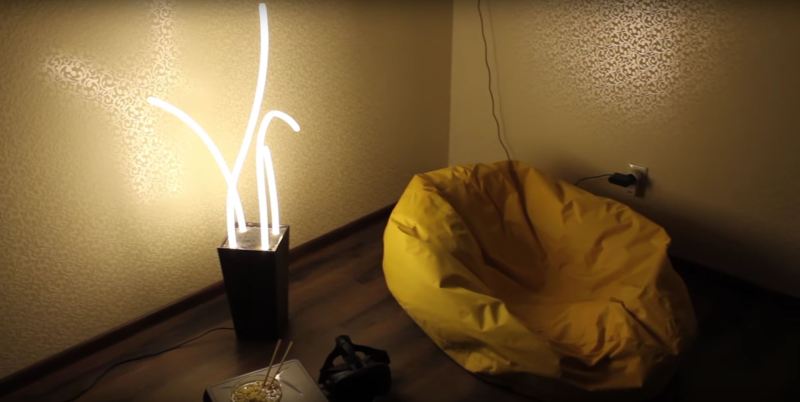
A good video game prop can really spruce up the decor — doubly so if it’s a glowing, futuristic potted plant transplanted(sorry!) straight from Deus Ex: Human Revolution.
Since it’s a bit difficult to grow neon light vines, this project is more lamp than plant. The maker with the green thumb is [Phil], from [JumperOneTV], and he is using five meters of warm white strip LEDs cut to varying vine lengths. He’s also procured a store-bought flower pot that conveniently mirrors the in-game model. The vines are made of 16mm polyethylene tubing which he’s shaped using a heat gun — setting their shape by pumping water through it — and secured in the pot with insulation foam. Feeding the LED strips through and wiring them in parallel was simple compared to his next conundrum: supplying the power.
http://www.youtube.com/watch?v=gyStNKpD0CA
In order to save some of the life of the LED strips, [Phil] is running them on 9V at about 1.5A using an adjustable power supply — well-hidden inside the flower pot’s base — emphasizing safety when turning your own. [Phil] doesn’t mention how he turns it on, but prodding slightly more living plant could be a neat trick when showing it off, provided your more musically inclined flora aren’t causing a ruckus.












One day regionally locked video will just not exist grrr. What ever JumperOneTV is :(
Which region are you in Saabman? – The channel does seem to work from the UK.
Perhaps the author can tweak his settings?
It’s not viewable in the United States either. What’s the point in hackaday posting a video nobody can see? In any case, it just appears to be side glow cable with some LED’s.
No idea what’s going on. The post was contributed by a US writer, and checked by US editors. Bah!
That said, it works fine from Germany. :)
If you care a lot, take this as an opportunity to learn about Tor or remote proxy server options. You’ll find it useful in the future anyway.
Like watching British TV. ;-)
James is from Canada, and it works for me too (also in Canada). Maybe Jenny edited it from the UK — dunno, I don’t have access to that info.
https://polsy.org.uk/stuff/ytrestrict.cgi?ytid=gyStNKpD0CA reports:
Disallowed countries
AU – Australia
KR – Korea (Republic of)
MX – Mexico
NZ – New Zealand
US – United States of America
Weird. The video is blocked for me too and I’m in Sweden, using a VPN that sometimes registers as German by a few sites.
Just gonna put this right here.
https://imgur.com/exVzbCS
[img]https://i.imgur.com/exVzbCS.png[/img]
(spoiler, it’s the Opera browser with built in VPN… chose Germany and could see the video. I recommend Firefox for everyday use, and avoid Chrome based browsers for privacy reasons. But this comes in real handy in a pinch.)
Apparently can’t watch the video in America, so now I’ll never know why the creator thought it was necessary to (presumably?) run the LEDs at a lower voltage to “save some of the life” in them.
Like, is he trying to pass this thing on to his grandkids? Or is the life of these LED strips not 50K+ hours like normal LEDs?
Heat concerns. They’re in sealed tubes after all. Paraphrasing the video ‘if you run these (120 LED/m) strips too hot you’ll lose like 50% of the brightness in 3 months’.
Separately, the quoted lifespan is rarely accurate, safer to assume it’s 50% of quoted at most.
I had similar LEDs sealed in tubes on my bike. This made them weatherproof, but it also trapped the heat and eventually that killed them. Running them at a lower voltage is indeed the solution to the problem.
his stinks of copyright trolling. On Youtube, this JumperoneTV leads to a channel with no videos. Seems fishy.
You in america by any chance? Over here in the UK there are definitely videos on the JumperOneTv channel. 18 of them.
Yea I’m in the US as well and it says no videos
It was only a matter of time before the world built an internet wall around America. ;-)