

With batteries being such an integral part of smartphones, it’s little wonder that extending the period between charging and battery replacement has led to many theories and outright myths about what may affect the lifespan of these lithium-ion batteries. To bust some of them, [HTX Studio] over on YouTube has spent the past two years torturing both themselves and a myriad of both iOS and Android phones to tease out some real-life data.
After a few false starts with smaller experiments, they settled on an experimental setup involving 40 phones to investigate two claims: first, whether fast charging is worse than slow charging, and second, whether limiting charging to 80% of a battery’s capacity will increase its lifespan. This latter group effectively uses only 50% of the capacity, by discharging down to 30% before recharging. A single control phone was left alone without forced charge-discharge cycles.
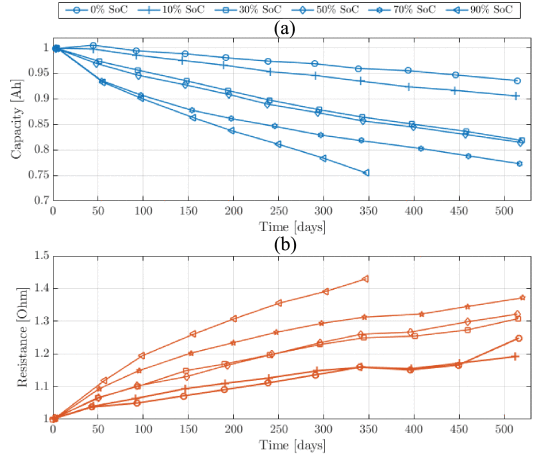
After 500 charge cycles and 167 days, these three groups (fast, slow, 50%) were examined for remaining battery capacity. As one can see in the above graphic for the Android group and the similar one for iOS in the video, the results are basically what you expect. Li-ion batteries age over time (‘calendar aging’), with temperature and state-of-charge (SoC) affecting the speed of this aging process, as can be seen in the SoC graph from an earlier article that we featured on built-in batteries.
It seems that keeping the battery as cool as possible and the SoC as low as possible, along with the number of charge-discharge cycles, will extend its lifespan, but Li-ion batteries are doomed to a very finite lifespan on account of their basic chemistry. This makes these smartphone charging myths both true, but less relevant than one might assume, as over the lifespan of something like a smartphone, it won’t make a massive difference.











The graph on the top shows that fast charging does – contrary to what the article says – not degrade the batteries faster. The capacity loss with fast charging was lower than with slow charging. But I would expect that the effect is not statistically significant as the variance is quite high.
Yeah, after reading the article, I’m still not sure what the results were (now I have to actually watch the video).
And using the statement “…the results are basically what you expect.”, in an article about challenging popular thought is less than useless; it is actively confusing.
I always read the comments section first and then the article itself if the comments are interesting.
FA reader.
We don’t like your kind.
I had to paste your comment into a Chatbot to understand it: ‘”FA reader” is a derogatory abbreviation for “F*cking Article reader.”
“We don’t like your kind.” This is a sarcastic, gatekeeping joke.’ ….. It’s actually quite a funny comment. I like it. Not enough humor on Hackerday.
Better still, paste this into your favorite Chatbot eg Gemini Pro: ‘Go to this website: ‘https://hackaday.com/2025/11/10/testing-whether-fast-charging-kills-smartphone-batteries-and-other-myths/’ , read the article and re-formulate it according to the comments section so that it makes better logical sense.’
And after looking at the graph where the axis doesn’t go through zero I’m even less sure what is shown.
In general, avoiding Li cell stress from deep-cycling will double the usable cycles from around 4k to 8k. If the cell is in “Fast” charge mode, it is usually above 60% full and in CV charge mode (this is ideal as long as the rates stay under 1C and keep temperatures between 4’C to 35’C.) Additionally, “boosting” the cells for an additional 11% power capacity can damage the cell. Leaving on charge can also be dangerous especially if the phone is turned off (some models will balloon the pack in a week), as some charger ICs are not smart enough to disconnect after a set period… and do not wait for cells to drop below 94% full due to slow self-discharge for the next cycle.
The best policy is to charge up to a “Storage mode” level on a concrete pad, leave on standby for 2 hours to stabilize (most smart chargers auto-disconnect), and then use the device down to 60% full (may show as lower on some models due to boosting/over-charging capacity inclusion.)
I have personally verified this phenomena, and if you store depleted LiIon or LiPol batteries they can often never fully charge again within only a few months (>20% rapid capacity loss). Hitting the battery protection low-voltage cut-out on a phone pack doesn’t mean anything, as many charger IC can’t even do slow preconditioning before CC and CV charge modes.
Many cell phones also hide degradation by over-provisioning capacity.. Thus, they round up the first 11% as 99% full.
Ran a 3 year long cell aging test the included several Panasonic, LG, and Samsung cells. Cell health was checked with the same RC3563 ESR Meter, and capacity tracking 0.5C charger.
Best of luck =)
It would have been helpful if they had tested the effect of leaving the device powered by the charger at 80% most of the time. No need to run it from the battery between charges. If you are at your desk, it can sit on the charger.
I typically get 4 or 5 years out of a phone battery. I buy older models for much cheaper than the new hotness, and only replace it when something goes kablooey.
This summer I replaced a phone I bought in 2019 because I had to charge it every night, and sometimes during the day. I didn’t baby the battery during those five years.
I think the conclusion that there are real effects, but they are unlikely to make a practical difference is spot on.
My phone is always fast charged while sitting on a large alloy heatsink. 2 years old now and still lasts 28 hours from a full charge.
That’s awful that we consider this performance normal.
I’m pissed off at my phone that I need to charge it twice a week. It’s only four years old, but that may not be relevant: The Ampere app claims the battery has 97% of its original capacity.
FWIW I charge it in “turbo” mode from a laptop charger, at 15 watts.
I just checked: Actually coming up on 5 years old. It’s a Moto One 5G Ace.
Twice a week? Motos are no wonder pieces of energy saving technology… You’re using it with cell / wifi off for most of the time then? No videos? No unneccessary doom-scrolling? Screen off most of the time?
Tell us your “charge twice a week” hacks pls!
I probably have to charge my phone three times a week, so not quite as good, but I just checked and in two days, I’ve apparently racked up 17 minutes of screen time. Personally, I tend to use a desktop computer for all my doom-scrolling, and a TV for videos, so my phone is mostly only used for messaging and 2fa.
As I understand there is 500 cycles for each group of the phones/batteries. So no wonder that 80 to 30 group “aged” much less – it went thro “half” of the energy back and forth vs other groups.
Yep. If one battery is charged and discharged more during the same period of time to reach the same number of charging events, the load is going to be different and the two cases are no longer comparable.
Lithium ion cycles are not calculated by how many times you plug them in, but by how much charge is put through relative to the nominal capacity. There’s actually two definitions of this: a cycle is either one nominal charge which may require multiple actual charges to accomplish, or one actual charge at the battery’s current state of health which is dropping over time.
The latter is more common as it’s easier to track, but it results in the same error because it means cycling the battery at the same charging interval to reach the same number of charging events means that the load on the battery must be dropping over time, whereas in reality what happens is that people see the battery go down sooner and charge it up more often.
Please rewatch the video – at 1:20, they explicitly state: “Since each round only uses 50% of the battery, we count that as half a cycle.” To me this means that they would have undergone 80-30-80 1000 times to reach 500 complete cycles of the battery.
They don’t account for battery state-of-health from what I remember, so Dude’s comment about that introducing error could still apply.
“To me this means that they would have undergone 80-30-80 1000 times to reach 500 complete cycles of the battery.”
This is assumption.
Bit of clarification from the author would be great.
This is also assumption but has at least some logical correlation with data – This could also mean 500 half-cycles… and as it happens life of battery is down half of the other ones (100 0 100).
One more sentence from the author can solve that easily.
On the side – I really like their testing rig.
Jesus what a useless ramble.
I had my last phone for almost 7 years (with upgrades from LineageOS). I limited the charging to 85% almost always. Also I did not discharge it to below 40% (with a few exceptions of course). I could not see any notable degradation in the battery performance over these 7 years. Of course I cannot say whether it would have been different if I had the battery treated differently, but experience suggests yes. I will continue doing this, since it does not really hurt me.
My Dumb phone stays charged for over a week. Is built like a brick and has a real torch in it. Has no spyware too, which is nice. JCB Tradesman 4 Phone is the future. And it has one wonderful feature I have wanted for decades. I can set a time for it to turn off and turn back on, between 11pm and 7am it’s off. This is a real off and not a ‘fake off’ do not disturb mode. Smart phones are dead to me, have no value. Going out and not caring if I have my phone with me is liberating. True happiness is living like it’s 1999 again. ;o)
Just a few days ago I was lamenting the fact that my first pocket computer — an old Handspring Visor — would last a month on a pair of AAA batteries. (I installed a GameBoy emulator and it dropped to a few hours — learned my lesson!) It did almost all of what I needed it to. #SomeoneShould build a low-power PDA again.
You’d think they’d start using lifepo4 batteries
They can fast charge, and don’t degrade or have a fire risk like lithium ion or li poly, and handle more charge cycles while being able to tolerate deep discharge better
Lifepo4 is like having the discharge ability of nicad but with a power density like lithium ion and lipoly
Another inestimable bonus: no blood cobalt.
Also lower voltage and less capacity per volume/weight.
True true. However, the voltage nicely matches that of most of the gadgets we build (I realise this is an article about phones, not IoT devices, bit I’m sure some of us are reading this with thoughts of our own projects in mind).
So yeah, I guess it’s all about choosing the appropriate tradeoff for your application. For most of my projects, I’d take safety and a more compatible voltage (and no blood cobalt) over higher energy density. I might even prefer that in my phones; dunno.