
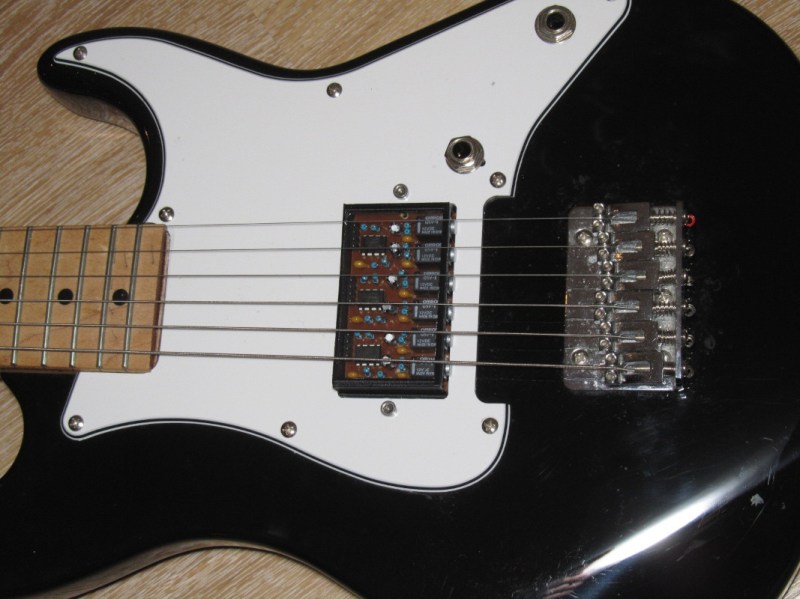
We’ve all built projects that are a rats’ nest of wiring and feature creep, but the best projects in the end are usually those that use a simple solution to elegantly solve a problem. [Kauz] had been thinking about a unique type of electric guitar pickup for a while and rather than purchase an expensive option or build a complex microcontroller-based system he found his elegant solution in the form of a common electronic component.
The core of this idea is that guitar pickups are essentially coils of wire, and are surprisingly similar to the coils of wire found in electromechanical relays. [Kauz] has used six small relays, left them unmodified, and then built an amplifier circuit for each to allow the vibrations of the guitar strings to resonate in the relay coils, eventually producing a sound. Not only do the relays work perfectly well as pickups, but [Kauz] also created a mixing board that allows the six relays to be combined into two channels, allowing for options like stereo sound for different strings directly out of the guitar or for different effects to be applied to different strings.
The build also allows for some interesting options in future versions as well. [Kauz]’s plans are eventually to build this into an instrument which can output polyphonic MIDI signals, where various strings can behave as different instruments. In theory, with six circuits six different instruments can be produced, and we’re excited to see what the next versions will look and sound like. In the meantime, be sure to check out some other guitar pickups we’ve seen that use even simpler parts found lying around the workbench.













Toadally rad!
This goes to show that there is a fine line between “component abuse” and “what a clever idea!” Phil Lesh of Grateful Dead fame was a big fan of mixing and EQing each string on his bass individually.
Big props for being the first hackaday instrument hack in a long time that actually gets played.
I did that once but I took the coils out first 😄.
I’ve been saving the little round beepers form countless motherboards, modems, and other e junk. Break open the cover take the metal disc off and a 1/2 inch one centimeter sized magnetic
polarized pickup is your big prize. Get 6 and you’re all set.
but do you have a matching set :)
20 @16 ohm, 26 @47 ohm, 4 that must be piezo discs. One is 130 ohm. The lowest ones have good pickup that I have tried, many of those have wire leads and a connector (speaker) from front panel use in PC,s. Easy to harvest, the rest are un-soldered from boards. I’m working with self sustaining single string slide not 6 string stuff.
A bit confused by this…. where is the bias field coming from? I didnt see mention of a permanent magnet.
In the build log it describes small disc magnets glued to the sides of the relays.
How about this idea? Ditch the disk magnets, and instead use a constant current source to apply a DC current to the relay coil. It can the become its own magnet.
A series resistor should decouple the coil from the supply and allow the “pickup” to swing however many mV above and below the bias value.
Audio would be picked off the relay coil through a DC blocking cap.
If the idea works, you could try varying the bias to gauge effect on amplitude and tone.
My ltd jr I changed the pickup to a Seth lover four months later, I noticed it’s upside down, but it sounds good so I’m not doing anything with it
Cool!
I have made guitar pickups out of relays and the coils from doorbells, and am using a hex pickup from a video game controller from a guitar playing game. I have a different effect chain for each string, so that it sounds like playing sin instruments at once.
I didn’t know about these relays in this form factor
Thanks for sharing this!
Now add sockets for the relays and let’s see which relay brand SOUNDS better! Will Omron be better for blues and Songle for heavy-metal?
What a cool idee, I go and try this on my experiments bassguitar.
In the late 70s-early 80s I read an article in an electronics magazine about a person who made a fretless bass, using fiber optic lines as the strings. Instead of a pickup it measured the change in transmissivity as the fibers flexed.
Fwiw he said it sounded like rubber bands.
IMHO, electric guitar was one of the marvelously entertaining forks off of Faraday (and Maxwell) fields theory.
I’ve personally known dozens of amateur musicians building and tweaking their own electrical guitars and some were rather good – given pretty much all of them were high school graduates. We are talking late 1970s, rural place in the middle of nowhere, with basic/crude tools of trade and unlimited curiosity trying to figure out just how far one can tweak what one has. Tube amps, yes, and the results were quite good.
(spoiler – I don’t need lecture on music; I am classical piano trained, been playing multiple instruments my whole life, writing my own music when I have free weekend, etc)
What I found fascinating is not that, but the fact that ordinary guitar, and electrical one – even more so, can produce such plethora of different tembres (compared with relatively fixed ones, say, flute or piano). The combination of such flexible instrument with such flexible chain of analog circuitry is what makes it so unique and incomparable with any other (except, of course, synth, but modern synth is a relatively modern invention, and it only started charting the waters properly maybe mid-1980s).
Back to the topic at hand, one coil per string is already quite kewl, since the vast majority of guitars will have one pickup coil (or two – second one usually reserved for noise cancellation). Where things get even more interesting is the phase-matching (and shifting), and I’ll stop at that, because that’s completely different topic on its own. I’ve also known self-taught geniuses who had figured that out, by themselves, in the late 1970s, soldering and fine-tuning their own internal guitar circuits, etc.