2025 Component Abuse Challenge: The Slip Ring In Your Parts Bin

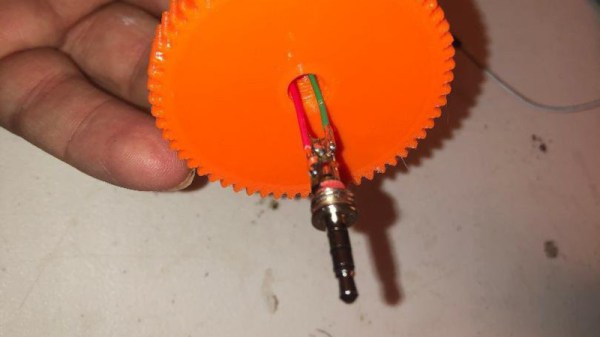
If you’re familiar with electrical slip rings as found in motors and the like you’ll know them as robust assemblies using carefully chosen alloys and sintered brushes, able to take the load at high RPM for a long time. But not all slip ring applications need this performance. For something requiring a lot less rotational ability, [Luke J. Barker] has something from his parts bin, and probably yours too. It’s an audio jack.

On the face of it, a 1/4″ jack might seem unsuitable for this task, being largely a small-signal audio connector. But when you consider its origins in the world of telephones it becomes apparent that perhaps it could do so much more. It works for him, but we’d suggest if you’d like to follow his example, to use decent quality plugs and sockets.

This is an entry in our 2025 Component Abuse Challenge, and we like it for thinking in terms of the physical rather than the electrical. The entry period for this contest will have just closed by the time you read this, so keep an eye out for the official results soon.

2025 Component Abuse Challenge: Dawg Gone LED Tester

The Hackaday 2025 Component Abuse Challenge is all about abusing electronic components in the service of making them do things they were never intended to. It’s not the 2025 Food Abuse Challenge, so in the case of [Ian Dunn]’s hot dog pressed into service as an LED tester, we’ll take the ‘dawg to be a component in its own right. And by any measure, it’s being abused!

Cooking hot dogs by passing an electric current through them has a long and faintly hazardous history to it — we’re sure we’ve heard of domestic hot dog cooker appliances that are little more than the mains supply on a pin at each end of a hot dog shaped receptacle. This one takes the ‘dawg in a bun with condiments, no less, and sticks an ordinary table fork wired up to the grid in each end. The LED testing is the cherry on the cake, because he simply sticks a pile of LEDs by their pins into the tasty sausage. It forms a crude potential divider, so there’s about enough volts across the gap between pins to light it up nicely.

We like this project on so many levels, though we’re not sure what heavy metals would leach out of those LED pins into the meat. If it’s inspired you to do something similar you still have a few days in which to enter the contest, so break out your convenience food and a pile of parts, and start experimenting!

2025 Component Abuse Challenge: Glowing Neon From A 9 V Relay

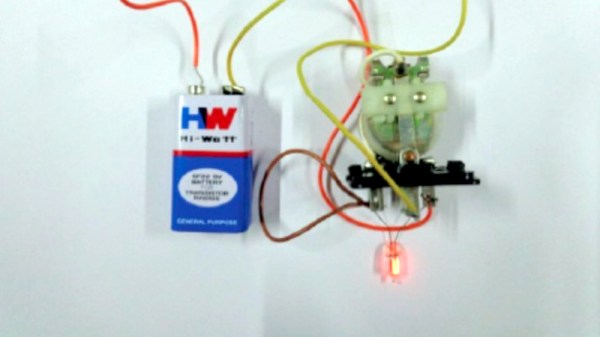
Most of us know that a neon bulb requires a significant voltage to strike, in the region of 100 volts. There are plenty of circuits to make that voltage from a lower supply, should you wish to have that comforting glow of old, but perhaps one of the simplest comes from [meinsamayhun]. The neon is lit from a 9-volt battery, and the only other component is a relay.

What’s going on? It’s a simple mechanical version of a boost converter, with the relay wired as a buzzer. On each “off” cycle, the magnetic field in the coil collapses, and instead of being harvested by a diode as with a boost converter, it lights the neon. Presumably, the neon also saves the relay contacts from too much wear.

We like this project for its simplicity and for managing to do something useful without a semiconductor or vacuum tube in sight. It’s the very spirit of our 2025 Component Abuse Challenge, for which there is barely time to enter yourself if you have something in mind.

2025 Component Abuse Challenge: Pushing A 555 To The Limit

The humble 555 timer has its origins back in the early 1970s as the NE555, a bipolar integrated circuit. Over the years it has spawned a range of derivatives, including dual versions, and ones using CMOS technology. Have these enhancements improved the performance of the chip significantly? [MagicWolfi] has been pushing the envelope in an effort to see just how fast an astable 555 can be.

The Microchip MIC1555 may be the newest of the bunch, a 5-pin CMOS SOT-23 which has lost the frequency control and discharge pins of the original. It’s scarcely less versatile though, and it’s a fine candidate for an oscillator to push. We see it at a range of values for the capacitor and resistor in an astable configuration, each of which is tested across the supply voltage range. It’s rated as having a maximum frequency of 5 MHz, but with a zero Ohm resistor and only the parasitic capacitance of an open circuit, it reaches the giddy heights of 9.75 MHz. If we’re honest we find this surprising, but on reflection the chip would never be a first choice for super-fast operation.

We like it that someone’s managed to tie in the 555 to the contest, and given that it still has a few days to run at the time of writing, we’re hoping some of you might be inspired to enter one of your own.

2025 Component Abuse Challenge: The Ever-Versatile Transistor As A Temperature Sensor

One of the joys of writing up the entries for the 2025 Component Abuse Challenge has come in finding all the different alternative uses for the humble transistor. This building block of all modern electronics does a lot more than simply performing as a switch, for as [Aleksei Tertychnyi] tells us, it can also function as a temperature sensor.

How does this work? Simple enough, the base-emitter junction of a transistor can function as a diode, and like other diodes, it shows a roughly 0.2 volt per degree voltage shift with temperature (for a silicon transistor anyway). Taking a transistor and forward biasing the junction with a 33 K resistor, he can read the resulting voltage directly with an analogue to digital converter and derive a temperature reading.

The transistor features rarely as anything but a power device in the projects we bring you in 2025. Maybe you can find inspiration to experiment for yourself, and if you do, you still have a few days in which to make your own competition entry.

2025 Component Abuse Challenge: Weigh With A TL074

The late and lamented [Bob Pease] was one of a select band of engineers, each of whose authority in the field of analogue integrated circuit design was at the peak of the art. So when he remarks on something in his books, it’s worth taking notice. It was just such an observation that caught the eye of [Trashtronic]; that the pressure on a precision op-amp from curing resin could be enough to change the device’s offset voltage. Could this property be used for something? The op-amp as a load cell was born!

The result is something of an op-amp torture device, resembling a small weighing machine with a couple of DIP-8 packages bearing the load. Surprisingly modest weights will change the offset voltage, though it was found that the value will drift over time.

This is clearly an experimental project and not a practical load cell, but it captures the essence of the 2025 Component Abuse Challenge of which it forms a part. Finding completely unexpected properties of components doesn’t always have to lead to useful results, and we’re glad someone had done this one just to find out whether or not it works. You still just about have time for an entry yourself if you fancy giving it a go.

2025 Component Abuse Challenge: A Transistor As A Voltage Reference

For our 2025 Component Abuse Challenge there have been a set of entries which merely use a component for a purpose it wasn’t quite intended, and another which push misuse of a part into definite abuse territory, which damages or fundamentally changes it. [Ken Yap]’s use of a transistor base-emitter junction as a voltage reference certainly fits into the latter category.

If you forward bias  a base-emitter junction, it will behave as a diode, which could be used as a roughly 0.7 volt reference. But this project is far more fun than that, because it runs the junctions in reverse biased breakdown mode. Using one of those cheap grab bags of transistor seconds, he finds that devices of the same type maintain the same voltage, which for the NPN devices he has works out at 9.5 volts and the PNP at 6.5. We’re told it damages their operation as transistors, but with a grab bag, that’s not quite the issue.

We’ve got a few days left before the end of the contest, and we’re sure you can think of something worth entering. Why not give it a go!