
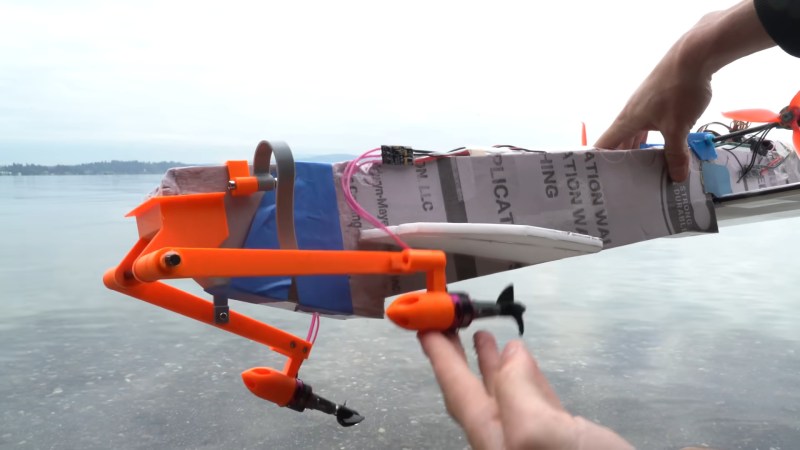
If there’s one thing [rctestflight] likes, it’s… probably radio controlled test flights. If there are two things [rctestflights] likes, the second one is probably ground-effect vehicles, AKA Ekranoplans. Tired of having them flip over and crash, he’s trying an an innovative solution: stick a planing hull on it.
Ekranoplans have a stability problem because the center-of-pressure isn’t static: as the wing gets closer to the ground, the high pressure cushion of air that creates the ground effect tends to put more lift rearwards. The net effect of that is to torque the vehicle nose-down, which is kind of a self-limiting problem at a fraction of a wingspan’s altitude. The opposite problem is more concerning: the higher the ekranoplan gets, the more it wants to nose up, and there’s nothing to stop it. That leads to the vehicle flipping over.
In this video, [rctestflight] takes a few stabs at trying to solve the stability problem– he starts with a flat planing hull on the nose, with the idea that the vehicle will be nose-heavy enough to ride serenely over the water. Water isn’t actually flat, though, and the nose bumping over the waves wasn’t able to do what he wanted. He then switches to a feeler that is to ride on-surface to adjust the pitch of the nose-mounted propellers–up if it pokes the water, down if it can’t– to provide passive pitch stabilization. That does work at some airspeeds, but produces a predictable porpoising effect, even with an elastic band for damping. That design might show promise with more refinement, but if you’re using something to give altitude feedback, it might as well be lidar.
The next iteration of the design places a pair of hydro-screw propellers on the nose, for all the world like a pair of outboard motors. We’re not even sure what to call the resulting vehicle, but “more stable” is unfortunately not it. It doesn’t seem to fly any worse, mind you, but certainly not well enough to justify the complexity, especially once he goes down the rabbit hole of adding suspension to the motors.
Ultimately he ends up refining the planning hull into a V-shape, since a V-hull can cut the waves and give a smoother ride than a flat-bottomed boat. We can’t help but agree with [rctestflight] that the standard configuration of a long hull and large horizontal stabilizer is likely the way to go, since the whole point of a ground-effect vehicle is to avoid the energy cost associated with skipping over waves. Still, it’s hard to deny that these prototypes are hacks, and we appreciate the brief lesson in aerodynamics he provides in the video.
Given some of the other projects he’s tackled, we’re kind of disappointed he didn’t try a hydrofoil.











a classic 3 point hydroplane is what he made there.
still a fun video
I wonder about having a solenoid to rapidly move a weight proportional to the angle of attack.
The effect will depend on where the center of pressure/lift is, because you’re effectively shifting the center of mass of the plane around that point. First you will create dynamic torque as you’re moving the weight, and then you’ll be shifting the center of pressure with the angle of the nose,
It might be doable, but it’s not going to be proportional. It’s going to be some weird feedback effect that has damping and resonating regimes at certain speeds and altitudes.
I highly agree as I fly complex remote controlled jets..Due to the design, several models have different reference points for the center of gravity and the center of lift. Take the F-14 Tomcat for example: When flying my models of this iconic jet, the center of pressure varies as the wings are swept back and forward. In the full scale F-14, the F-14 initially used “glove vanes” to keep the nose up when the wings are swept rearward. The was a bandaid for the issue of the cg moving forward as the wings were swept rearward. On later F-14’s the glove vanes were removed, using electronics to control the center of pressure and cg lift issues. I met Bob Kress, chief engineer on the F-14, and he explained how the wing sweep affected the cg and center of pressure, and his resulting “fix” for the issue.
Perhaps the blunt bow and canards defeat the boat in front airfoil in back starting proposition. Maybe a different design for the prow could be explored.
Have you thought about a different airfoil… One with a concave underside. The air compression as the air enters the wider gap will provide extra pressure towards the trailing edge under surface.