
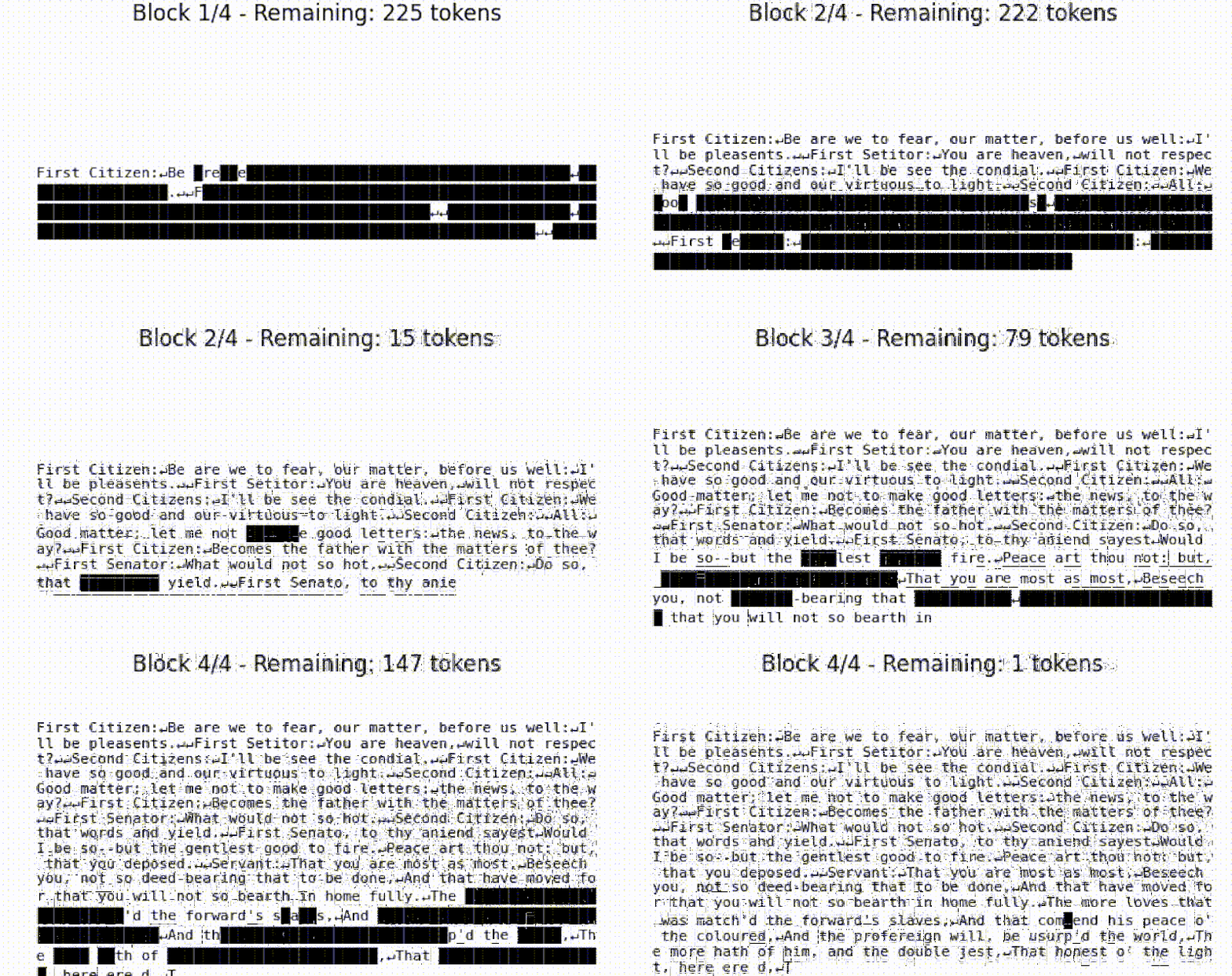
While there are many AI programs these days, they don’t all work in the same way. Most large language model “chatbots” generate text by taking input tokens and predicting the next token of the sequence. However, image generators like Stable Diffusion use a different approach. The method is, unsurprisingly, called diffusion. How does it work? [Nathan Barry] wants to show you, using a tiny demo called tiny-diffusion you can try yourself. It generates — sort of — Shakespeare.
For Stable Diffusion, training begins with an image and an associated prompt. Then the training system repeatedly adds noise and learns how the image degenerates step-by-step to noise. At generation time, the model starts with noise and reverses the process, and an image comes out. This is a bit simplified, but since something like Stable Diffusion deals with millions of pixels and huge data sets, it can be hard to train and visualize its operation.
The beauty of tiny-diffusion is that it works on characters, so you can actually see what the denoising process is doing. It is small enough to run locally, if you consider 10.7 million parameters small. It is pretrained on Tiny Shakespeare, so what comes out is somewhat Shakespearean.
The default training reportedly took about 30 minutes on four NVIDIA A100s. You can retrain the model if you like and presumably use other datasets. What’s interesting is that you can visualize the journey the text takes from noise to prose right on the terminal.
Want to dive deeper into diffusion? We can help. Our favorite way to prompt for images is with music.












Very cool tech. I expect something like this comes in useful for cryptoanalysis. As in, when you have a cipher text of unknown encryption, but you can make faster guesses of the plain text. A tool like this can expedite the search, as is, or with any available plain text of the author of the encrypted message.
I’m sure it will come in handy for those who are into CTF. (It is unlikely to make much of a difference with modern crypto, though.)
I thought it was un(de?)-redacting. Disappointed.
you are not alone…
I concur.
To un-redact a PDF, just copy the text and paste it into an empty text file. And voila! Your original text appears as if by magic.
People never learn. Thank goodness.
similar https://www.cambridge.org/core/journals/iraq/article/literary-texts-from-the-sippar-library-v-a-hymn-in-praise-of-babylon-and-the-babylonians/B477D54E6554CA35718880339B3736CD
homework from many many pieces
Reminds me of that guy who tricked stable diffusion into creating music by telling it to create images of the waveforms.
IMHO, it’s okay, but the main use really should be “untangle the 2008 financial mess, so that we don’t run into the same situation again” (which we will, collectively speaking, at some point, because The Mess got even thicker after the feeble attempts to un-mess/regulate it into something partially manageable).
I had my own pet theory that the 2008 mess was the low of the Kontrative Cycle (which was kinda sorta predicted to arrive early, 2004, I think – when compared with its other low, 1930s Depression, but since 2000s were the second part of the internet-growth-powered stretch, it was delayed a bit).
Regardless, I long wanted for the AI to untangle me a way to invest into lending banks at the fixed/guaranteed APR of 30%. Yes, credit the credit card issues at their exact rate. Fixed. Guaranteed by the full weight of the international maf … pardon … banking/financial system, with the full 100% support of international and domestic laws. Just like the credit cards, except it will be average Sam lending banks his meager/sorry money for the solid return, zero negotiations, and no backing out of the one-way contract created by me. How banks make that happen is not my problem, but it is fare to say that of all the years of making them juicy profit, now I want part of it back, on my terms. AI, get to work, we have to crack that nut wide open.
Credit card interest is high because it’s not secured debt. They lose a good chunk of that as unrecoverable debt.
You want to see 30% returns? Start replying to random crypto investment scams. You’ll get 50% or more returns… some of the time 😂
Naah, one of the boats I missed was real estate. One particular place seen its residential estate growth way pass 200% within four years. Gotta go to seek some other opportunities.
Crypto is non-fungible tokens, ie, sand dollars sold/resold/exchanged in hope to dump these onto some unsuspecting sucker. There are other ponzi schemas abound, and I generally stay away from these.
Translation – any currency has to be backed by something OTHER than the promise of the future returns. Some kind of industry or two. Ideally, industry that are known not to ever run out of steam, like anything food-related, or rare earth ores, or something that’s reasonably stable. Cryptos I’ve looked at are mostly hot air (gaming is a niche industry with rather limited ceiling, so it is about as good an industry as any other) riding off of some other industry/industries. In that sense I see no difference between cryptos and options, both promise future profits, and options are one of the worst preforming investments known – not much different from casinos.
But I know what I want – and it is decidedly doable, just not available to average Sam with his meager sorry finances. Say, insurance for the payment clearing, trillions per day, happens nightly, globally, only what, five clearing houses (US has two, EU has one, Asia has two or three, etc) handling pretty much 90% of the banking transactions, THAT’S the investment opportunity, insurance is not cheap either, but I want to invest into these, surefire returns, solid chunk of global economy, not some microsoft stock trading, or some other trifle shit sold to average Sam as “investment opportunities”, that’s peanuts already resold by dozens of peanut resellers.