
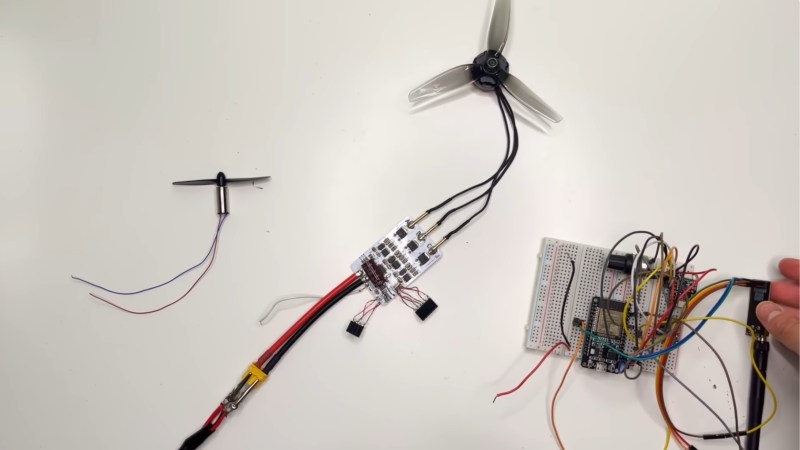
[Thinking Techie] takes us back to basics in a recent video explaining how magnets, coils, brushed DC motors, and brushless DC motors work. If this is on your “to learn” list, or you just want a refresher, you can watch the video below. It’ll be ten minutes well-spent.
The video covers the whole technology stack behind the humble DC motor in its various incarnations. Starting with basic magnetic effects, it then proceeds through 2-wire brushed DC motors and finally into 3-wire brushless DC motors (BLDC motors).
It’s worth knowing that the 3-wires in a BLDC motor are for three power phases; they are not, as in an RC servo, positive, negative, and signal leads. But, confusingly, the BLDC motors in your PC fans do have positive, negative, and signal pins. But that’s because, like an RC servo, the fans have controllers built into the case.
Thanks to [Keith Olson] for writing in about this one. If you’d like to go deeper into BLDC controller tech, check out Take A Ride Through The Development Of A Custom BLDC Motor Controller and Moteus Open Source BLDC Controller Gets Major Upgrade.












how is a 3-phase brushell motor ‘bldc’ ??
It is when you squint hard enough, or you look at it from a distance so it all looks like one smudge.
Electronic commutator built-in, speed control by applied DC voltage or current: BLDC.
No commutation in the motor, ESC sold separately: PMAC.
Commutation and ESC built-in, speed control by analog or digital signal separate of the power input: servomotor.
I mean, by those definitions, very few motors sold as BLDC are BLDC, they should all be called PMAC. Which is fair, but isn’t what someone needs to navigate the market.
On the flipside, it’s hard to find a BLDC motor because other motors are all incorrectly labeled.
When you actually want a small brushless DC motor, all you find is a bunch of drone motors and the aliexpress spam that lists every possible term anyways.