
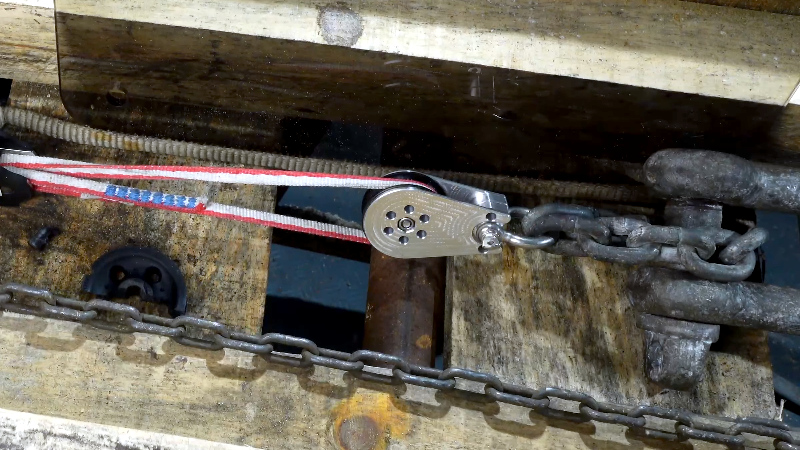
When thinking of humanity’s ability to harness wind energy, many people will conjure images of windmills from places like The Netherlands or Persia. But people have been using wind energy for far longer than that in the form of sailing ships. Using the wind for transportation goes back another four thousand years or so, but despite our vast experience navigating the seas with wind alone there is still some room for improvement. Many modern sailboats use a number of different pulleys to manage all of the rigging, but this new, open-source pulley can replace many of them.
The pulley, or “block” as they are sometimes called, is built with a polymer roller made out of a type of nylon, which has the benefit of being extremely durable and self-lubricating but is a bit expensive. Durability and lack of squeakiness is important in sailing applications, though. The body is made from CNC-machined aluminum and is composed of two parts, which pivot around the pulley’s axis to allow various ropes (or “lines”) to be inserted without freeing one end of the rope. In testing, this design outperformed some proprietary stainless steel pulleys of similar size.
Another perk of this design is that it can be set up to work in many different applications on a sailboat, whether that’s for hoisting a mainsail or pulling in a jib or any other task a pulley could be used for. It can also be stacked with others in many different configurations to build custom pulleys of almost any type, and can support up to 14 mm lines. For a sailor this could be extremely valuable, because as it stands each pulley on a ship tends to be used in only certain applications, and might also be proprietary from a specific company. This pulley is being released into the open-source world, allowing anyone to create them who wants one.
Thanks to [Keith] for the tip!










Now to make a 3D printable version :)
It would not be strong enough. You might be able to print the spindle, but not the housing.
Ok, maybe I should’ve said “Make it with a 555 timer”
Can it run Doom?
Depends, for some applications it might actually be strong enough.
Strong enough for what?
be interesting to see how that aluminium fares in the real world, might be ok for lake sailors. At sea it will be subject to lots salt water in most sailing applications. And blocks get knocked around a lot, so abrasion will be constantly disrupting the oxide layer. And finally the steel pins will be setting up galvanic corrosion. For anything safety critical i would prefer a stainless version i think
I’ve had to junk entire outboard motors becasre mixing of aluminum ans stainless parts. Their is a few thing you can use to try to prolong the life. none ideal.
Nice looking item, but why? Pulley blocks have been around since at least the Romans. Feels to me a bit like a breathless announcement of a revolutionary new circular anti- friction device. …
Seems a bit excessive to mill it out of a solid block. Two laser-cut stainless steel plates and a small intermediate piece would probably be cheaper to manufacture, and less prone to fatigue.
Or die stamp parts with same hole congfiguration to provide multi-use capability. 5 pieces plus assembly hardware provide multi-purpose configuration. On the plus for aluminum is the weight savings.
“Pulley blocks have been around since at least the Romans.”
We had pulleys exactly like this at least 60 years ago.(I’m sure much older).
We used them on the Rescue Squad.
I use a similar block in caving but it’s not stackable nor multi-configuration capable.
if you go to the science museum in london there is a navy pully block making machine. Well worth taking a look. Item all turned on one machine something like this https://commons.wikimedia.org/wiki/File:Science_Museum_-_Portsmouth_Block_Mills_6.jpg
For your galvanic issues:
1) 6061-T6 Al has good corrosion resistance. Have not researched the corrosion resistance of your Al.
2) Treat the finished parts with Alodine (or similar product). It will provide a yellowish surface coating that increases corrosion resistance. This process is fairly inexpensive. It is used on aircraft piston engine cases and airframes.
3) Use a quality teflon pipe thread sealant on the hardware. I worked for a company that operated manned submersibles to 1000 ft. When we switched from anti-seizing compounds on the fasteners (SS to Al) to the teflon thread sealant and our annual teardown and refurbishment became a lot less problematic and the corrosion was greatly reduced.
OceanGate?
I don’t think you counted the zeros in the depth…
Later certified to 3000 ft.
Harbor Branch Foundation
I was just on a large sailing boat in the Caribbean that was built in the 1990s and saw that it uses a lot blocks made entirely out of wood (though the pulley inside is some sort of metal and rotates on a steel shaft).
No. They’re not. The whole load bearing section is made of steel. The wood that you see around it is there to prevent the rope from slipping off the wheel, and to protect other things from when stuff bumps into each other.
This design is centuries old. In the old days iron and steel were expensive, so the amount of those materials was minimized.
They can be built with just wood for the structure, with the addition of rope wrapped around to add strength.
There’s some wooden ones being made in this video: https://youtu.be/z2Ei9oHqF54?si=7eiacebOJOO7EsaV&t=524
I want some for my Benchy.
I like that he found a way to not have a bearing inside – much simpler, less parts, easier to fabricate on your own. Even with more expensive plastics.
How is a sailing block different from any other block? Those are used in climbing, in hoisting loads, winching. How would you make this safe to stand under a load? Sea water seems to be fine, but what about dust or sand?
But patent?
Apart from not having a ball bearing, what is even new about it? Im not from the field, but this construction seems rather straight forward. You can try to protect the specific design, but not in the sense of an invention.
Opening the design.
I like the choice! If you wanted to make money off it, freedom-to-operate would be a challenge – I expect many others to hold patents on these devices and you would need to check and circumvent their patents. Selling those might be difficult from the liability. Both not an issue if you do it just for yourself.
I think [ThisOldTony] did a video a while ago on pulleys and belays.
We often get so caught up in pursuing high-tech innovations that we overlook the significant room for improvement in basic components like pulleys. The simplified rigging system resulting from this new design not only makes the boat lighter but also drastically reduces maintenance costs. I am very curious to see whether this design could be applied to large cargo ships to help reduce their reliance on fossil fuels.