
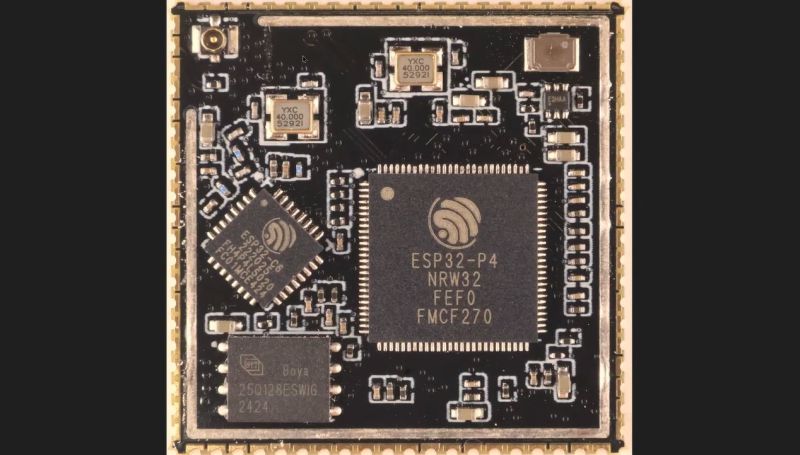
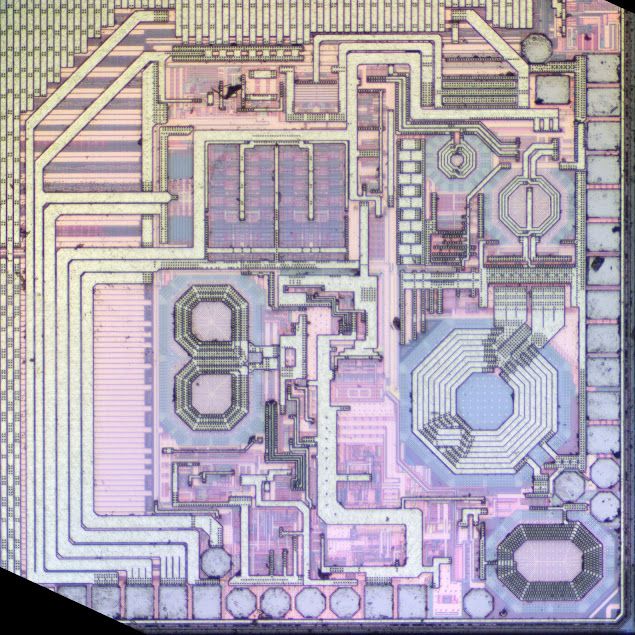
With the ESP32-P4 not having any wireless functionality and instead focusing on being a small SoC, it makes sense to combine it with a second chip that handles features like WiFi and Bluetooth. This makes the Guition ESP32-P4-M3 module both a pretty good example of how the P4 will be used, and an excellent opportunity to tear into, decap and shoot photos of the dies of both the P4 and the ESP32-C6 in this particular module, courtesy of [electronupdate]. There also the blog post for those who just want to ogle the shinies.
After popping the metal shield on the module, you can see the contents as in the above photo. The P4 inside is a variant with 32 MB of PSRAM integrated along with the SoC die. This results in a die shot both of this PSRAM and the P4 die, though enough of the top metal seems to remain to clearly see the latter.
The Boya brand Flash chip is quite standard inside, and along with a glance at the inside of one of the crystal oscillators we get to glance at the inside of the C6 MCU. This is a much more simple chip than the P4, with the RF section quite obvious. The total die sizes are 2.7 x 2.7 mm for the C6 and 4.29 x 3.66 mm for the P4.












Fascinating detail that the ESP32-P4 has its PSRAM die glued on top of its SoC die. Having done some programming and debug work with ESP’s IDF-SDK, I can attest to the ESP32 parts, and their software, being extremely sophisticated and complex.
What? I’m asking because i don’t know: Why would someone get the cut-down ESP32 and then add a radio? Instead of getting the ‘regular’ ESP32?
The P4 is vastly more capable than any other ESP32 – MIPI DSI, more GPIOs, faster cores (two 400 MHz RISC-V), the already mentioned 32MB PSRAM. The only thing missing is a radio – which is actually a good thing for some use cases because a lot of people want an ESP with wired-only I/O, but other people want wireless hence the radio coprocessor.
I mean, if you just read the article it’s obvious.
P4 die size: 4.29×3.6mm without radio
C6 die size: 2.7×2.7 including radio
You’ve started with a false premise. An ESP32-P4 isn’t a cut down ESP32, it’s a high performance ESP32 with additional IO.
With the primary selling point of the ESP line removed. Cut down but at the same time built up.
Wireless comms may once have been the primary selling point of the ESP line, but they’ve since become very capable microcontrollers that happen to have wireless comms. An even more capable micro that doesn’t have (built-in) wireless comms is still an appealing product.
The price of ESP32-P4 boards is actually less than Arduino MEGAs. I think we have a clear challenger that offers more.