
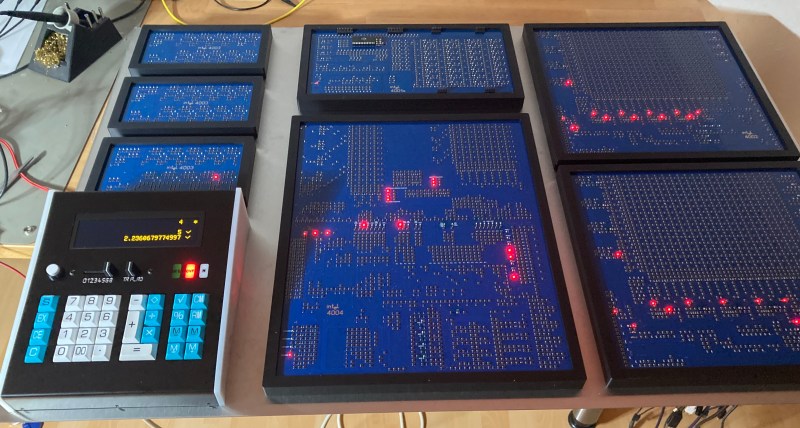
Though mobile devices and Apple Silicon have seen ARM-64 explode across the world, there’s still decent odds you’re reading this on a device with an x86 processor — the direct descendant of the world’s first civilian microprocessor, the Intel 4004. The 4004 wasn’t much good on its own, however, which is why [Klaus Scheffler] and [Lajos Kintli] have produced super-sized discrete chips of the 4001 ROM, 4002 RAM, and 4003 shift register to replicate a 1970s calculator at 10x the size and double the speed, all in time for the 4004’s 50th anniversary.
We featured this project a couple of years back, when it was just a lonely microprocessor. Adding the other MSC-4 series chips enabled the pair to faithfully reproduce the logic of a Busicom 141-PF calculator, the very first to market with Intel’s now-legendary microprocessor. Indeed, this calculator is the raison d’etre for the 4004: Busicom commissioned the whole Micro-Computer System 4-bit (MCS-4) set of chips specifically for this calculator. Only later, once they realized what they had made, did Intel buy the rights back from the Japanese calculator company, and the rest, as they say, is history.
Since its history, it belongs in a museum– and that’s where this giant, FET-based calculator is going. If you happen to be in Solothurn, Switzerland, you’ll be able to see it at a new history of technology exhibit opening at the Enter Museum in 2026. Do check out the write-up and links at 4004.com if you want to learn about this important piece of human history.











Can 4004 run Linux?
I don’t see why not, with RISC-V or ARM emulation, as has been done with 6502 and AVR. Might take a few weeks to boot though.
Yes, there was even a HaD article about it. [Dmitry Grinberg] did so here: https://dmitry.gr/?r=05.Projects&proj=35.%20Linux4004
Someone ran an emulator on the 4004 to do just that. https://linux.slashdot.org/story/24/09/28/2238229/how-i-booted-linux-on-an-intel-4004-from-1971
Forget Linux, can it run Doom? ;)
Disagreements often arise over “who invented it first.” In the case of the first microprocessor, it comes as no surprise that this question is disputed. My take on the 4004’s place in history (“civilian” or otherwise) is this: yes, the F-14 avionics “Central Air Data Computer” (CADC) was truly a groundbreaking use of multi-chip, silicon integration (LSI). Ray Nolt and his team deserve bragging rights. They do! But to me, whether the CADC was “the first microprocessor” is a distraction. Intel really did “shoot the first salvo” in the “war” of customer-programmable microprocessors (while companies like Texas Instruments were a mere “photo finish” behind them). There is no sense in quibbling over whether the CADC was a custom DSP or a general purpose computer. In my considered opinion, the key feature of the 4004 was that anyone could write code for it, burn their code into a ROM, and make a microprocessor the “brain” of their product. And this enabling technology is what kicked off the microprocessor industry as a driver of innovation. A revolution takes more than one inventor. It takes a village.
By what about the Four Phase Systems AL1?
Sellam
Ken Shirriff’s blog provides an unusually readable treatise on what it means for a chip to be a “microprocessor” in his article about the TMX-1795 (nee TI’s “8008”).
http://www.righto.com/2015/05/the-texas-instruments-tmx-1795-first.html
Shirriff explains why, to him, the AL1 was really a “bit slice” ALU and not a microprocessor at all (Four Phase Systems’ 24-bit computer had three 8-bit AL1s inside plus a separate PC and micro-sequencer). The article’s die photographs back up his claims. Ken also articulates why the CADC wasn’t a general-purpose computer, let alone a single-chip microprocessor. I spent years appeasing Ray Holt, and while I agree with the article, I don’t think it really matters. Ken sides with my position in his conclusion, “the inevitability of microprocessors,” where he argues that the microprocessor was not really an invention.
P.S. Federico Faggin deserves bragging rights too, for squeezing an entire CPU onto a single chip. (Or should he be remembered for the 8080? Or for the Zilog Z80?)
And it is a fluke of history that Texas Instruments (TI) was not given more credit. They developed a fixed-function, single-chip calculator (around a 4-bit microprocessor with internal ROM) at the very same time Faggin was working on Intel’s multi-chip Busicom 141-PF printing calculator contract.
It was stiff competion from single-chip calculators that motivated Busicom to negotiate away exclusive rights to the Intel 4004 family in exchange for lower prices, allowing Intel to pivot from being a semiconductor RAM company to, well… The rest is history.
There was an Intel 8008 to.
Very true, but IMHO no one will remember the 8008.
Amazing calculator!
Looks like they cheated with the 4001 ROM.
Well, we only replaced the ROM transistor array with an programmable EEPROM, the remaining parts such as I/O etc are unchanged. To build a ROM out of transistors hardwired to a certain program code is possible, but very unflexible. So I wouldnt call it a cheat
I supported Scheffler’s practical decision to prototype his first “discrete transistor” 4001 ROM using a flexible EEPROM. The original Busicom calculator accommodated either four or five 256×8 ROMs (allowing for an optional square-root function). This many “100% authentic,” giant 4001 replicas would have required customized pick-and-place scripts for ~4,000 additional transistors, providing little benefit other than “authenticity.” For flexibility, cost, and space savings, the upcoming Enter Museum exhibit will use a single ROM “chip” (PCB) for code storage and I/O logic. The team did debate whether to design a 4001 PCB faithful to Kintli’s reverse-engineered schematics. In the end Scheffler prototyped his “4001x” using discrete transistors only for bus and I/0 logic, the mask programmable ROM array replaced with an EEPROM. I think this was a good compromise.
My very first job was an assembler building LORAN C receivers. We used the msc4 set and eeproms. Max ram, hand made 7 segment displays each segment was a hand stuffed single led hand wired to a header. It was very hi-tech for it’s time 76-77.
Years before GPS, LORAN C was developed for marine navigation in coastal waters. After miniaturization of the sort [Ditdotdodo] describes, this technology became suitable for aviation!
I love reading about how pre-home-computer-era microprocessors were leveraged back in the day.
Anyone got more stories to tell?
A bit of a common myth here – the 4004 is completely unrelated to the 8008. The ISA of the 8008 was designed by the DataPoint computer terminal company, and is the basis if the modern x64 ISA.
Federico Faggin and his team worked on the 4004 exclusively, and and shared no ISA details whatsoever.
The 8008 team just liked the name of their internal rival, and saw a marketing opportunity.
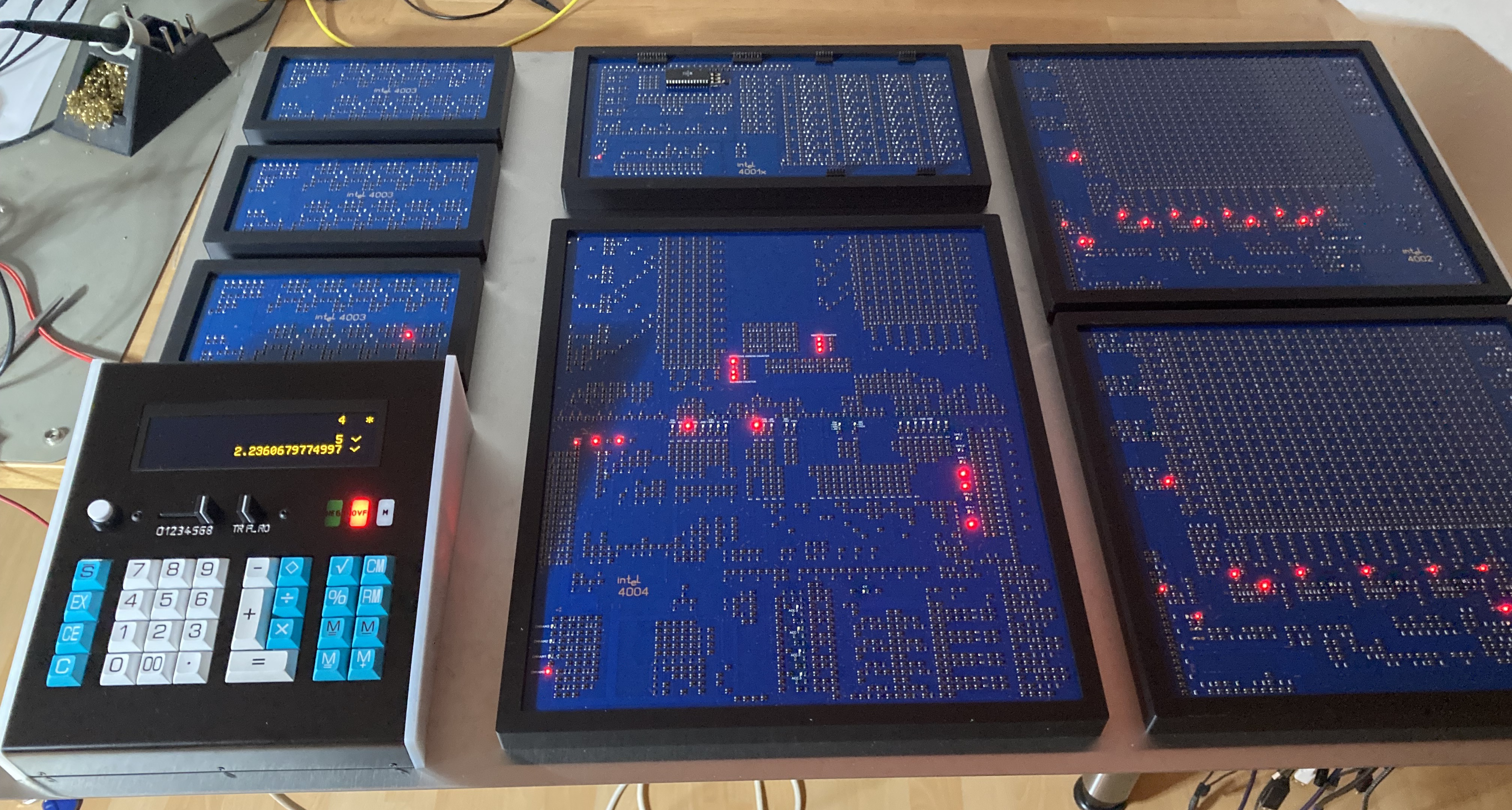
I had a hard time reading and counting the “chips” mentioned in the caption about midway throught the article.
The source material says:
Note: two 4002 RAMs.
Hackaday caption:
Note: three 4002 RAM “chips”
I also only count two on the right side.
You are right. It is just a typo in the Hackaday article. I confirmed that the photo legend at 4004.com is accurate. The Busicom calculator firmware employs one 10-bit 4003 shift register to scan the keyboard matrix plus two 4003s (20 bits total) to control the line-printer’s hammers and black/red ink ribbon.
I’m not a fan of Germans, having lived there for 10 years, but you can’t talk about the first computer and not mention Konrad Zeus’s Z machine from 1938, predating this calculator by 3 decades.
Thanks, I am German. And I never hear about Konrad Zeus. And Z3 was not a silicon chip
Anyone interested in buying a good condition vintage 4004 chip?