
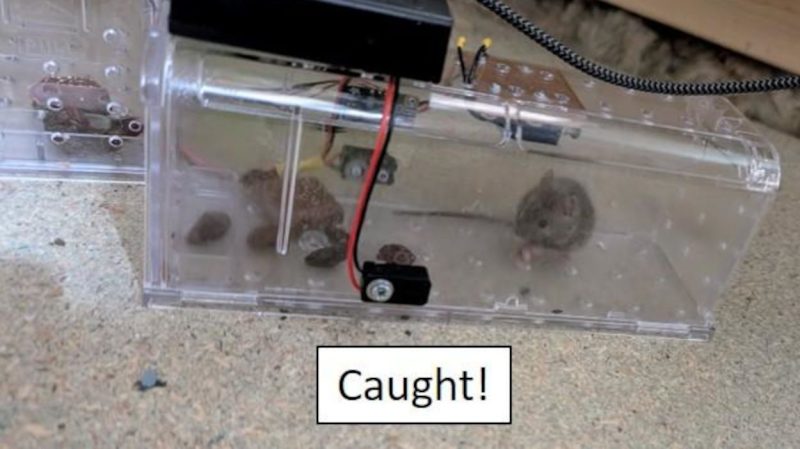
“Build a better mousetrap and the world will beat a path to your door,” so goes the saying, but VHS beat Betamax and the world hasn’t been the same since. In any case, you might not get rich building a better mousetrap, but you can certainly create something more humane than the ol’ spring’n’snap, as [nightcustard] demonstrates.
The concept is the same as many humane mousetraps on the market. The mouse is lured into a confined cavity with the use of bait, and once inside, a door closes to keep the mouse inside without injuring it. [nightcustard] achieved this by building a plastic enclosure with plenty of air holes, which is fitted with a spring-loaded door. When a mouse walks through an infra-red break beam sensor, a Raspberry Pi Pico W triggers a solenoid which releases the door, trapping the mouse inside. This design was chosen over a passive mechanical solution, because [nightcustard] noted that mice in the attic were avoiding other humane traps with obvious mechanical trigger mechanisms.
As a bonus, the wireless connectivity of the Pi Pico W allows the trap to send a notification via email when it has fired. Thus, you can wake up in the morning and check your emails to see if you need to go and release a poor beleaguered mouse back into the wild. This is critical, as otherwise, if you forget to check your humane trap… it stops being humane pretty quickly.
If you’re looking for more inspiration to tackle your mouse problems, we can help. We’ve featured other traps of this type before, too. Meanwhile, if you’ve got your own friendly homebrew solutions to pesky pest problems, don’t hesitate to hit up the tipsline.












Overnight is still not good. I have had mice die from stress in less than 4 hours, and switched to snap and break the neck traps. No, not in an open or high traffic area, but a closed off attic, where every other fall a few find a way in.
I am wondering what are they going to do with the live mouse afterwards?
If they are drowning it in water, or using CO2 (recommended “humane” way), to kill it, then a snap and break the neck trap would like be more humane… (quicker and less suffering).
You don’t have to kill things you know. You can always take the outside things that found their way inside and take them back outside a ways away.
“You can always take the outside things that found their way inside and take them back outside a ways away.”
With meeces it needs to be about 3-5 miles, or over a major highway [frogger], as they will absolutely try to reseek their home.
Don’t forget the stress the animal will feel being moved to an unknown area, or that it was potentially born inside your house and you are ‘wilding’ it to the peregrins, or that it might well just go into someone else’s home and get snapped anyway.
More humane to just snap it’s neck fast and quick.
So it’s more humane to kill it without a chance than to at least give it a chance to survive. I love your mindset, you are probably very fun at parties.
@sweethack
It depends on which one you find more “humane”: death or torture.
Death or torture?
Cats ask ‘Why not both?’
The most magnificent gift I’ve ever received?
A headless squirrel?
Thought that counts…
Baba Yaga gave me the his favorite thing (was likely full).
He usually ate the best bits before leaving the rest for me, but that once I even got the liver.
Too bad it was too far gone to make a stew, I snuck it into the trash while he wasn’t looking.
You don’t need to keep pests alive, you know? Mice are pests. They destroy your house and furniture, contaminate your food, their feces contains deadly bacteria, they host several diseases, they are fierce predators responsible for several bird species being extinct, and maybe you have heard of the Black Plague somewhere.
Why endanger your own family over a mouse? Kill it, as quick as you can. Catch and release just throws the problem on your neighbor’s house. You don’t need to make them suffer for the sake of it, but thinking they are nice fluffy innocent animals is naïve…
Hmm… now that you say this, I might experiment with loading live mice into a potato gun and firing them over at neighbour properties. Could be a quite kinky and fun way to spend summer afternoon.
And let it potentially find its way back to my house and cause tens of thousands of dollars in damage? No way in hell.
Mine went to the furthest corner of the garden, where there are natural cover, and AFAICT there were no returns.
Notes:
Several species of mice are protected were I live.
Rolled oats works well and lasts long in a dry space.
I would love to see a Rube Goldenberg mouse trap, including pneumatic tubing, to deliver the critter to the furthest corner of the garden.
“Here’s a fax from Cooter in Orlando…’In retrospect, lighting the match was my big mistake”
Prefer ‘snap’. Done.
maybe they have a pet snake.
Feeding a live mouse to a pet snake is cruel to the mouse and risks injuring the snake.
or as i call it, a natural meal for a snake and a natural death for a mouse. nature is very metal.
First you have to break the mouse’s legs so the snake doesn’t get hurt by swallowing a kicking live mouse. So doubly cruel to the mouse…
I feed mine to the kookaburras. If you’re trapping them, they have to be relocated a few km to ensure they don’t return and continue to defecate and urinate all over the kitchen and pantry, looking for tiny scraps of food that I’ve missed when cleaning up after dinner. No-one’s perfect and I dare anyone to claim their kitchen is both pristine and mouse-proof. I’ve even observed teeth-marks on tupperware containers of bread and rice. They’re persistent little buggers.
Risks injuring the snake? No, it really doesn’t.
Snakes eat mice outside your house, in the forest/woods. Is that cruel or risky for snakes?
If you’ve ever seen a snake in action you wouldn’t use the term “risky” referring to the snake.
Actually, it can. Snakes eat things alive, alive things tend to kick and struggle when they are eaten alive. My pet snake keeping neighbor broke the legs of live mice before feeding them to the snake. The big issue is eye damage and infection risk according to him.
I CO2ed a mouse once and I found it very unpleasant. I searched online for a humane way to kill the mouse, and it was pretty rough.
Only thing worse was having to put a gecko out of its misery after it got stuck on a cockroach glue trap that the building contractor placed. I actually cried when I couldn’t get it unstuck and decided a quick blow with a frying plan would be the most humane way to end the suffering.
You could use acetone or some brake cleaner to dissolve the glue.
Vegetable oil will unstick critters from glue traps.
‘Anybody who can heft a frying pan owns death’
Burroughs.
I got to kill, clean, cook and eat a chicken on a riverbank in middle school.
IIRC it was part of an ‘Outward Bound’ class.
Hippie teachers were trying to uncityfy and smarten the kids.
The best way is to grab the chicken by the head and spin your hand in a small circle until the head pops off.
Better then cracking them like a whip, though they run further with the whip method.
When I design life support systems I always include more CO2 absorber than O2. This way once life support consumables run out the crew dies of nitrogen narcosis (happy) rather than CO2 poisoning (unhappy, painful, splitting headaches, unable to breath, etc.).
The paradox of “humane” is that it’s more about appeasing the human than providing a painless and stress-free death to the animal.
The concern for animal welfare arises out of the empathy that we have towards each other – a biological trait that ensures co-behavior – because perceived pain in others causes pain in us. That pain is imaginary, so as long as you can pretend that the animal is happy, you’re fine. Whether there is suffering, and whether it matters in a deeper philosophical sense, is a secondary concern that is usually ignored. The “bad thing that’s happening” is not that the animal is hurt, but that I am hurt.
just get a cat and leave the torture-murder to an animal that will actually enjoy it. the cats have a better health care plan than i do, they will be fine.
Ah, but then you get animal rights activists up in arms about how keeping a cat indoors is torture and letting it outside is murder and you’re complicit in it.
Cats in the wild though – see no evil, hear no evil…
I preferred VHS over Betamax for its 6+ hour tapes for time-shifting.
That’s mainly why VHS won – longer recording time. Tape handling for Betamax was better and a multi-generation copy of copy test showed its recording quality was better without a need for test equipment to show that.
humans, when given multiple options, will inevitably gravitate to the worst one.
Porn is why VHS won.
Don’t overcomplicate it.
i usually just have my cat take care of these guys. they wont kill it, but they will let it loose in the house.
Betamax wasn’t better. Betacam was better, but it was a professional standard, not a consumer one. Here’s the Technology Connections video about it: https://youtu.be/hGVVAQVdEOs
Video2000 from Philips (and Grundig too) was the 3rd option, superior in many ways but often not mentioned. Not well known across the pond, due to the fact that is was a system that focused on the PAL format. For more info: https://en.wikipedia.org/wiki/Video_2000
It’s missing an elevator music so the mouse knows at some point it’ll arrive somewhere. It’s more humane that storing an animal in a closed box for a given period, look that’s how human does it.
Gives the mouse a safe place to hides from the cat, because the cat seems go for maximum stress and suffering, over a long period for maximum entertainment.
its really not entertainment. its a way to protect themselves from infection. rodent bites are often infectious. a mouse when threatened will enter flight of fight mode. given no other choice than to fight, it will fight (mice have probibly read sun tsu). so the cat will minimize contact, fling it across the room, break its limbs, inflict wounds, until it is exhausted and submits to its death. the cat’s goal in all this is simply not to get bit.
A mouse and rat trap channel. Demonstrates modern and antique traps in use with low light night vision cameras. Most traps use water to drown the vermin. Some mechanisms are pretty clever.
Huge RATS Sucked Up With New Rat Vac Trap – 30 Rats At A Time! Amazing New Trap.
https://www.youtube.com/watch?v=Z-c9vFpKgyg
A dirt simple clever one uses a tilting platform over a five gallon bucket with water in it. The bait is on the opposite side of the pivot of the tilt platform. Mouse or rat goes to bait, platform tilts, splash.
Often there is no need to be fancy. Give a mouse a way to get to the top of an empty 2 foot deep plastic planter, no bait required. Mouse jumps or falls into planter, can’t jump high enough to get out, can’t climb up slippery side.
Guess what I find in my sink full of water? Yeah, I wish they wouldn’t do that, but it does work.
Mice are vermin and spread disease. If you aren’t killing them, you are just transporting the mice and any diseases they have to another area to spread further.
If you have mice in your house you need to locate where and how they are getting in and seal up the holes. Remember, mice spread diseases that can KILL you and your family. Deal with the root of the issue. and seal up their avenues into your house. One mouse can poop, pee and chew on enough stuff to do thousands of dollars or more worth of damages to the things in your home. Even if you have a cat, you should still seal up all the ways they can get in.
I don’t really want to trap a live mouse but i’ve been thinking about building a trap like this one for a long time. I set up a camera to watch my traps, and i learned that mice and rats are each able to interact with the trap without setting it off. Rats because they’re smart and mice because they’re light. And a lot of trap designs are especially insensitive, it’d be almost impossible for a mouse to set them off. The best ones use a little bent piece of copper as the trigger and those can be very sensitive but they also bend easily and can become over- or under-sensitive from one day to the next.
The pest would go straight to the target but without setting off the trap. But on the camera, you can see when they’re in position and if the camera could trigger it instead of the mechanical doodad, then it’d be a huge improvement in efficiency / efficacy. Mice are literally interacting with my trap a dozen times for every capture. I’m not sure if i could make a camera+servo drive a snap trap effectively, so i’m thinking a plastic tube with a door, just like this one.
Just need to actually do it. It should be a product. Wouldn’t it be great if an IoT “innovation” actually improved the function for a change!