
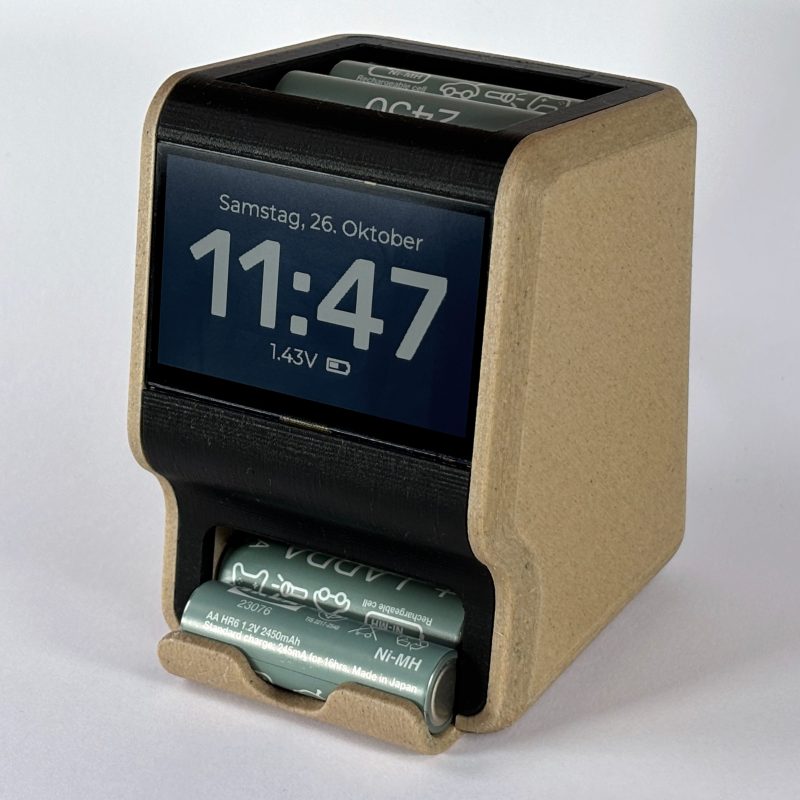
The increasing dominance of lithium cells in the market place leave our trusty NiMH cells in a rough spot. Sure, you can still get a chargers for the AAs in your life, but it’s old tech and not particularly stylish. That’s where [Maximilian Kern] comes in, whose SPINC project was recently featured in IEEE Spectrum— so you know it has to be good.
With the high-resolution LCD, the styling of this device reminds us a little bit of the Pi-Mac-Nano— and anything that makes you think of a classic Macintosh gets automatic style points. There’s something reminiscent of an ammunition clip in the way batteries are fed into the top and let out the bottom of the machine.
[Maximilian] thought of the, ah, less-detail-oriented amongst us with this one, as the dedicated charging IC he chose (why reinvent the wheel?) is connected to an H-bridge to allow the charger to be agnostic as to orientation. That’s a nice touch. An internal servo grabs each battery in turn to stick into the charging circuit, and deposits it into the bottom of the device once it is charged. The LCD screen lets you monitor the status of the battery as it charges, while doubling as a handy desk clock (that’s where the RP2040 comes in). It is, of course powered by a USB-C port as all things are these days, but [Maximilian] is just drawing from the 5V line instead of making proper use of USB-C Power Delivery. (An earlier draft of this article asserted incorrectly that the device used USB-C-PD.) Fast-charging upto 1A is enabled, but you might want to go slower to keep your cells lasting as long as possible. Firmware, gerbers and STLs are available on GitHub under a GPL-3.0 license– so if you’re still using NiCads or want to bring this design into the glorious lithium future, you can consider yourself welcome to.
We recently featured a AA rundown, and for now, it looks like NiMH is still the best bang for your buck, which means this project will remain relevant for a few years yet. Of course, we didn’t expect the IEEE to steer us wrong.
Thanks to [George Graves] for the tip.










Nice feature in IEEE Spectrum! Its good to see a project get cleaned up and get a proper writeup. The Spectrum article has way better illustrations and writing than the last time this was making the rounds. https://hackaday.com/2024/12/02/the-automatic-battery-charger-you-never-knew-you-needed/
What is a high-resolution LED ? Is it superior to a thorough proof-reading process ?
Maybe it’s a Light Emitting Display? ;-)
That is technically correct– the best kind of correct! This Light Emitting Display is an LCD, though, and the article has been updated to reflect that.
should probably have read “LED panel” — it’s the display, a matrix of individual diodes
The sister technology to the LCD, LED is the Liquid Emitting Display ;-)
The display on my old DELL laptop failed that way, by emitting a sticky viscous liquid. SVLED
One year on, let’s see how this project is doing:
https://hackaday.com/2024/12/02/the-automatic-battery-charger-you-never-knew-you-needed/
Thanks for digging that out.
I knew I saw this on HAD before.
Correction: this doesn’t use USB Power Delivery, just a USB Type-C port. The CC lines are just pulled to ground with 5.1 kΩ resistors.
Which is, er, not great? 1.2 W is more than some old-fashioned USB ports can provide, as a unit load is only 100 mA at 5 V, but I see nothing to indicate that it checks if it can take at least 3 unit loads. A non-enumerating option would be to hook up an ADC to the CC lines to do Type-C Current detection, but the PCB has no such connection.
Props for solving the problem of charging multiple AA cells in a much sillier and more complex way than just using a multi-cell charger, but falls into the typical camp of being cavalier about USB power limitations.
Huh. I admit when his writeup said “USB-C powered” I assumed that meant PD given the current draw. Checking the schematic shows you are absolutely correct. How disappointing.
That’s an interesting topic. I think as long as you connect this to any USB-C device, everything should be good, as USB-C specifies a minimum of 500mA. This would only be an issue with a USB-C to USB-A adapter cable. Any even then, ports with less than 100mA of current capability are rare. Now I have to check if the rp2040 could do the enumeration…
I’ve read somewhere that practically no PC manufacturers ever enforced the 100mA limit, so you will get 500mA in 99% cases.
Is this what we are down to, reused content from old HaD articles?
Not deliberately– [George] submitted his tip in good faith, and I evidently missed the previous feature in our archives. Mea culpa.
Well, I’m glad you did as I missed it first time around. Now I want one. :D
No mention of the Olight Ostation X?
https://www.olight.com/ostation-x-super-charger
https://www.olight.com/store/ostation-x-3-in-1-rechargeable-aa-aaa-battery-charger
The flaw I see with these hopper style chargers is that the charged batteries end up sitting off charger.
Maybe I need new batteries, but I always find my spare batteries are dead unless I’ve left them on the charger. Presently I have 16 battery chargers and just leave my NiMH batteries to cook on them.
You need some good Low Self Discharge batteries, often advertised as “Ready to Use” or “Pre charged.” LSD NiMH batteries have been around for a while now (starting with Sanyo Eneloop) but the technology has continually improved, the 5th gen Eneloops are advertised to hold 70% of their charge after 10 years (1st gen was 70% after 1 year)
I have been using Enloop almost exclusively but I bought a pack of Amazon Basics AAA batteries and they seem to be performing better.
I was thinking the same. I wonder if the Olight Ostation X came first. Wouldn’t that just mean that the project SPINC is just a copy but made ‘Opensource’
You need the “Floaty-Thingie”: https://www.ka7oei.com/floaty_thingie.html
I modified the idea by using cheap-as-chips LM317LZ in constant-current mode for each set of four cells. No ambiguity in charging current that way. Batteries are always ready when I need them.
I know that NiMH batteries aren’t quite that old, but at first blush, I thought the timepiece in this build was a flip-clock. IMO, it would really round out the retro aesthetic.