
Antihydrogen forms an ideal study subject for deciphering the secrets of fundamental physics due to it being the most simple anti-matter atom. However, keeping it from casually annihilating itself along with some matter hasn’t gotten much easier since it was first produced in 1995. Recently ALPHA researchers at CERN’s Antimatter Factory announced that they managed to produce and trap no fewer than 15,000 antihydrogen atoms in less than seven hours using a new beryllium-enhanced trap. This is an eight-fold increase compared to previous methods.
To produce an antihydrogen atom from a positron and an antiproton, the components and resulting atoms can not simply be trapped in an electromagnetic field, but requires that they are cooled to the point where they’re effectively stationary. This also makes adding more than one of such atom to a trap into a tedious process since the first successful capture in 2017.
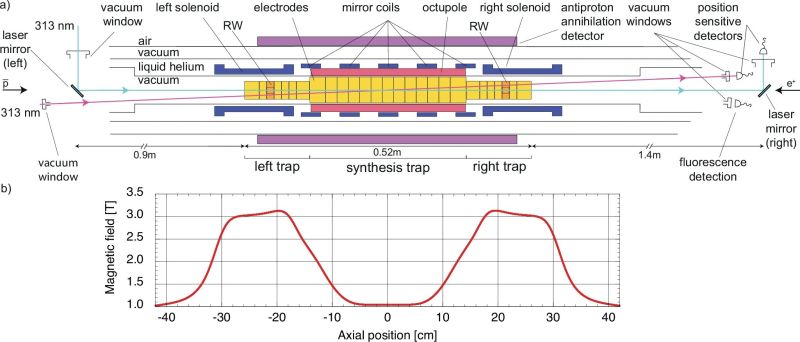
In the open access paper in Nature Communications by [R. Akbari] et al. the process is described, starting with the merging of anti-protons from the CERN Antiproton Decelerator with positrons sourced from the radioactive decay of sodium-22 (β+ decay). The typical Penning-Malmberg trap is used, but laser-cooled beryllium ions (Be+) are added to provide sympathetic cooling during the synthesis step.
Together with an increased availability of positrons, the eight-fold increase in antihydrogen production was thus achieved. The researchers speculate that the sympathetic cooling is more efficient at keeping a constant temperature than alternative cooling methods, which allows for the increased rate of production.











Getting closer to warp core? Since we need antimatter to make it work
15,000 antimatter atoms each when combined with matter will release approximately 511keV through annihilation, which would be a grand total of about 7665 meV. You are not going to be warping anywhere with that.
Jeez, man, at least get your order of magnitude right. Rest energy of a hydrogen atom is about 939 Mev
I was thinking electron + anti-electron of course you are right a proton is roughly 1,836 times more massive than an electron. So scale by about 2 and add 3 zeros to my previous numbers. It is still not enough energy to warp anything.
Yeah, a few microjoules. A perceptible or audible tick or pop, but that’s about it.
Am I the only one disappointed that it’s beryllium, not lithium? At least tell me it’s spheres (Galaxy Quest)
That reminds me, how did the crew move that sphere without protection? Beryllium is pretty toxic and rolling them would shake the dust loose, and those foolish people breathing in the dust.
IKR! That absolutely wrecks this, otherwise perfectly scientifically sound movie, movie for me, too!
Can you fashion some sort of rudimentary lathe?
Dilithium.
Engage.
Dilithium is just two lithium atoms bonded together… which is really just lithium with a fancy presentation.
OK, that turns out to be an interesting rabbithole.
Lithium is not on the canonical list of seven elements that for diatomic molecule.
Most elements don’t form diatomic molecules.
First, it needs to be a gas.
Second, the diatomic binding energy needs to be greater than the thermal energy in the gas (so it stays diatomic when whacked by a brownian neighbour). Which rules out elements that aren’t a gas until very high temperatures.
And the orbital configuration must[mumble mumble mumble it’s dark in this rabbithole]
So, can Lithium make a diatomic molecule? Why not?
ah. comment spam. no report button in sight this time. :(
So the “Report” button was removed, but comments are still not editable…
great…
Do ye not know a hack when ye see one laddie?
The report button was removed because people were using it and it created undesired work. Do ye not know a hack when ye see one, Laddie?
p.s. this may be a double post but at the end of the day after careful consideration and taking all things into account in the cold light of day, whose fault is that? To quote the great philospher Buckwheat “It may choke Artie but it ain’ gonna choke me!” Shamon! Hee hee!
The function of the report button has been merged with the Contact us link at the bottom of the page. If the “report” function hasn’t been officially merged, it will be unofficially merged as soon as people start using it to report spam.
Always nice to hear some meaningless bibblebabble from Corporate. Be best! Who am I kidding? That ship has sailed. HaD is not only not interested in improving the comments section, it’s actively making it worse.
It’s been merged, it hasn’t been officially merged, it will be unofficially merged. I hope you’re not driving or operating heavy machinery.
I want everything you got.
As long as is space and radiation proof and it does not bucle at warp speed.
It has to stand to prolonged phaser and disruptor fire and hold integrity under photon and quantum torpedoes.
It also should smell a bit like vulcanian roses.
I am waiting for a demonstration of it’s capabilities asap. Thank you.
Is positronium a simpler antimatter atom than antihydrogen? To answer that, a decision must be made: Positronium is
(A) an antimatter atom.
(B) a matter atom.
(C) neither (A) nor (B).
(D) both (A) and (B).
(E) shut up prfesser, you’re picking nits.
https://en.wikipedia.org/wiki/Positronium
From a layman perspective, C. It isn’t an atom because it doesn’t have a nucleus. I’m sure there are arguments to call it an atom, but I find it odd.
Wow i have no idea what it is but it sure is unexpected! (to me, anyways)
It’s an ion which by definition is an atom. Shamon! Hee hee!
Oh wow I was super wrong. IF this site had a report button I’d click on it. I have brought shame to myself, my family, my teacher, and my clone batch. One day thousands of years from now I hope to redeem myself in battle for the glory of the Sontaran Empire. In the meantime: stupid! stupid! stupid!
Thanks so much, just what I needed to know for my anti-jieli biomass disrupior.
This post is a best confusing, and on one point gets the physics wrong.
The experimental apparatus is illustrated in the top image of the post, an image drawn from the paper. The apparatus is not just one kind of trap, but two, and not one trap, but three. It’s a combination of two Penning-Malmberg traps and a “Ioffe-Pritchard type, magnetic-minimum trap” (quoted from paper, see also reference below). The P-M traps work only on charged particles, but the magnetic trap works on neutral ones. As a chemical synthesis apparatus, the two P-M traps hold the positron reagents (each trap has a different function during the cooling cycle), and the magnetic trap holds the products. In the illustration, the “left” and “right” traps are P-M types and the “synthesis” trap is the magnetic-minimum one.
From the post: “the components and resulting atoms can not simply be trapped in an electromagnetic field”. This is confusingly worded enough to be considered wrong. The traps work entirely because of electromagnetic fields, although the two kinds of trap work differently. And immediately following: “but requires that they are cooled to the point where they’re effectively stationary”. The positrons are cooled to around 7 K, which is nowhere near stationary. And the trapping efficiency of the product is only around 5 parts per ten-thousand (see paper Figure 3), since the magnetic-minimum trap has an effective depth of 0.5 K.
Reference: https://en.wikipedia.org/wiki/Magnetic_trap_(atoms)
This makes no sense: “However, keeping it from casually annihilating itself along with some matter hasn’t gotten much easier”. Antimatter doesn’t annihilate itself any more than “normal” matter. Thass jus’ raciss.
This reminds me of the difference between “viceregent” and “vicegerent” which I learned from an Indian from Tanzania by way of Iran.
I really really really try not to correct writing except when wrong writing = wrong science. One man’s nitpick is another’s fine gradient.