
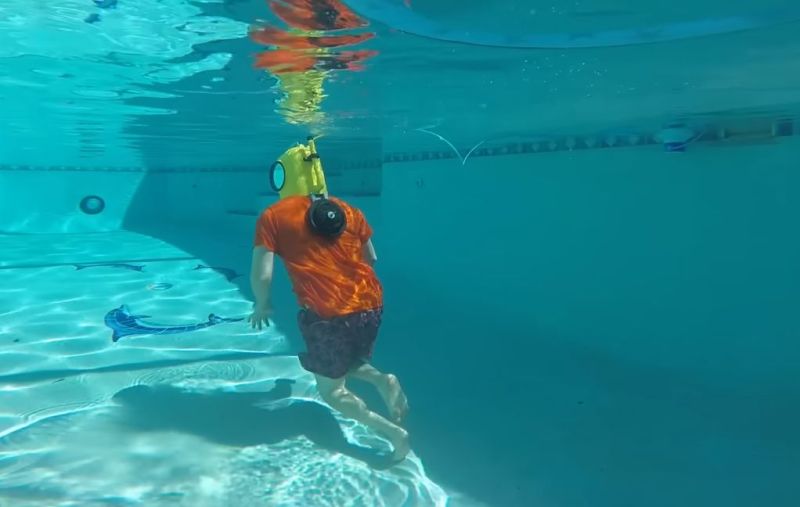
 Old-school diving helmets are deceivingly simple, even if they are – as [Hyperspace Pirate] puts it in a recent video – essentially the equivalent of an upside-down bucket with an air hose supplying air into it. While working on a 3D-printed diving helmet, he therefore made sure to run through all the requisite calculations prior to testing out said diving helmet in his pool.
The 3D model for the diving helmet can be found over at Thingiverse if you too feel like getting wet, just make sure that you size it to fit your own head. In the video CAD (cardboard-aided design) was used to determine the rough bounding box for the head, but everyone’s head is of course different. The helmet was printed in ABS, with the sections glued together before being covered in fiberglass and epoxy resin. Note that polyester resin dissolves ABS, so don’t use that.
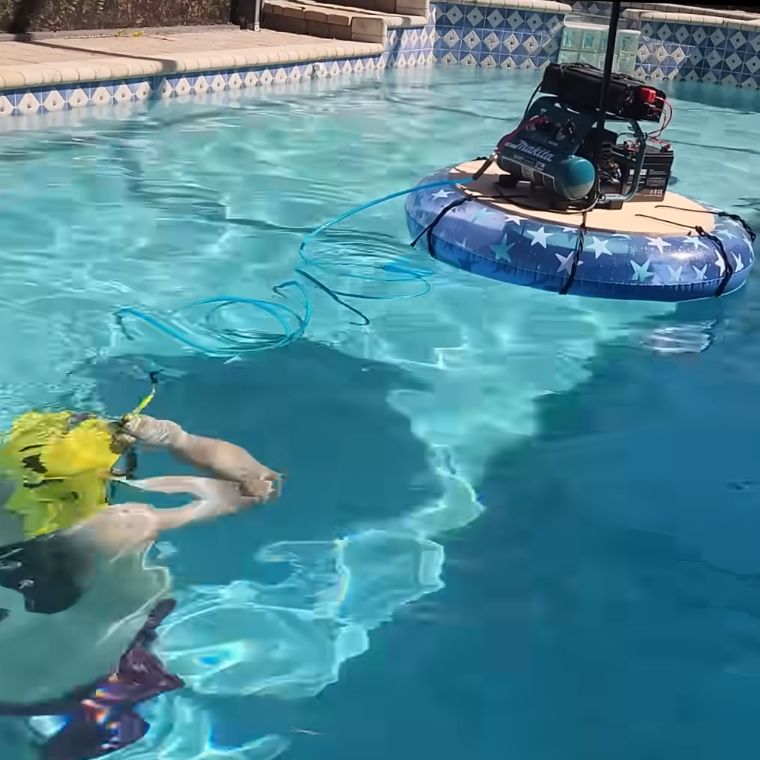
On the helmet is a 1/4″ SAE fitting for the air hose, with the air provided from an oil-less compressor that in the final iteration is strapped to a floatation device along with an inverter and batteries. Of note is that you do not want to use a gas-powered compressor, as it’ll happily use any CO2 and CO it exhausts to send down the air hose to your lungs. This would be bad, much as having vaporized oil ending up in your lungs would be bad.
Although in the video the system is only tested in a backyard pool, it should be able to handle depths of up to ten meters, assuming the compressor can supply at least 41 L/minute. With some compressor-side miniaturization and waterproofing, [Hyperspace Pirate] reckons it would work fine for some actual ocean exploration, which while we’re sure everyone is dying to see. Perhaps don’t try this one at home, kids.












I love a [Hyperspace Pirate] video and his results are impressive, but if I was going anywhere besides my own swimming pool I’d rather pick up a hookah system like those used by gold dredgers.
stationary gas engine + belt drive + slow running compressor with a high snorkel pole on a raft
You are missing a gas washer after the compressor, because “oil-free” != oil-free, also it would wash away CO2.
Think about it, every nose hose in a hospital has its own washing bottle, just in case.
Also at the inlet you’ll want a ball-in glass pipe flow meter, so that you don’t have to guess on your air flow.
The “washing bottle” on a hospital medical air or oxygen supply is a humidifier. Bottled medical air, compressed purified air, or pure oxygen are all very dry. It’s already super clean and doesn’t need any sort of “washing”. Humidifying it before inhaling is desirable, and that’s the function of bubbling it through a bottle.
commercial hookah diving rigs dont have any of that hoohah. Not even the flow meter. I mean who is going to see it anyway, your underwater and its floating around on an innertube. You just use a pump that provides more flow than you need, and if you find yourself struggling for air because of a malfunction you surface. Its not rocket surgery,
Yep, a filter for multiple purpose. You’ll breathe with an increased mass throughput, and you wouldn’t want any dust (or worse) particles. Just cross-check with the scuba compressor implementations. Sure, they use much higher pressure / mass throughput (scuba pressure is about 200bar), they solve the filter problems quite well.
Scuba isnt analogous. This is homemade hookah diving. Most hookahs run at 20-50psi. Also scuba is basically on demand valved to your breath with a hose in your mouth, where hookah divers are typically receiving a constant flow into their masks/helmets, letting both their exhalations, and their excess flow bubble away. Im not saying cleanliness doesnt matter but the tolerance for “dust(or worse) particles” is significantly higher as they have a designed in path of escape/rejection.
A whole lot easier to just use a scuba bottle and a boat rig and do it safely. If you need a compressor any dive shop can help you out. Mini compressors that feed a single boat rig can be found easily and yeah, like the article stresses your new 3D printed helmet is probably best used only in the swimming pool. This looks fun… But not real fun at any depth much beyond one atmosphere. DBD. Don’t Be Deadly.
There is a reason these are made of metal. I don’t really want to think about why that is.
In the 70s maybe.
“Kirby Morgan dive helmets are primarily constructed from a hand-laid, glass fiber reinforced thermal setting polyester (fiberglass) shell, often reinforced with carbon fiber for added durability”
And metal dive helmets were typically made of copper or brass before modern composites took over because those metals are easily formed. They do not require great strength. They arent subjected to much force unless something bashes into you. The internal airpressure should be equal or ever so slightly higher than the water pressure at operating depth causing a minimal net force exerted on the helmet.
Goes over it in the video – so that they sink.
An inverter and batteries? So the compressor is powered by 120 or 220 V AC? And it’s sitting on an inflatable in an unstable configuration? This is an electrocution waiting to happen.
Not really since it isn’t mains referenced so even if it does short out it’ll just go straight between its own AC/DC rails and fry itself. Maybe if you are right next to it when it happens you’ll get a short zap but otherwise current isn’t going to magically go 30 feet underwater to track you down and electrocute you when the shortest path is right near the inverter/batteries.
Thank you, I had the same concern.