
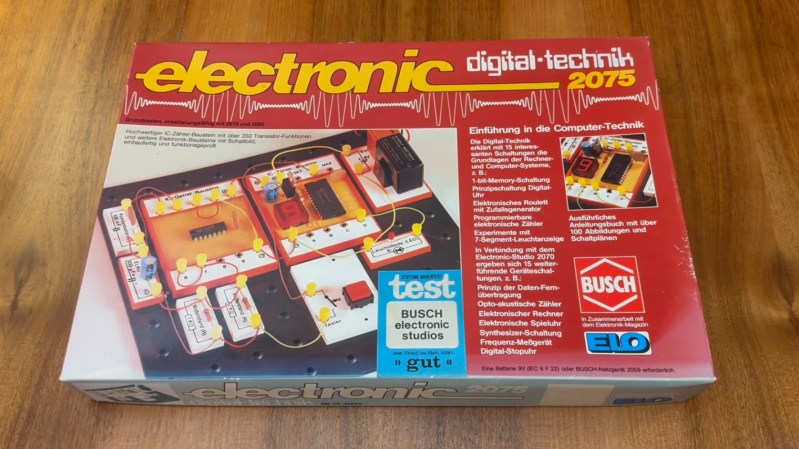
In a recent video, [Jason Jacques] demos the Busch Electronic Digital-Technik 2075 which was released in West Germany in the 1970s.
The Digital-Technik 2075 comes with a few components including a battery holder and 9 V battery, a push button, two 1 K resistors, a red LED, a 100 nF ceramic capacitor, a 100 µF electrolytic capacitor, a quad NAND gate IC, and a counter module which includes an IC and a 7-segment display. The kit also comes with wires, plugs, a breadboard, and a tool for extracting modules.
The Digital-Technik 2075 doesn’t use the spring terminals we see in other project labs of the time, such as the Science Fair kits from Radio Shack, and it doesn’t use modular Denshi blocks, such as we saw from the Gakken EX-150, but rather uses wire in conjunction with yellow plastic plugs. This seems to work well enough.
In the video, after showing us how to do switch debouncing, [Jason] runs us through making a counter with the digital components and then getting the counter to reset after it counts to five. This is done using NAND gates. Before he gets stuck into doing a project he takes a close look at the manual (which is in German) including some of the advertisements for other project labs from Busch which were available at the time. As he doesn’t speak German [Jason] prints out an English translation of the manual before working through it.
We’ve heard from [Jason] at Hackaday in recent history when we saw his Microtronic Phoenix Computer System which referenced the 2090 Microtronic Computer System which was also made by Busch.












I had one from the 80’s that had a DUAL LCD COUNTER module. That was my first electronics kit before I got the Phoenix as a hand me down later. Bought that with the money I had with me back when the Deutschmark was still around. I had a full suitcase on the way home. Between that and the Elektor and Computer mags from the decade (64er, CHIP and Elektor.) Such great memories and a very educational kit. Although we were taught different schematic symbols for capacitors and resistors (Kondensator and Wiederstand), the outcome was the same. Thanks for the article.
I have a confession. My son got a kit “like the one above but completely different” (I don’t remember name but duckduckgo found it under “sekrety elektroniki” which is strange because my kit was almost certainly Czech made). I showed him few basics and we build one circuit – oscillator. And I failed to understand how it works! I knew every element but could not explain to myself why it works this way?
But must admit that those sets are really creative. Maybe they just need some interface to modern solutions like Arduino, Raspberry Pi or similar so kids can naturally use them.
The obvious answer is that you didn’t – instead you probably fell into the error of “naming is explaining”.
Oh I loved that thing. I had lots of sets, including the 2090 microcomputer thing.
Sadly, not much is left. I could punch my past self in the dick for being so careless….
I had a similar kit in the late 80’s or early 90’s. But mine did the wire connections in a very clever way: there was a short spring attached to the terminals and sticking straight out of the board, with a plastic cap at the end, IIRC. When you pushed the top of the spring sideways, the coils of the spring would separate on the opposite side. You would put your jumper wire through the space between the coils, then release the spring, causing it to snap back to upright and clamp down on the wire (similar principle to a Wago). Making connections only took a few seconds for each, allowing you to focus on what should be connected rather than spending a lot of time securing the connections.
I work at a second-hand whatever charity shop.
We get these electronic kits in regularly. I love them.
The problem is that the battery sizes are obsolete, half of the pieces are missing, everything that should be magnetic is not magnetic, and vice versa.
But we still sell them as long as the boxes are in nice shape. Nostalgia is strong with us gen X.