
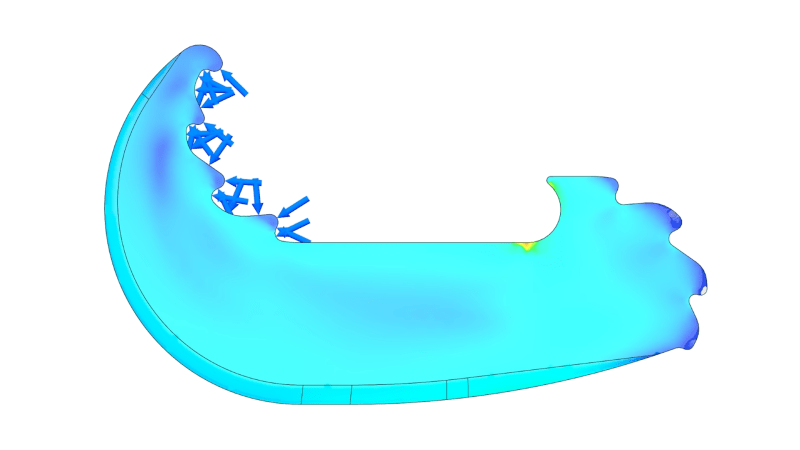
There’s never been such a thing as being “too competitive” when it comes to competition. This is something that [Tom Stanton] from “Tim Station”, [Tom]’s 2nd channel, took to heart for Polymaker’s 3D design challenge. The goal was simple: a single 3D printed part to hold as much weight as possible.
While seemingly simple, when considering the requirements, including a single print in addition to being able to open up for the mounts, the challenge gets exponentially more complicated. While the simplest and strongest joint would be a simple oval for uniform stress, this isn’t possible when considering the opening requirements. This creates a need for slightly more creativity.
[Tom] starts out with two flat C-shaped geometries to test his design. The design includes teeth specially placed to allow the forces to increase their own strength as force is applied. Flat features have the unfortunate quality of being able to slide across each other rather easily, which was the case during testing; however, the actual structures held up rather well. Moving onto the final design, including a hollow cavity and a much thicker depth, showed good promise early on in the competition, leading up to the finals. In fact, the design won out over anything else, getting over double the max strength of the runner up. Over an entire metric ton, the piece of plastic proved its abilities far past anything us here at Hackaday would expect from a small piece of PLA.
Design can be an absolute rabbit hole when it comes to even the simplest of things, as shown with this competition. [Tom] clearly showed some personal passion for this project; however, if you haven’t had the chance to dive this deep into CADing, keep sure to try out something like TinkerCAD to get your feet wet. TinkerCAD started out simple as can be but has exploded into quite the formidable suite!











Try it with duramic pla+. It’s stupid strong. Strongest pla based filament I’ve found
Creep. The plastic kind. It only survives under stress for a short while.
Example:
https://www.reddit.com/r/3Dprinting/comments/eb6fuj/i_gathered_a_lot_more_data_on_creep_in_pla_these/
” I have not found any asymptote or lower limit for the stress, below which creep does not occur. Even if the sample survives initial loading, the sample can snap anyway. I loaded a sample to 57.5 MPa, it creeped for about 25 seconds, and then it snapped.”
40-50 MPa is a pretty typical limit for common thermoplastics where you can expect an “instant” creep failure. If you do a finite element analysis in your preferred CAD suite, reaching this level of stress means your design will fail. 4-5 MPa means it’ll last a good while – practically forever – that’s a good rule of thumb design goal.
What that means, a 10×10 mm sample (100 mm^2) will hold 5 MPa x 100 mm^2 = 500 Newtons or 51 kilograms OR about 510 kg for a few seconds. Reaching a ton is pretty easy, but, you would not want to suspend yourself from it since the static stress limit is just 102 kg and that’s too close for comfort. Swing around a little and the plastic starts to give up.
Just in case anyone starts thinking they can design 3D printed climbing shackles.
This is a repeat. There is another post about it. But search is not that good to let me find it.
Going back a year with the “3d printing” tag shows nothing on this.
Living in a country that has been fully metric since 1970 I actually had to search what the term “Metric Ton” meant. Was it the tonne (1 Megagram) being referred to, or was this a strange idiom like the very common “a metric crapload”.
So I guess I really did genuinely learn something today, tonne (rhymes with John) isn’t the universal term for a megagram.
Here in the states, ordering a ton of gravel gets you 2000 pounds. A metric ton gets you 1000 kilograms=2200 pounds.
A ton is 100 quid, I don’t know what the arguing is about.
So a Benjamin is a ton.
Or, today, a Benjamin is 3/4 ton.
But 3 Benjamins won’t get you a deuce and a half.
Divided by a common language indeed.
Reminds me of an old column on car dealer slang by the late great Quentin Wilson, the title of which was: “A monkey for that endy camel?”
And the best slang term from it was for a vehicle with a rear wash-wipe – also known as a bidet.
Why does this article talk about metric ton? It is never mentioned in the video.
I love Tom Stanton’s engineering, he calculates carefully and rarely guesses.
His excellent second channel is named Tim Station, not Tim Stanton as written above.
Thanks for pointing out the oversight on the channel name. I fixed it.
OTOH, the whole second half of the video is him explicitly engineering the hook to hold 1000 kg — a metric ton. He puts those numbers in a calculator, converts it to Newtons, and doubles it for safety margin.
A metric tonne? Wow. How much will it hold after sitting in a hot car for a while?