
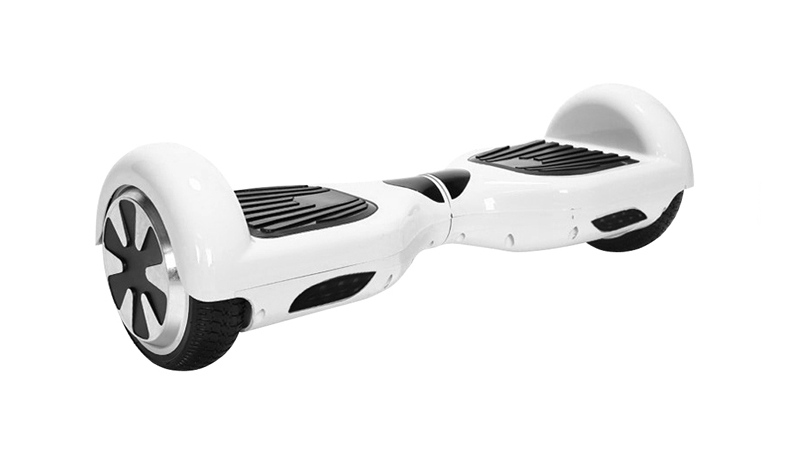
The hoverboard, one of the teen crazes of the last decade, is both a marvel of technology and a source of hacker parts that have appeared in so many projects on these pages. It contains an accelerometer or similar, along with a microcontroller and a pair of motor controllers to drive its in-wheel motors. That recipe is open to interpretation of course and we’ve seen a few in our time, but perhaps not quite like this steampunk design from [Skrubis]. It claims a hoverboard design with no modern electronics, only relays, mercury switches, and neon bulbs.
The idea is that it’s a hoverboard from 1884 using parts available in that era, hence there’s talk of telegraph relays and galvanomic piles. The write-up is presented in steampunk-style language which if we’re honest makes our brain hurt, but the premise is intriguing enough to persevere. As far as we can see it uses a pair of relays and a transformer to make an oscillator, from which can be derived the drive for a 3-phase motor. This drive is sent to the motors by further relays operating under the influence of mercury tilt switches.
There are a full set of hardware designs once you wade past the language, but as yet it has no evidence of a prototype. We admit we kinda want it to work because the idea is preposterous enough to be cool if it ran, but we’d be lying if we said we didn’t harbor some doubts. Perhaps you our readers can deliver a verdict, after all presenting you with entertainment is what it’s all about. If a working prototype surfaces we’ll definitely be featuring it, after all it would be cool as heck.
Oddly this isn’t the first non-computerized balance transport we’ve seen.
Featured image: Simakovarik, CC BY-SA 4.0.












For starters, the motor hall sensors aren’t considered semiconductors, which disqualifies the whole concept, if you ask me.
The “galvanic pile” could never provide the instantaneous current required, but if we ignore that, it might actually work, if you’d use regular brushed DC motors, either with permanent windings or with a field winding.
Tilt sensors to control a forward/reverse relay, and a couple of sensors switching resistors for crude speed control could work, although it may be very prone to oscillations.
Now the real steampunk version would be to drive it with actual steam, with weights and levers controlling the flow!
Maybe a DC motor with field windings and a Ward Leonard control would do the trick
afaik hall effect sensors are very much semis, thus alternative reed switch feedback is provided.
First lead acid batteries were already more than a decade old by the time, thus the assumption is that, provided enough are connected in parallel, enough current can be produced.
The Hall effect can be observed in any conductor. It was discovered in the 19th century as part of the experimental work that subsequently led to the discovery of electrons, long before anyone had seen a diode or thought of a band gap.
Modern Hall effect sensor ICs do include semiconductor components, not least because they need amplification to produce a useful signal (and probably an ADC, SPI etc.). I’m not sure what pre-20th century amp options were available, but they were undoubtedly large and bad.
This has huge vibes of “why not”, which is the purpose of hackaday I suppose.
I love it. Favorite phrase from the diagram: “The apparatus consists of a small polyphase electro-magnetic motorof the newer pattern, without commutator”. Also the “stout brass terminals”. I now want to make my panel wiring diagrams look like this with nice engravings.
What are the big red X’s though?
Those are kicad DNPs (do not place).
What the HELL are those schematics!? Abysmal!
The entire project is rife with AI slop.
Yeah .. hate to see it.
Are you not entertained?
This’ll be amusing. Relay control for an inverted pendulum will be quite the rodeo. There’s a silly tune in most vesc one wheel packages that probably reasonably approximates what this will be like to ride :p a steam punk self balancing unicycle (not the euc kind that you stand on) would probably be doable but you’d need to help it along quite a bit with your bodyweight
if it works it’s a great hack but if there’s not even a prototype then i think the fact that the design obviously won’t work dominates
The main problems in my opinion and as stated by others for a prototype are the following:
*Current limiting with the large resistor may smoke out being at consant stall
*Snubbers on motor phases being a guess, and this rev has no snubber towards vdrive. No clue how quickly the phase relays would weld themselves up.
*adequate current from hall/reed position sensors to drive the first position relay pack without welding themselves up/failing
*Switching time for relays – the output power stage sixpack can probably do with relatively slow omrons, but most of the control logic needs to be quite quick in relay terms for this to keep up.
This summer I absolutely loved daily reading about electric scooter accidents. So many dumb kids learned the hard way that if you FA by driving 40+ km/h while standing upright on a narrow board with two tiny wheels, you are likely to FO what happens once it crashes. So many vegetables put on life support and on a straight road to permanent disability.
I don’t love it. So many deeply nested failures, with such a huge cost. Of course individuals are stupid, and i’m not happy to see that. But the systemic stupidities are much more distressing to me. It’s a sad evolution of the already very lethal decision to design our cities around cars.
You are a deeply disturbed individual.
Thanks! :3
So, a budget less functional Seque. As is the thing in the main illustration. By the definition used here I drive a hovercar every day.
Noted with interest: the neon bulb was invented in 1902.
The AI Slop illustrations are deeply disappointing. They look kinda like what you’d expect to see, but like a magic eye mirage when you actually look at them the effect is lost and they are revealed to be a waste of time.
Please reconsider posting these.
NOT a hoverboard. It’s a ROLLERboard. Stop using clearly wrong terms.
The new one is “flying car” applied to VTOL aircraft that don’t even have wheels, and are therefore not flying cars.