
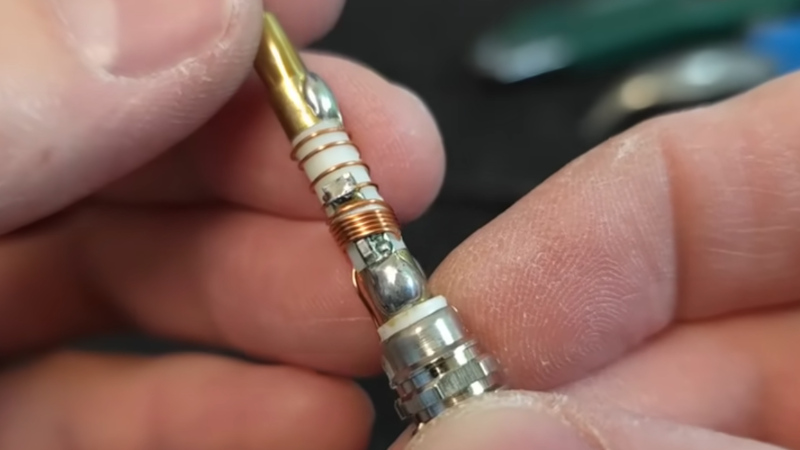
If you own a handheld transceiver of any type then the chances are it will come with a “rubber duck” style antenna. These flexible rubber-coated antennas are a compromise in performance, being significantly smaller than a wavelength at their frequency of operation. [OM40ET] has an interesting video in which he investigates this by tearing down a cheap rubber duck antenna and an even cheaper fake.
These antennas usually have a flexible upper section and a bulge at the bottom over the connector. The fake one has nothing in the bulge except the antenna wire and thus has a very high SWR, while the “real” one has a loading coil. This coil is an interesting design, because it’s designed such that the antenna has two resonant points at the 2 metre and 70 centimetre amateur bands. On paper it’s a tapped coil fed at the tap through a capacitor for matching, but a more detailed appraisal will tell you that the two halves of the coil are designed to return those two resonances. It’s still a not-very-good antenna, but the fact that it works at all is something.
If you want something better at VHF and haven’t got much space, all is not lost. We recently featured a VHF magnetic loop.












minor correction: his callsign is OM0ET
In my day … VHF rubber duckies were not 50 ohm at any frequency 🤠
Aka “dummy load”.
But easier to carry around than a 19″ whip.
I had a base-loaded whip rubber duckie from Larsen which seemed to work better than the shorter ones. Not really any surprise there. Also, antennas need a counterpoise, and the human body isn’t the best choice, so it’s not all the fault of the antenna…
When I converted my marine vhf (Pathcom from Pace) to a 2-meter transceiver, I made a 1/4 wave vertical consisting of a coat hanger soldered into a pl-259. I’ve owned many antennas since on many rigs, but none has performed so well as that coat hanger cut to 1/4 wave and trimmed for mid band resonance.
I bought some of these ‘fake’ Nagoya antennas from a ‘name’ with a good reputation, they do seem to perfor but don’t look particularly good on my NanoVNA.
I think perhaps I need to slice one apart now and see what’s inside…
Colour me impressed, the dirt cheap £1.50 Nagoya clones I bought from TIDRadio have the coil, the cap and are actually tuned, I think perhaps I need to revisit my NanoVNA skills.
HT antennas are really hard to properly measure with a VNA. You need an antenna connector attached to something that will act as a ground plane. The gutted chassis of a broken HT will work for that. You also need a coax with a common mode choke near the antenna connector to connect it to the VNA. It won’t be perfect, but it will work better than connecting the antenna directly to the VNA.
Yeah, I believe they also rely on being held as well so your body becomes part of the counterpoise.
Eitehr way, I may not have measured it correctly or it might, depsite looking tuned and having the capacitor, be not that great.
A few short wires would stand in just fine for the gutted chassis of a broken HT. No need for such versamillitude.
Same goes for those tiny mobilephone band stubbies. We tested a bunch of ones for 4G.
The ones that had the counter-poise curlled up around a section of the radiator were worse than those that just had a coiled radiator.
I did the LORA / Meshtastic thing a few years ago. Wasn’t impressed. Got a NanoVNA and quickly realized that the usual suspects qualify their antennas based solely on connector type and gender.
EVERY ANTENNA IS SUSPECT UNTIL TESTED.
That is all.
+1 Andy! Spec sheets are to be taken with a grain of salt until performance is validated in the specific implementation.
So the fakes are ok for receive-only
Title needs editing. All handheld antennas are unique?