
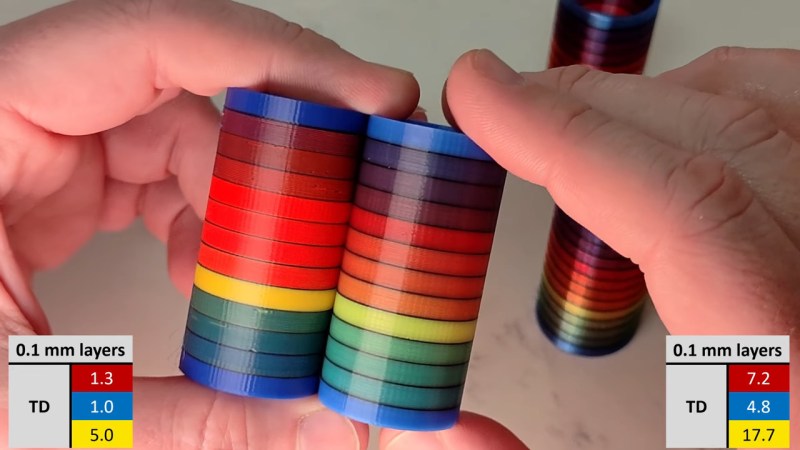
Full-color 3D printing is something of a holy grail, if nothing else, just because of how much it impresses the normies. We’ve seen a lot of multi-material units in the past few years, and with Snapmaker’s U1 and the Prusa XL, it looks like tool changers are coming back into vogue. Just in time, [Ratdoux] has a fork of OrcaSlicer called FullSpectrum that brings HueForge-like color mixing to tool-changing printers.
The hook behind FullSpectrum is very simple: stacking thin layers of colors, preferably with semi-translucent filament, allows for a surprising degree of mixing. The towers in the image above have only three colors: red, blue, and yellow. It’s not literally full-spectrum, but you can generate surprisingly large palettes this way. You aren’t limited to single-layer mixes, either: A-A-B repeats, and even arbitrary patterns of four colors are possible, assuming you have a four-head tool-changing printer like the Snapmaker U1 this is being developed for.
FullSpectrum is, in fact, a fork of Snapmaker’s fork of OrcaSlicer, which is itself forked from Bambu Slicer, which forked off of PrusaSlicer, which originated as a fork of Slic3r. Some complain about the open-source chaos of endless forking, but you can see in that chain how much innovation it gets us — including this technique of color mixing by alternating layers.
[Wombly Wonders] shows the limits of this in his video: you really want layer heights of 0.08 mm to 0.12 mm, as the standard 0.2 mm height introduces striping, particularly with opaque filaments. Depending on the colors and the overhang, you might get away with it, but thinner layers are generally going to be a safer bet. Fully translucent filaments can blend a little too well at the edges, but the HueForge community — that we’ve covered previously — has already got a good handle on characterizing translucency and we’ll likely see a lot of that knowledge applied to FullSpectrum OrcaSlicer as time goes on.
Now, you could probably use this technique with a multi-material unit (MMU), but the tool-changing printers are where it is going to shine because they’re so much faster at it. With the right tool-changer, it’s actually faster to run off a model mixing colors from the cyan-yellow-magenta color space than it is to print the same model with the exact colors needed loaded on an MMU. That’s unexpected, but [Wombly] does demonstrate in his video with a chicken that’s listed as taking nineteen hours on Bambu’s MakerWorld as taking under seven hours.
Could this be the killer app that pushes tool-change printers into the spotlight? Maybe! Tool changing printers are nothing new, after all. We’ve even seen it done with a delta, and lots of other DIY options if you don’t fancy buying the big Prusa. If you’ve been lusting after such a beast, though, you might finally have your excuse.












Hueforge is literal AI slop and responsible for ruining several 3d printing community upload sities with a dev who genuinely is just a really awful person. I can’t believe hackaday would ever bring it up.
I’m not even joking or exaggerating why the hell would you people mention it?
Possibly they’ve not encountered whatever controversy you’re referencing, for example, I have no idea what you’re talking about even after some Googling for more info ¯_(ツ)_/¯
On topic though I wonder how much better this effect could be with colour dithering? It’d be awfully slow to print I bet but if you were going for the colour quality instead of speed that might be acceptable
It’s in the article because it is a useful point of comparison: both let you do prints with colour palettes, and both rely on translucency to mix colours so you aren’t restricted to the handful of colours in your printer. Since most people in the 3D printing sphere know about HueForge at this point, using it as a point of reference serves as useful information.
Whatever beef might exist with the dev doesn’t come into it; I have no idea what you’re talkig about, but I’m certain it isn’t relevant in this context. If Lucifer the Lord of Darkness himself had published a well-known software suite that a project I was writing about could be compared to, I’d reference Satan’s software, too.
… and now you’ve made me spend the whole day’s allotment of self control not making a Bill Gates/Windows joke. I hope you’re happy.
HueForge doesn’t make AI slop. People and (their bots) do.
What on earth are you talking about? You mean people USE it to generate AI slop? Fine. But the app itself has been around for a few years, well before “vibe coding” was a thing.
Have you ever actually used Hueforge or are you just assuming? There’s zero AI slop in the program. In fact, the process of using it well is at least as involved as using a slicer, if not more.
The issue comes down to people using it to essentially upload pictures (AI art or otherwise) to STL repositories. This is a problem because it relies on the downloader having filaments with the same hue and TD but, to dismiss Hueforge (the program) as ‘AI slop’ betrays ignorance about the program, AI art in general or both.
You have obviously not used HueForge at all, or you wouldn’t be talking like that. Have no idea what you’re even talking about, nor does anyone else.
Just one more step and we re-invented CMYK.
Calm down, you will be ok
Bambu already supports CMYK for (e.g.) lithophanes, and sells a 4-spool bundle just for that.
For a full colour gamut you’d need CYMKW– white to make up for the fact there’s no white paper backing like CYMK printing normally expects. Unfortunately black is going to run into problems with low translucency in this context.
True. Bambu technically misrepresents what they offer: They call it CMYL, but it’s actually CMYW, and they make K (I presume) by C+M+Y.
duh, reinterpret the obvious typo as required. Still can’t edit comments, HaD!
I’m not sure who made up the “primary” colors R, Y, and B, but I see in the examples shown that RYBis just as crappy for mixing filament colors as it was for tempera paint when I was in first grade. Which was a long time ago. But I remember finding a set of watercolors that had cyan and magenta, and was flabbergasted that with those (and of course the standard yellow), I could for the first time mix a decent green and a decent purple. I pointed this out to the teacher and asked why they tell us that RYB are the primary colors when clearly CYM worked much better. She had no answer, and 20 other students to deal with.
Citation?
It’s Ratdoux not Radoux
Fixed! Thanks.
Thanks to both of you!
Yeah be his bing!
” Some complain about the open-source chaos of endless forking, but you can see in that chain how much innovation it gets us ”
Yah but it would be nice to have access to all that innovation at the same time!
I get why Prusa forked. Slic3r was still full of Perl! Couldn’t it have ended there? Does Prusa not accept pull requests?
Hmmm… this has me thinking of doing a print with Slic3r and Pronterface just for old times.
Toolchangers make mixed-color prints practical because the swap cost drops. The design-side last mile is still the same: a file that is actually printable, not just a pretty mesh. That’s what I’ve been working on at luphra.com — prompt or sketch in, then an editable file meant to manufacture. FullSpectrum on the slicer side is the other half of that.