
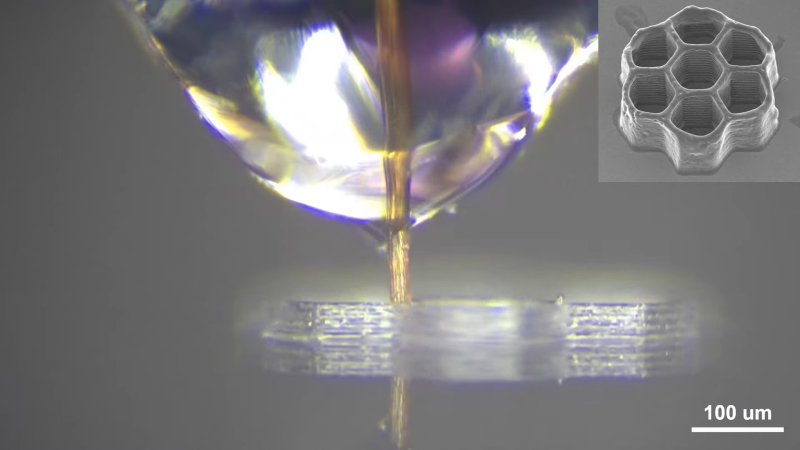
A mosquito has a very finely tuned proboscis that is excellent at slipping through your skin to suck out the blood beneath. Researchers at McGill University recently figured that the same biological structure could also prove useful in another was—as a fine and precise nozzle for 3D printing (via Tom’s Hardware).
To achieve this feat, the research team harvested the proboscis from a female mosquito, as only the female of the species sucks blood in this timeline. The mosquito’s proboscis was chosen over other similar biological structures, like insect stingers and snake fangs. It was prized for its tiny size, with an inside diameter of just 20 micrometers—which outdoes just about any man-made nozzle out there. It’s also surprisingly strong, able to resist up to 60 kPa of pressure from the fluid squirted through it.
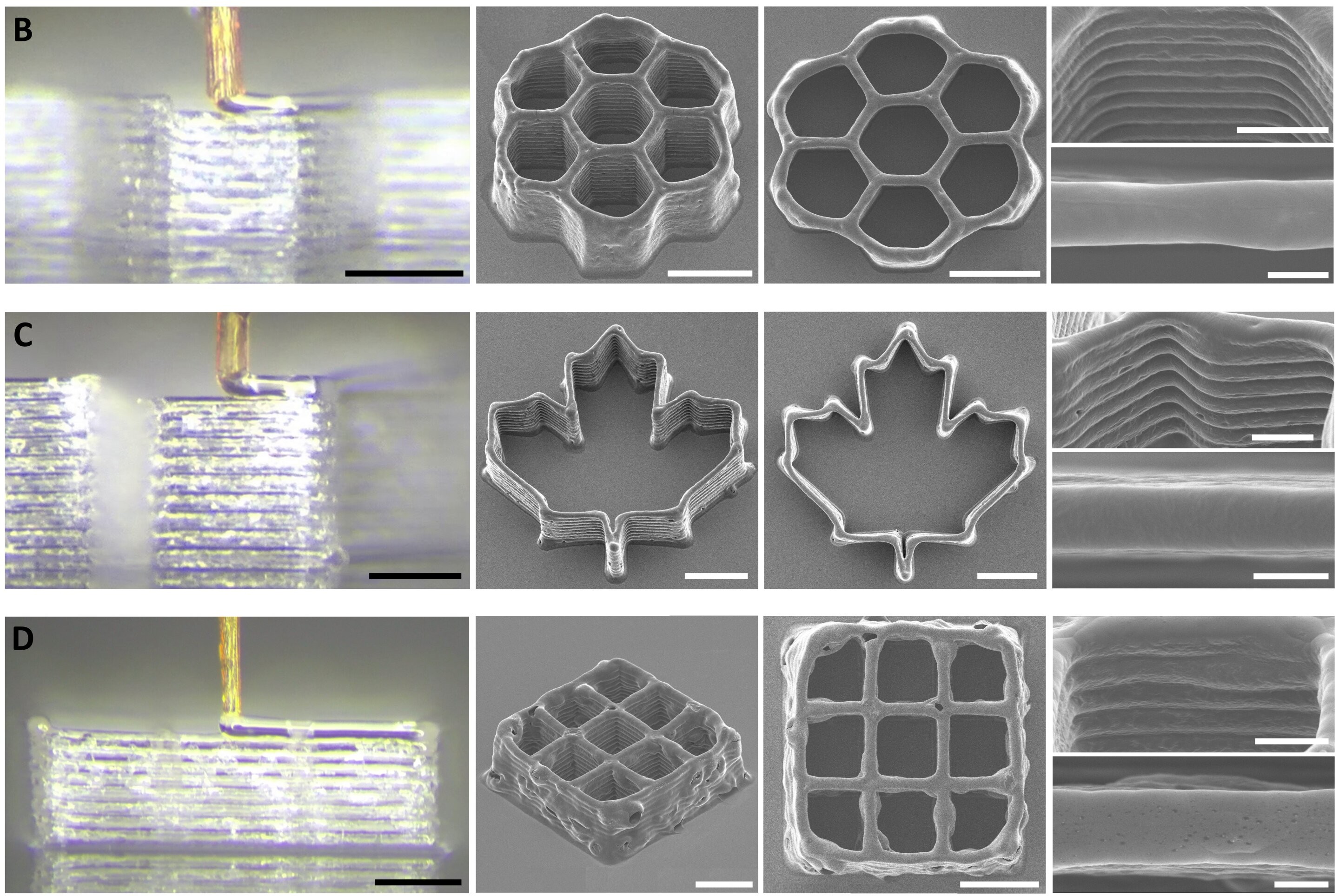
Of course, you can’t just grab a mosquito and stick it on your 3D printer. It takes very fine work to remove the proboscis and turn it into a functional nozzle; it also requires the use of 3D printed scaffolding to give the structure additional strength. The nozzle is apparently used with bio-inks, rather than molten plastic, and proved capable of printing some basic 3D structures in testing.
Amusingly, the process has been termed 3D necroprinting, we suspect both because it uses a dead organism and because it sounds cool on the Internet. We’ve created a necroprinting tag, just in case, but we’re not holding our breath for this to become the next big thing. At 20 um, more likely the next small thing.
Further details are available in the research paper. We’ve actually featured quite a few mosquito hacks over the years. Video after the break.
[Thanks to Greg Gavutis for the tip!]











Next small thing – love it!
also prove useful in another was
Good job
Very cool but why not use pulled glass.
Pulled glass isn’t reliable to manufacture tubes of and is incredibly fragile, while a proboscis has the perfect mix of biological properties to make a durable nozzle.
Also I can’t believe there’s a typo in the first paragraph of the article; was should be way
I’d guess the repeatability and predictability is higher with the biologically derived source, strange as that sounds in general at this scale I’d suggest nature is far more likely to get the production ‘right’. Also I suspect the glass tube wouldn’t take the feed pressure and minor side forces from that extrusion process, but that is a good point and not something I’ve ever seen documented. So glass may actually be the best way to go.
TFA claims they are too expensive ($80) and not available as small as 20 um.
I call BS on both counts. Glass micropipettes are a commodity item used in many fields, available for less than $30 in small quantities, and as small as 10 um.
But I do wholeheartedly endorse the harvesting of wild female mosquitos for any purpose.
I bought a 1/16″ stainless steel tube with a 5 micron laser drilled opening for a project. Lennox has 20 micron available as well. They arent cheap but certainly more durable than a proboscis.
Maybe a type? Lenox laser has holes from 50um down to 1um with prices of $110-$216.
They wanted something biodegradable.
At least, that is their claim; I personally suspect that may be a retcon for mosquito pull-apart activity.
I guess the mosquitoes had it coming. Now is payback time!
Why not take it to the next level and squeeze the mosquito to print with the human blood it contains?
The failure modes section should really be titled “How a mosquito blows it’s nose”
It would be interesting to learn the molecular structure and protein composition of the proboscis. Does the mosquito operate on the host pushing blood through the proboscis or use a reduced pressure to pull blood?
It is if you are the mosquito.
Corpses are going to have a, print by date.
At least it’s less creepy than the pneumatic spider claw.
Do mosquitos have enough neurons to read an STL?
“To achieve this feat, the research team harvested the proboscis from a female mosquito, as only the female of the species sucks blood in this timeline.”
“To achieve this feat, the research team harvested the proboscis from a mosquito.”
ChatGpt do not speak in circles interjecting irrelevant and useless factoids when writing articles for Lewin Day.
I enjoy useless factoids (and would argue that this one is relevant) and don’t like crying “AI!”, but this snippet did make me question whether AI was used for a different reason — the use of “in this timeline” at the end, which seems unnatural in this context and feels more like something a mindless algorithm instructed to write like a semi-informal millennial/zoomer would include than a professional writer.
(and no, I didn’t use AI for this comment; I’m just verbose and love my em dashes)