
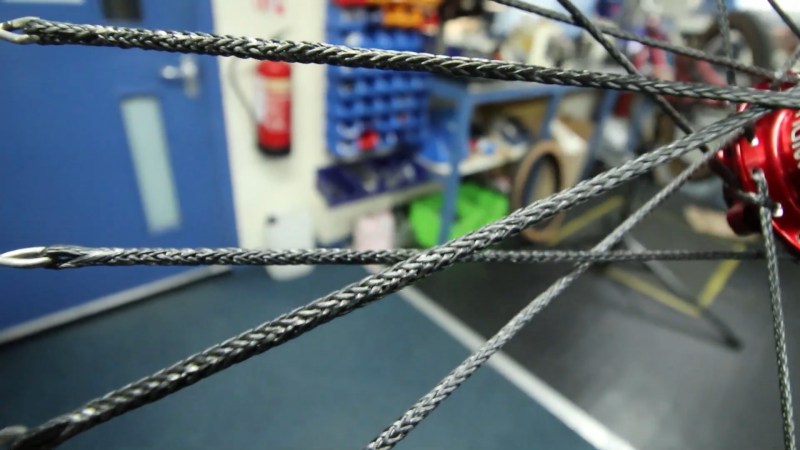
We know this one is a few years old, but unless you’re deep into the cycling scene, there’s a good chance this is the first time you’ve heard of [Ali Clarkson’s] foray into home made rope spokes.
The journey to home-made rope spoke begun all the way back in 2018, shortly after the company Berd introduced their very expensive rope spokes. Berd’s spokes are made of a hollow weaved ultrahigh molecular weight polyethylene (UHMWPE) rope with very low creep. They claim wheels stronger than steel spoke equivalents at a fraction of the weight. Naturally forum users asked themselves, “well why can’t we make our own?” As it turns out, there are a handful of problems with trying this at home.
There are a number of ways to skin this proverbial cat, but they all center around some very special nautical ropes, namely, Robline DM20. This rope has excellent wear and creep characteristics, in a hollow weave much like what Berd developed. The hubs also require the addition of a bevel around the spoke holes to prevent wear. Beyond those two similarities, there are quite a number of ways to lace the spokes between the hub and wheels.
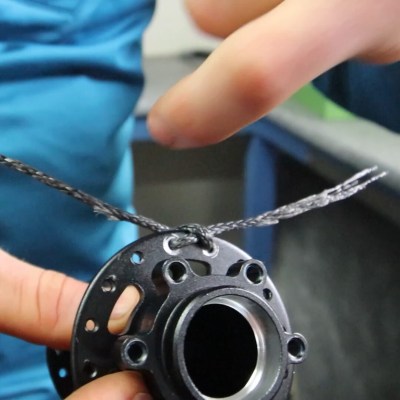 As detailed by [Ali Clarkson], one method involves creating loops out of bike spokes, with a custom jig and some brazing. Then a length of rope is passed through the hub and a special hitch is used to keep it in place. Two loops are made in the ends of this length of rope and passed through the spoke ends made earlier. Finally everything is brought up to tension and trued much like a normal wheelset. The front wheel ended up weighing around 700g, a rather impressive feat for a 24 inch downhill wheel.
However, a number of other methods have been tried on the forum threads. Namely, a number of users have attempted to varying degrees of success putting a length of spoke inside the hollow rope weave and “Chinese finger trapping” it together. The key issue here is sourcing a glue strong enough to hold the spoke piece on at lower tensions, but flexible enough to not crack with the cyclical loading on a rim.
Ultimately, this is a great look at the properties of some extremely special rope. This also isn’t the first time we have seen strange bicycle wheels made with UHMWPE.












DT.
My big concern would be stress at the loops bends. HDPE looses a ton of strength at extreme bends. Those bends get extremely hot under load / stress weakening the material. I would be afraid of a cascading failure.
Having seen a carbon-fiber-spoke wheel explode into a mass of spoke-fiber fluff because of a single event, I think your concerns are well placed. Fortunately the guy was just getting on the road so he wasn’t hurt.
Would it work better if the cords were wrapped around the hub to reduce the bend radius?
I wonder if the weight reduction outweighs the increased air drag. Those certaily don’t make aero-shaped spokes.
You’re not going to find track bikes using these. They’re generally already at their low weight limit (6.8 kg), and air drag is important at 60 km/h.
i’m in awe…i’ve made a few things with PE or nylon straps under tension and the creep is really hard to manage. I bought slightly more expensive and severely over-rated (by weight) straps and the creep is on the edge of manageable for my very forgiving application (a cot). I would not even dream of getting a wheel up to tension and having it stay that way for more than a couple weeks.
Nevermind that, yeah, i’d be scared to be the beta tester for a bike wheel :)
I’ve worked with the same Dyneema wire, be it thread of sub millimeter in diameter with a strength up to 50 kg. It’s quite amazing stuff, and works well in many engineering projects. I love the tinkering and toolmaking in the video, where the world could use more of this. There are too few people who do.
The diameter wire used in the video seems quite thick. Thicker than the steel equivalent, at least. I’m a bit ignorant on bike construction and couldn’t easily find how much tension the standard spokes endure. Does someone here have the details, and can tell me why a wheel full of 100 kg rated (0.8 mm) won’t work?
Probably more about momentary forces, such as those experienced traversing terrain, than the steady load forces required to maintain structural integrity. I’ve seen super-slo-mo of a bike wheel going over an obstacle, and I can see why sometimes if the momentary load is too much, they “taco’.
A steel spoke is typically preloaded to 100 kgf. You’ll want a cross section sufficient for several times that.
Thank you. I’ve greatly underestimated the force on each spoke, let alone the whole hub.
Most of my builds are very low risk, and even if I break a cable, all I lose is time.
Materials for making archery bow strings are available relatively cheaply, Dyneema is at the lower end of the capability/price curve. Much like with bow strings, you may be able to control the length of the spoke (and hence the tension) by adding more twists.
Normally when wheel building spokes are tensioned to about 100kgf/1000N. This will drop slightly when the tyre is inflated, but when riding will vary substantially between carrying weight or being pushed into the ground.
You’d probably want to experiment on the back wheel first, where failure is frustrating rather than a trip to the hospital. Unfortunately the back wheel is where spoke tension demands are highest due to asymmetry due to the gears.
Misc bicycle info:
* Boring (read: cheap) wheels use 2.0mm steel spokes. They will last thousands and thousands of miles.
* Most spokes, even racing ones, tend to still be ~2.0mm, but are made of lighter materials (read: less weight, less strength overall, shorter lifespan)
* You can usually break one or two steel spokes and keep going. That outcome is less likely if you have a low-count spoke wheel. It’s more likely if you hit a stick and break two consecutive spokes that the loose spoke will tangle, stab you, or the wheel will “taco”, becoming non-flat so that it no longer spins without hitting the frame.
* Off-the-shelf, flexible, non-metallic spokes exist: https://www.treefortbikes.com/Berd-PolyLight-14g-Spoke
It moves the structural forces to the other side of the wheel and inverts them. Neat.
FWIW – The steel spokes already distributed force in basically the same way :)
(saying this because it was kind of a shock to me when i really thought about how a typical bike wheel works)
exactly. existing spoke technology is 100% tension. If your spokes drop to 0 tension (zero pulling force), you’re in trouble!
Fair point, given some thought.
I remember when carbon fiber was the new hotness. But, like Roman concrete, it appears our society has forgotten not only how to make it but that it ever even existed.
What? They cost an arm and a leg but bike catalogs are just absolutely chock full of carbon frames, carbon rims, carbon rims+spokes. Surely this was made for the joy of it, not because it was expected to meaningfully compete with carbon fiber-reinforced resin??
A hack anecdote…in my mind, steel is nearly infinitely repairable, with welds comparable to original material and minimal loss of strength from bending. I view carbon fiber as the opposite, once it delaminates I think you oughta throw it out. Very hard to imagine patching a part of a carbon fiber frame after something like crash damage to one of its corners.
But i’ve asked around at a couple bike shops if anyone knows a frame doctor, just a guy with some welding / brazing equipment that specializes in bikes. And they all say, no that was big business 30 years ago but today the only frame doctor they see works with carbon fiber. Even though it’s a lot harder to repair and a lot harder to get a good result, they’re so expensive that people will pay real sums of money to repair them. But the replacement cost on a wanged steel frame is too low to justify making a career out of repairing them.
In the early 1990’s, Tioga made the Disk Drive wheel (or possibly Sugino made everything and Tioga just rebranded it) using a single Kevlar strand that wove back and forth between the hub and rim. Everyone wanted one, but in use, they were pretty flexible and felt weird. Also hard to true up if you bend a rim.
Ali Clarkson is a smart guy (and also really nice) and has a decade worth of great bike videos. He’s an inspiration to a whole lot of trials riders, and it’s cool he’s getting this exposure.
That definitely worked better than I imagined at first glance. Then again, it looks like he went to quite some lengths before arriving at his own bespoke solution.
…Sorry. I’ll show myself out.
Nothing new I remember when Spinergy came out in the 90’s https://bicycle.spinergy.com/pages/about
Dumb question but could this be changed to a single line of cord going in a big loop instead of a bunch of segments?
Yes. But then it would be hard to adjust. And if if one piece breaks the entire thing falls apart,
Also, you still need some sort of technology to be able to change the tension on every single length. that’s how you true (adjust) a rim for straightness. they aren’t laced for “constant tension”.