
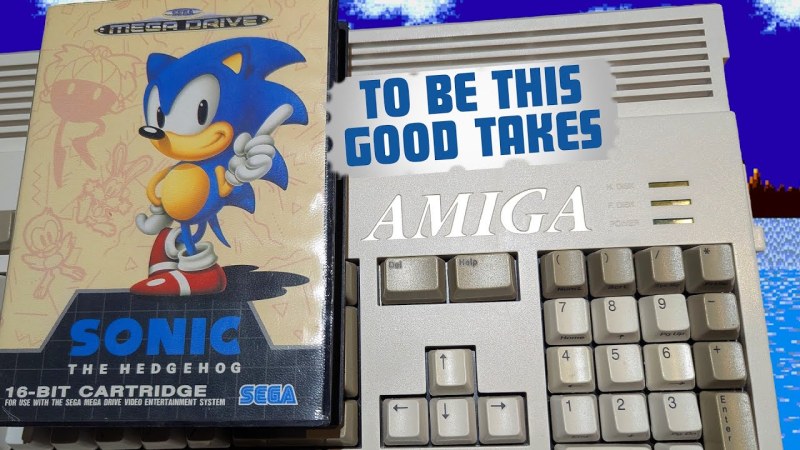
The Amiga was a great game system in its day, but there were some titles it was just never going to get. Sonic the Hedgehog was one of them– SEGA would never in a million years been willing to port its flagship platformer to another system. Well, SEGA might not in a million years, but [reassembler] has started that process after only thirty four.
Both the SEGA Mega Drive (that’s the Genesis for North Americans) and Amiga have Motorola 68k processors, but that doesn’t mean you can run code from one on the other: the memory maps don’t match, and the way graphics are handled is completely different. The SEGA console uses so-called “chunky” graphics, which is how we do it today. Amiga, on the other hand, is all about the bitplanes; that’s why it didn’t get a DOOM port back in the day, which may-or-may not be what killed the platform.
In this first video of what promises to be a series, [reassembler] takes us through his process of migrating code from the Mega Drive to Amiga, starting specifically with the SEGA loading screen animation, with a preview of the rest of the work to come. While watching someone wrestle with 68k assembler is always interesting, the automation he’s building up to do it with python is the real star here. Once this port is done, that toolkit should really grease the wheels of bringing other Mega Drive titles over.
It should be noted that since the Mega Drive was a 64 colour machine, [reassembler] is targeting the A1200 for his Sonic port, at least to start. He plans to reprocess the graphics for a smaller-palette A500 version once that’s done. That’s good, because it would be a bit odd to have a DOOM-clone for the A500 while being told a platformer like Sonic is too much to ask. If anyone can be trusted to pull this project off, it’s [reassembler], whose OutRun: Amiga Edition is legendary in the retro world, even if we seem to have missed covering it.
If only someone had given us a tip off, hint hint.









Chris has done some amazing work in the retro scene, so I always look forward to seeing it get a wider audience. More like this, please!
Since there’s a sonic port to C64 (+reu), i imagine Amiga is easier.
Depends on whether you’re trying to port the original graphics assets and code.
Clones of Sonic already exist on the Amiga.
Old Amiga freaks like myself might remember the Sonic demo which ran on a A500 and there were Sonic style games like Kid Chaos which was the most blatant Sonic clone I can think of. There is a 8-bit Sega Master System port too. Actually if you started from the ground up in assembler playing to the Amiga’s strengths an Amiga 500 Sonic is totally possible and could even out shine the original game in some areas, but Sega had the talented Sonic team making this flagship game and they were trying to out do Mario and sell Megadrives and Genesis’s which is why it is so good and the game holds up to this day.
Right! The Sonic version for Master System was very popular in Europe (and Brazil, I think).
It’s basically same version as the later released Game Gear version, except that it has a bigger viewport (good).
It’s so notable because it was built into the ROM of the Master System 2, a cost-reduced version of the original SMS.
Well, in later models, at least. Older versions had Alex Kidd in ROM, if memory serves.
The SMS 2 sold well in early to mid 90s here in Europe, I think.
It was sold along Game Gear and the old NES (we had no re-designed NES with dog bone controllers).
Over here, the 8-Bit Sonic series was perceived as its own interpretation of Sonic, I would say, rather than being an 8-Bit conversion.
The level design and the story was different, as well, after all.
But of course, the Mega Drive version was seen as a reference over here, too.
Fans of a Mega Drive sometimes had the Master System converter or a cheap knock-off of it, too.
So they probably had played 8-Bit Sonic, as well, at one point.
Being so common it wasn’t a collector’s item for sure.
The first thing someone tried the (mechanical) converter cart with was probably something like Sonic, Sonic 2, OutRun or Phantasy Star 1.
The latter also was available as a re-release for Mega Drive (Genesis), if memory serves:
By using the unaltered SMS ROM version and wiring the cartridge in a way it would boot up the MD in SMS mode (Z80 being the master).
So it basically had an Master System converter built-in.
Also on the MSX2 platform!
That version is from ’95-’97, for example:
https://www.youtube.com/watch?v=KoG9EHcnXJo
Sonic can run on anything, because he is very fast. ☝️🤓
Touché.
The Sega Genesis/MD and Amiga are often being compared to each other because of the common 68k processor.
However, I think that the Super NES and Amiga had more in common overall, because both used an intelligent chipset.
Also, both Super NES and Amiga used sample-based sound.
The Super NES had the SPC-700 module, while the Amiga had Paula chip.
The A500 could do Extra Half Brite (https://en.wikipedia.org/wiki/Amiga_Halfbrite_mode) to give a very game-friendly 64-colour palette that still gave fast & smooth graphics. It was a really smart feature of the chipset and when made use of properly could give stunning graphics and enable some clever effects too.